


Chinatrust plans to buy shares
Chinatrust Financial Holding Co (中信金控), owner of Taiwan’s biggest credit-card issuer, said it plans to buy back about 1 percent of its shares.
Chinatrust plans to buy 84 million of its shares at between NT$17 and NT$26 each, from Monday to Nov. 21, the Taipei-based company said in a filing to the Taiwan Stock Exchange yesterday. The stock surged 6.7 percent to close at NT$15.85.
Wistron ready to talk to Dell
Wistron Corp (緯創), the world’s third-largest contract manufacturer of notebook computers, said it would be open to begin negotiations to buy production facilities from Dell Inc.
“If Dell is interested in talking to Wistron, then Wistron would be willing to enter discussions” about factory purchases, said Joyce Chou (周文玲), a spokeswoman for Wistron, confirming comments by chairman Simon Lin (林憲銘) on Thursday. “We won’t give up any investment opportunity.”
The Chinese-language Economic Daily News yesterday reported that Lin said he was interested in talking with Dell about purchasing the US company’s factories.
Dell plans to sell factories and has approached manufacturers about a deal, the Wall Street Journal reported on Sept. 5, citing people familiar with the matter.
Government sells bonds
The government sold NT$40 billion (US$1.2 billion) in 10-year bonds at a yield of 2.243 percent, lower than the rate of return at the last sale of comparable debt.
The yield in the previous sale in June was 2.716 percent. The latest auction drew bids equal to 1.33 times the debt on offer, compared with 1.22 times at the last auction, a central bank statement said.
Phone firm sees stability
Deutsche Telekom AG, Europe’s biggest telephone company and the owner of T-Mobile, said the domestic wireless market may stabilize and even grow as the company bets on mobile data to spur growth.
“There’s still a lot of room when it comes to mobile usage in Germany,” Philipp Humm, who runs the company’s T-Mobile Germany wireless unit, said in an interview.
The company said on Thursday it will start subsidizing notebooks like mobile phones this year to boost data revenue.
T-Mobile will start reselling Acer Inc’s (宏碁) Aspire One notebook for 1 euro in November to users signing up for a 24-month contract, the company said on Thursday. Notebooks from LG Electronics Inc and Taiwan’s Asustek Computer Inc (華碩) will also be available.
WiMAX share set to grow
Taiwan’s WiMAX customer premises equipment (CPE) industry global market share is estimated to reach 40 percent next year thanks to the growing performance of the WiMAX service, a senior market analyst said.
Chang Chi (張奇), a senior industry analyst of the Market Intelligence Center (MIC, 資訊市場情報中心), made the forecast at a seminar in Tokyo on Thursday.
CPE is equipment installed at customers’ sites to connect them to service providers’ networks. Chang said the shipment volume of Taiwan’s CPE industry for this year is expected to hit 1.04 million units, and that the projection for next year is 2.92 million units.
NT dollar declines again
The New Taiwan dollar declined for a ninth week as global financial turmoil prompted overseas investors to pull funds out of emerging markets.
The NT dollar rose 0.2 percent yesterday but fell 0.4 percent this week to NT$32.158 per US dollar, according to Taipei Forex Inc. The local currency has dropped 4.9 percent since the beginning of last month.
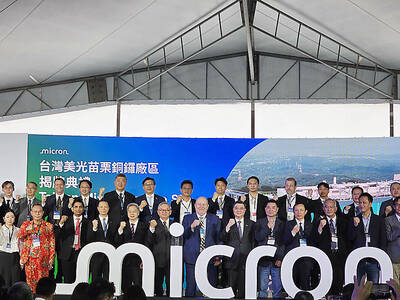
UNPRECEDENTED PACE: Micron Technology has announced plans to expand manufacturing capabilities with the acquisition of a new chip plant in Miaoli Micron Technology Inc unveiled a newly acquired chip plant in Miaoli County yesterday, as the company expands capacity to meet growing demand for advanced DRAM chips, including high-bandwidth memory chips amid the artificial intelligence boom. The plant in Miaoli County’s Tongluo Township (銅鑼), which Micron acquired from Powerchip Semiconductor Manufacturing Corp (力積電) for US$1.8 billion, is expected to make a sizeable capacity contribution to the company from fiscal 2028, the company said in a statement. It would be an extended production site of Micron’s large-scale manufacturing hub in Taichung, the company said. As the global semiconductor industry is racing to reach US$1 trillion

Singapore-based ride-hailing and delivery giant Grab Holdings Ltd has applied for regulatory approval to acquire the Taiwan operations of Germany-based Delivery Hero SE's Foodpanda in a deal valued at about US$600 million. Grab submitted the filing to the Fair Trade Commission on Friday last week, with the transaction subject to regulatory review and approval, the company said in a statement yesterday. Its independent governance structure would help foster a healthy and competitive market in Taiwan if the deal is approved, Grab said. Grab, which is listed on the NASDAQ, said in the filing that US-based Uber Technologies Inc holds about 13 percent of
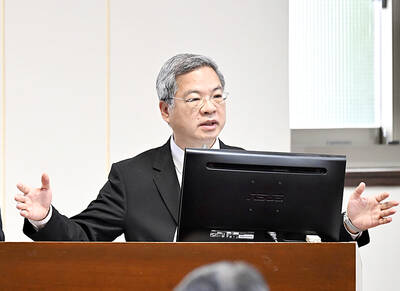
ABOVE LEGAL REQUIREMENT: The Ministry of Economic Affairs is prepared if LNG supply is disrupted, with more than the legal requirement of 11 days of inventory Taiwan has largely secured liquefied natural gas (LNG) supplies through May and arranged about half of June’s supply, Minister of Economic Affairs Kung Ming-hsin (龔明鑫) said yesterday. Since the Middle East conflict began on Feb. 28, Taiwan’s LNG inventories have remained more than 12 days, exceeding the legal requirement of 11 days, indicating no major supply concerns for domestic gas and electricity, Kung said at a meeting of the legislature’s Economics Committee in Taipei. The ministry aims to increase the figure to 14 days by the end of next year, he said. While one or two LNG or crude oil shipments for May

Taiwan’s food delivery market could undergo a major shift if Singapore-based Grab Holdings Ltd completes its planned acquisition of Delivery Hero SE’s Foodpanda business in Taiwan, industry experts said. Grab on Monday last week announced it would acquire Foodpanda’s Taiwan operations for US$600 million. The deal is expected to be finalized in the second half of this year, with Grab aiming to complete user migration to its platform by the first half of next year. A duopoly between Uber Eats and Foodpanda dominates Taiwan’s delivery market, a structure that has remained intact since the Fair Trade Commission (FTC) blocked Uber Technologies Inc’s


 RSS
RSS