


Taiwanese semiconductor companies can expect annual revenue growth of nearly 5 percent this year thanks to a slightly better-than-expected rebound in the prices of computer memory chips, a local research house forecast.
The latest forecast represents an upward adjustment from the 4.4 percent annual growth rate that had been projected by the Hsinchu-based Industrial Technology Research Institute (ITRI, 工研院) three months ago.
“Prices of computer chips, or dynamic random access memory [DRAM], hit the bottom in the second quarter, which will help retard the decline in local DRAM makers’ overall revenues,” ITRI semiconductor analyst Jerry Peng (彭茂榮) said by phone.
Local DRAM companies are expected to report an 11 percent drop in revenues to NT$253.7 billion (US$8 billion) this year, better than the previous estimate of a 14 percent decline, as the supply glut eases, the report said.
“We are still quite conservative about the second half because of the sustained impact of the global economic slowdown and rising inflation,” Peng said.
Nanya Technology Corp (南亞科技), the nation’s second-largest DRAM maker, said the US subprime lending crisis and mounting inflation have hurt consumers’ purchasing power in the PC and consumer electronics sector.
The company said it would be an uphill battle to make a turnaround this quarter after a more than one-year slump.
This year, local semiconductor companies may see their revenues rise 4.8 percent to NT$1.54 trillion from last year, according to the ITRI’s latest report. It did not provide last year’s figures.
DRAM chip suppliers and contract chipmakers may account for 48 percent of local semiconductor companies’ total revenues, the report said.
Chip packagers, led by Advanced Semiconductor Engineering Inc (日月光半導體), are expected to outpace semiconductor companies in other fields to report 10.3 percent year-on-year growth to NT$253.7 billion in revenues this year, the ITRI forecast said.
Taiwan Semiconductor Manufacturing Co (TSMC, 台積電), the world’s top contract chipmaker, last month trimmed its forecast for the global semiconductor industry’s revenue growth for this year to an annual increase of 4 percent, compared with a previous estimate of between 4 percent and 6 percent growth.
“Demand seems to be going down,” TSMC chief executive Rick Tsai (蔡力行) told investors last month.
Neverheless, TSMC would outperform its peers by several percentage points, Tsai said.
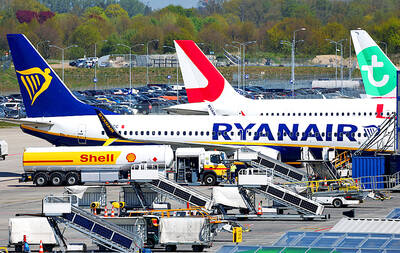
Ryanair, Transavia, Volotea and other low-cost airlines are feeling the financial pain from high jet fuel prices as a result of the Middle East war and are cutting flights. The closure of the Strait of Hormuz has taken a huge chunk of oil supplies off the market, sending the price of jet fuel soaring and triggering fears of shortages that could force airlines to cancel flights. Airlines are not waiting for a lack of supplies to react. “Travel alert: Airlines are cutting thousands of flights right now,” Travel Therapy host Karen Schaler said in an Instagram reel this past weekend.
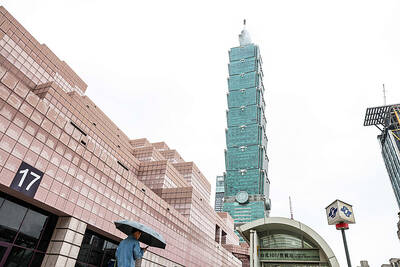
MANAGING RISKS: Taiwan has secured LNG sufficient to cover 95 percent of electricity demand for next month, UBS said, describing the government’s approach as proactive UBS Group AG has raised its forecast for Taiwan’s economic growth this year to 8 percent, up from 6.9 percent previously, and said expansion could reach as high as 8.6 percent if external energy shocks are avoided. The upgrade reflects a stronger-than-expected first-quarter performance and sustained momentum in artificial intelligence (AI)-driven exports, which UBS said are providing a firm foundation for growth despite geopolitical and energy risks. Taiwan’s GDP expanded 13.69 percent year-on-year in the first quarter, the fastest growth since the second quarter of 1987, the Directorate-General of Budget, Accounting and Statistics (DGBAS) reported on Thursday. On a seasonally

The Fair Trade Commission’s (FTC) ongoing review of Grab Holdings Ltd’s US$600 million acquisition of Foodpanda Taiwan’s operations, announced on March 23, has taken on fresh urgency as industry experts warn that the transaction could embed significant Chinese cybersecurity vulnerabilities into Taiwan’s digital infrastructure through Grab’s deep ties to autonomous-driving firm WeRide (文遠知行). Less than 16 months after the FTC blocked Uber Eats’ direct attempt to acquire Foodpanda Taiwan — citing potential combined market shares of 80 to 90 percent — the emergence of Grab as the buyer has prompted questions about whether the same competitive harm is simply being rerouted

The list of Asian stocks that benefit from business partnership with Nvidia Corp is getting longer, as the region further integrates into the artificial intelligence (AI) chip giant’s business ecosystem. Just in the past week, South Korea’s LG Electronics Inc, Taiwan’s Nanya Technology Corp (南亞科技), as well as China’s Huizhou Desay SV Automotive Co (德賽西威) and Pateo Connect Technology Shanghai Corp (博泰車聯) have become the latest to rally on news of tie-ups, supply-chain participation or product collaboration with the US chip designer. Asian suppliers account for about 90 percent of Nvidia’s production costs, up from about 65 percent last year, data compiled


 RSS
RSS