


US Secretary of the Treasury Henry Paulson held talks with senior Chinese leaders yesterday amid expectations he would press for fresh economic reforms, including faster currency appreciation.
The former Goldman Sachs chief executive met Chinese Vice Premier Wu Yi (吳儀) in the afternoon and was due to meet central bank Governor Zhou Xiaochuan (周小川). He will also hold talks with President Hu Jintao (胡錦濤) today.
The meetings are part of a biannual economic strategic dialogue between Washington and Beijing that was established last year to help ease rising trade tensions between the two economic powerhouses.
Paulson's visit comes amid growing pressure to reduce the yawning US trade deficit with China, with moves in the US Congress to punish Beijing for what some say are unfair trade policies.
Paulson's three-day visit began on Monday in Qinghai Province, where he inspected a range of environmental protection projects.
"I am sure your visit to Qinghai will deeply enrich the material you can present to Congress in future testimony," Wu told Paulson after a one-on-one meeting.
"In making this contrast, you can understand -- who could China threaten?" Wu said.
Although the forum covers a range of economic and environmental issues, the issue at the forefront is the yuan.
US legislators say an undervalued yuan makes US-bound exports cheaper, thereby fueling a massive trade deficit with China, which hit US$232.5 billion last year according to US figures.
China itself has acknowledged that its overall trade surplus, up 85.5 percent to an all-time high in June of US$26.91 billion, is too large and has enacted curbs, such as ending export tax rebates on July 1.
But last week, the Senate Finance Committee overwhelmingly approved a bill that requires the Treasury to identify nations with "fundamentally misaligned" currencies, potentially opening the door to economic sanctions against Beijing.
While Paulson is expected to again press China for a quicker pace of yuan appreciation and to rebalance its export-reliant economy, the secretary has warned that expectations should be managed.
He said the official dialogue was more effective at managing the tension than legislative threats but it was "unrealistic" to expect his talks to be a panacea for trade tensions between Washington and Beijing.
"President Hu is going to do exactly what he believes is in the best interests of China," Paulson told reporters in Xining, capital of Qinghai.
China revalued its currency in July 2005 and Beijing has since repeatedly said it will allow the yuan to strengthen as part of reforms to a financial system it says would risk full collapse with a full flotation.
For China's main trade partners, the US and the EU, the 9.4 percent appreciation of the yuan since 2005 has come too slowly, even though Paulson acknowledged the gains.
"The rate of appreciation has gone up considerably over the last year and the renminbi [yuan] has now appreciated well over nine percent," Paulson told reporters on the way to China.
During the last strategic economic dialogue meeting held in Washington in May, China agreed to reduce trade barriers in financial services and the energy, environment and civil aviation sectors.
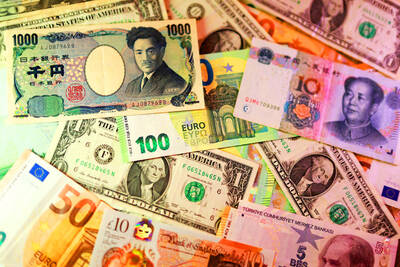
Taiwan’s foreign exchange reserves fell below the US$600 billion mark at the end of last month, with the central bank reporting a total of US$596.89 billion — a decline of US$8.6 billion from February — ending a three-month streak of increases. The central bank attributed the drop to a combination of factors such as outflows by foreign institutional investors, currency fluctuations and its own market interventions. “The large-scale outflows disrupted the balance of supply and demand in the foreign exchange market, prompting the central bank to intervene repeatedly by selling US dollars to stabilize the local currency,” Department of Foreign
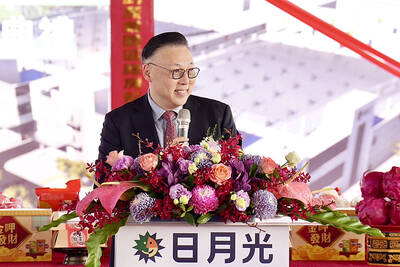
ENERGY ISSUES: The TSIA urged the government to increase natural gas and helium reserves to reduce the impact of the Middle East war on semiconductor supply stability Chip testing and packaging service provider ASE Technology Holding Co (日月光投控) yesterday said it planned to invest more than NT$100 billion (US$3.15 billion) in building a new advanced chip testing facility in Kaohsiung to keep up with customer demand driven by the artificial intelligence (AI) boom. That would be included in the company’s capital expenditure budget next year, ASE said. There is also room to raise this year’s capital spending budget from a record-high US$7 billion estimated three months ago, it added. ASE would have six factories under construction this year, another record-breaking number, ASE chief operating officer Tien Wu

For weeks now, the global tech industry has been waiting for a major artificial intelligence (AI) launch from DeepSeek (深度求索), seen as a benchmark for China’s progress in the fast-moving field. More than a year has passed since the start-up put Chinese AI on the map in early last year with a low-cost chatbot that performed at a similar level to US rivals. However, despite reports and rumors about its imminent release, DeepSeek’s next-generation “V4” model is nowhere in sight. Speculation is also swirling over the geopolitical implications of which computer chips were chosen to train and power the new

The EU and US are nearing an agreement to coordinate on producing and securing critical minerals, part of a push to break reliance on Chinese supplies. The potential deal would create incentives, such as minimum prices, that could advantage non-Chinese suppliers, according to a draft of an “action plan” seen by Bloomberg. The EU and US would also cooperate on standards, investments and joint projects, as well as coordinate on any supply disruptions by countries like China. The two sides are additionally seeking other “like-minded partners” to join a multicountry accord to help create these new critical mineral supply chains, which feed into


 RSS
RSS