


China's aviation industry, the fastest growing worldwide, may be held back by a lack of qualified maintenance workers, according to Hong Kong Aircraft Engineering Co (HAECO, 香港飛機工程) chief executive officer P.K. Chan (陳炳傑).
"The point isn't how many hangars you can build, it's how many people you can train," Chan said in interview in Xiamen on Wednesday last week.
Taikoo (Xiamen) Aircraft Engineering Co (TAECO, 廈門太古飛機工程), which is 57 percent owned by HAECO and is also the world's second-largest third-party airplane maintenance provider, opened a fifth hangar in the southern Chinese city last week.
About 10 percent of the workers at the HAECO unit were poached last year, according to Chan, as rivals and airlines build maintenance centers and other companies seek engineers.
Maintenance providers are expanding in China because the nation's commercial fleet will likely more than double to 2,666 by 2025, according to Airbus SAS.
China's need for aircraft engineers has "become more urgent simply because of its growth rate," said Ian Thomas, a consultant at the Centre for Asia-Pacific Aviation. "Wages are a key point as far as the future is concerned."
TAECO has already begun building a sixth hangar, due to open in 2009, because of surging demand for maintenance work and freighter conversions. The company converts Boeing Co 747 passenger planes into all-cargo aircraft for customers including Nippon Cargo Airlines Co and Cathay Pacific Airways Ltd.
TAECO plans to double the size of its training center and to offer courses to Chinese airlines and maintenance companies in order to boost the number of engineers in the market, chief executive officer Merlin Swire said in an e-mailed response to questions.
TAECO employs 4,800 workers. About 400 were poached last year, Chan said. He declined to comment on wages.
Boeing, Cathay Pacific and Japan Airlines Corp all own a 9.1 percent stake in TAECO.
Deutsche Lufthansa AG and Air China Ltd's maintenance venture is spending 3.5 billion yuan (US$460 million) on a 15-year expansion plan including the construction of Asia's two largest line maintenance hangars at Beijing's airport. Boeing, Shanghai Airport Group Corp and Shanghai Airlines Co are also building a US$85 million maintenance center in Shanghai.
Separately, Taiwan's China Airlines Ltd (中華航空) said on Wednesday last week that it was planning to buy an 8 percent stake in Chinese aircraft maintenance company Taikoo (Xiamen) Landing Gear Services Co (廈門太古起落架維修服務) for US$1.11 million.
The investment is aimed at improving China Airlines' ground maintenance capacity, the company said in a filing to the Taiwan stock exchange.
Taikoo Landing Gear is 50.2 percent owned by HAECO, according to the company's Web site.
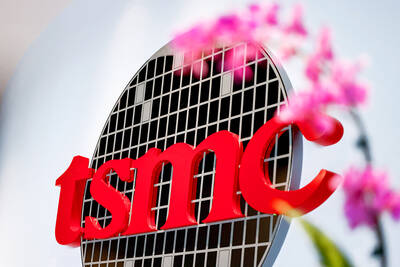
Taiwan Semiconductor Manufacturing Co (TSMC, 台積電) has approved a capital budget of US$31.28 billion for production expansion to meet long-term development needs during the artificial intelligence (AI) boom. The company’s board meeting yesterday approved the capital appropriation plan for purposes such as the installation of advanced technology capacity and fab construction, the world’s largest contract chipmaker said in a statement. At an earnings conference last month, TSMC forecast that its capital expenditure for this year would be at the higher end of the US$52 billion to US$56 billion range it forecast in January in response to robust demand for 5G, AI and
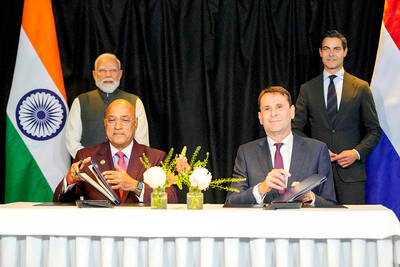
NEW MARKET: The partnership opens up India to the Dutch company, which already has a strong hold in the semiconductor market of South Korea, Taiwan and China ASML Holding NV entered into a partnership agreement with Tata Electronics Pvt Ltd aimed at ramping up India’s goal to develop domestic chip-manufacturing capabilities. The Dutch company’s technology would help power Tata Electronics’ planned 300 millimeter (mm) semiconductor foundry in Gujarat, according to a joint statement from the two companies on Saturday. The signing of a memorandum of understanding coincides with a visit by Indian Prime Minister Narendra Modi to the Netherlands, which is looking to deepen bilateral relations with New Delhi. ASML, whose top customers include Taiwan Semiconductor Manufacturing Co (台積電) and Samsung Electronics Co, makes lithography machines that can print
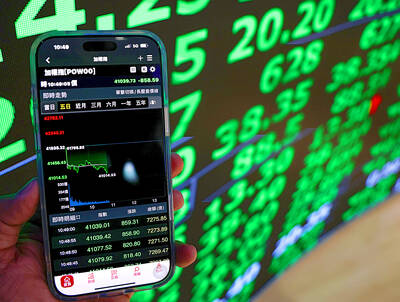
PORTFOLIO REBALANCING: The adjustments in three global equity indices reflect rising investor appetite for semiconductor and artificial intelligence-related stocks Taiwan’s weighting in major global equity indices compiled by MSCI Inc is to rise modestly following the latest quarterly review, underscoring the market’s expanding role in emerging-market portfolios, as global investors continue to favor the nation’s technology sector. Taiwan’s weighting in the MSCI Emerging Markets Index is to increase by 0.30 percentage points to 23.76 percent, after the changes take effect at the close of the May 29 session. Its weighting in the MSCI All-Country Asia ex-Japan Index is to rise 0.37 percentage points to 27.16 percent, while that in the MSCI All Country World Index is to edge up slightly to
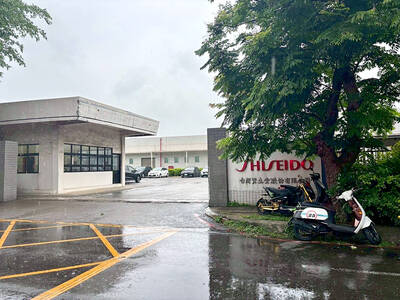
The Hsinchu County Government’s Labor Affairs Department yesterday said that it has received a plan from cosmetics brand Taiwan Shiseido Co (台灣資生堂) detailing mass layoffs at its plant in Hukou Township (湖口). While the labor authorities did not disclose the number of employees to be laid off, Japanese news media earlier in the day reported that the closure of the company’s factory in Hukou would result in 170 employees losing their jobs. Shiseido followed the law by reporting its layoff plan, the department said, adding that authorities would closely monitor negotiations between the management and affected employees and step in if any


 RSS
RSS