


Democratic presidential contender Howard Dean said on Friday that US Federal Reserve chairman Alan Greenspan had become too political and should be replaced, broaching a subject on which his opponents have been largely silent.
"I think Alan Greenspan has become too political," Dean said in response to a question from the audience at a town hall meeting.
"If he lacks the political courage to criticize the [budget] deficits, if he was foolish enough -- and he's not a foolish man -- to support the outrageous tax cuts that George Bush put through, then he has become too political and we need a new chairman of the Federal Reserve," he added.
"Greenspan has been an excellent chief, and yet in the last couple of years, I've been deeply troubled by his willingness to accede to positions that I don't think are in the best interest of the country," Dean later told reporters.
"I'm troubled by his willingness to bend in political winds. That's something a Fed chief should never do."
Greenspan is highly regarded in financial markets and closely associated in the public's eye with the record 10-year US economic expansion that ended in early 2001.
Although Greenspan backed the notion of tax cuts in early 2001, he has consistently warned of the dangers of high budget deficits. He has also on numerous occasions voiced a preference for tax cuts over spending increases.
Many analysts believe Greenspan's tax-cut views helped US President George W. Bush win congressional approval for an initial tax reduction package totaling US$1.35 trillion over 10 years. In all, since taking office, Bush has won tax cuts that add up to some US$1.7 trillion.
The tax cuts -- which the administration is now pressing to make permanent -- and an economic slowdown helped fuel a record US$374 billion budget gap last year, or about 3.5 percent of US GDP, the highest proportion since 1993. The White House expects the deficit to hit about 4.5 percent of GDP this year.
In some ways, Dean's criticism is academic.
At a news conference in Nashua, New Hampshire, later on Friday, Dean explained he was not calling for Greenspan to be ousted before his term ended but that if he were elected president he would not reappoint him.
Under the law, he would not be able to reappoint Greenspan even if he wanted.
While Greenspan's term at the helm of the central bank expires on June 20, Bush said last April the 77-year-old chairman should get another four-year term and Greenspan said he would serve if nominated and confirmed by the Senate.
But even if Greenspan is renamed to the post this year, the winner of the November presidential election will almost certainly need to name a new chairman.
That is because Greenspan's separate term as a member of the Fed's board ends on Jan. 31, 2006, and he cannot be renominated since he would have already served the one full 14-year term permitted. When he first took office as Fed chairman in 1987, he filled an unexpired term, before being appointed to the full term.
Aides to Democratic presidential hopefuls Senator Joseph Lieberman of Connecticut and retired General Wesley Clark said their candidates would turn to someone like former Treasury Secretary Robert Rubin, who served under President Bill Clinton, if faced with the task of naming the next Fed chief.
The campaigns of Dean's other major Democratic rivals -- Sens. John Kerry of Massachusetts and John Edwards of North Carolina -- did not comment.
Dean, who pursued a short career on Wall Street before becoming a doctor, declined to offer any names but told reporters he would look for someone who had a resume like Greenspan's, or his predecessor at the Fed, Paul Volcker, if he were in a position to nominate Greenspan's replacement.
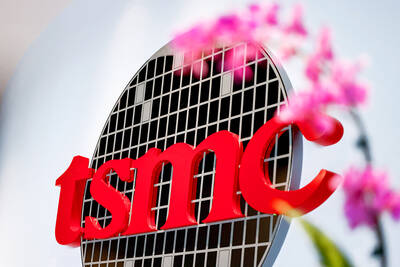
Taiwan Semiconductor Manufacturing Co (TSMC, 台積電) has approved a capital budget of US$31.28 billion for production expansion to meet long-term development needs during the artificial intelligence (AI) boom. The company’s board meeting yesterday approved the capital appropriation plan for purposes such as the installation of advanced technology capacity and fab construction, the world’s largest contract chipmaker said in a statement. At an earnings conference last month, TSMC forecast that its capital expenditure for this year would be at the higher end of the US$52 billion to US$56 billion range it forecast in January in response to robust demand for 5G, AI and
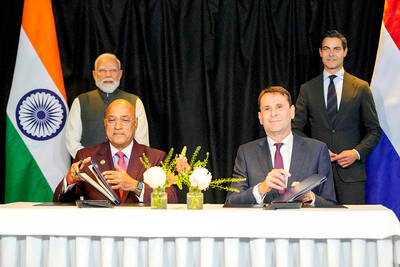
NEW MARKET: The partnership opens up India to the Dutch company, which already has a strong hold in the semiconductor market of South Korea, Taiwan and China ASML Holding NV entered into a partnership agreement with Tata Electronics Pvt Ltd aimed at ramping up India’s goal to develop domestic chip-manufacturing capabilities. The Dutch company’s technology would help power Tata Electronics’ planned 300 millimeter (mm) semiconductor foundry in Gujarat, according to a joint statement from the two companies on Saturday. The signing of a memorandum of understanding coincides with a visit by Indian Prime Minister Narendra Modi to the Netherlands, which is looking to deepen bilateral relations with New Delhi. ASML, whose top customers include Taiwan Semiconductor Manufacturing Co (台積電) and Samsung Electronics Co, makes lithography machines that can print
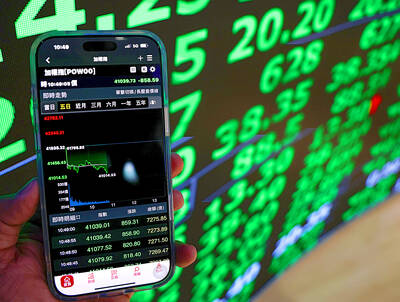
PORTFOLIO REBALANCING: The adjustments in three global equity indices reflect rising investor appetite for semiconductor and artificial intelligence-related stocks Taiwan’s weighting in major global equity indices compiled by MSCI Inc is to rise modestly following the latest quarterly review, underscoring the market’s expanding role in emerging-market portfolios, as global investors continue to favor the nation’s technology sector. Taiwan’s weighting in the MSCI Emerging Markets Index is to increase by 0.30 percentage points to 23.76 percent, after the changes take effect at the close of the May 29 session. Its weighting in the MSCI All-Country Asia ex-Japan Index is to rise 0.37 percentage points to 27.16 percent, while that in the MSCI All Country World Index is to edge up slightly to
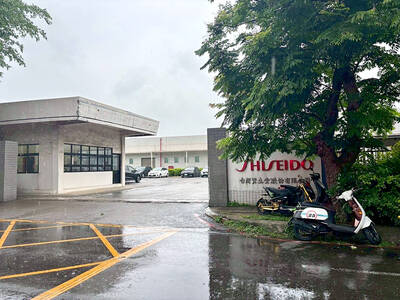
The Hsinchu County Government’s Labor Affairs Department yesterday said that it has received a plan from cosmetics brand Taiwan Shiseido Co (台灣資生堂) detailing mass layoffs at its plant in Hukou Township (湖口). While the labor authorities did not disclose the number of employees to be laid off, Japanese news media earlier in the day reported that the closure of the company’s factory in Hukou would result in 170 employees losing their jobs. Shiseido followed the law by reporting its layoff plan, the department said, adding that authorities would closely monitor negotiations between the management and affected employees and step in if any


 RSS
RSS