


Giant Manufacturing Co (
The plant, to be built next year in Chengdu or Tianjin, will be the first Giant plant to sell exclusively to China, the world's largest bicycle market.
Giant made one of every 20 bikes sold in China last year, said company spokesman Jeffrey Hsu (許立忠).
"There's potential in the north if it locates in Tianjin because the bicycle factories there aren't very big," said Dison Wang, an analyst at Yuanta Core Pacific Securities (
"As for Chengdu, there's room to grow as development moves to the west from the eastern coast. Factories in the east are approaching overcapacity," Wang said.
Giant will be shifting its focus to China's rural areas, where farmers who earn 1,802 yuan a year can't indulge in the car-ownership craze now sweeping Beijing, Shanghai and other major cities.
Bicycles made at the new plant will sell for as little as 200 yuan (US$24), Hsu said.
"There are more and more Giant bicycles in my village," said Sun Zihua, a security guard in Beijing who hails from Juye County, a poor region in the Shandong Province.
"Though most of people at my hometown still find it too expensive," he said.
Giant has grabbed market share from state-controlled domestic rivals Phoenix Co and Shanghai Forever Bicycle Co by offering lighter aluminum alloy frames, stylish design and mountain bike models. Its standard one-speed bikes sell for 500 yuan, compared with 400 yuan for a comparable Phoenix and 300 yuan for a Forever.
"I just got a second-hand Giant a few months ago after my first Giant was stolen," said Lorein He, a Beijing bank clerk.
"It looks nice and is durable," He said.
Sturdy stalwarts
For decades, Forever, China's oldest bicycle maker, and Phoenix, its largest, dominated pedal power in a nation where one in three people owns a bike. The then state-owned stalwarts produced bicycles with sturdy steel frames at prices the masses could afford.
Foreigners entered the market in the late 1980s, when urban incomes were beginning to rise as China opened its doors to foreigners and began deregulating its markets. Brands such as Giant, Peugeot and Emmelle came to symbolize style and status. Two decades on, the status symbol in cities has become the automobile, pushing the market for bicycles to the countryside, where people earn two-thirds less than in cities.
China produced about 70 million of the 110 million bikes manufactured globally last year. About 45 million bicycles valued at US$1.5 billion were exported, both by domestic and overseas manufacturers with factories in China.
"I've always preferred the convenience of a bicycle," said Li Wei, an investment manager who cycles to work everyday at China's second-biggest brokerage, Shenyin & Wanguo Securities Co, in Shanghai.
"Since I live close to the office, there's no sense worrying about parking space," Li said.
Wei is a dying breed in China's richest city, where the well-to-do are turning to cars from bicycles. Shanghai has extended street bans on bicycles to the city's two busiest shopping streets, Nanjing and Huaihai. Car sales in China are expected to surge a third this year, aided by expansion in consumer lending. Bicycle sales growth may remain flat, Giant's Hsu said.
Weak revenues
Shanghai-based Phoenix reported only 10.2 million yuan (US$1.2 million) of profit last year after posting losses in three of the last five years. Its shares are up 4 percent this year. Forever said last year's profit declined fourth-fifths to 56.9 million yuan. Its shares dived 46 percent.
Giant forecasts sales in China will rise as much as a fifth this year. Last year about a 10th of the company's NT$17 billion (US$500 million) in sales came from China.
Its new bicycle plant will have the capacity to make 500,000 bicycles a year and will require investment of as much as US$7 million, a Chinese-language newspaper reported.
Spokesman Hsu declined to comment on details of the investment.
Taichung-based Giant has a factory in Kunshan near Shanghai, where the company expects to make 2.6 million bikes this year.
The company also controls 45 percent of a venture in Shanghai that is forecast to manufacture 1.2 million bikes this year, Hsu said.
Both plants make bicycles for export and sale at home. The company also has a bicycle-parts maker in China.
Giant has factories in China, Taiwan and the Netherlands.
The US accounts for 30 percent of the company's sales, Europe makes up about 32 percent and Japan contributes 13 percent. Giant also sells to Australia, New Zealand and Canada.
Net income last year rose to NT$746.1 million from NT$543.4 million a year earlier on sales of NT$16.8 billion.
Giant, which made bikes under the Schwinn brand for the US market a decade ago, has been faring better than competitors. Ohio-based Huffy Corp, which owns the Schwinn/GT brands, has posted losses in four of the last five years. Cannondale Corp, which became the second-largest US bike maker after Huffy by selling custom-made mountain bikes, won bankruptcy court approval earlier this year.
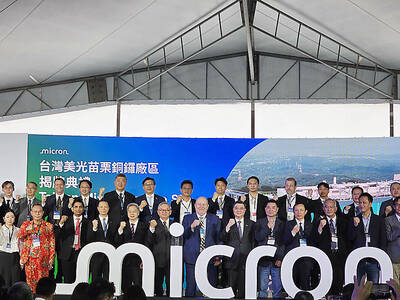
UNPRECEDENTED PACE: Micron Technology has announced plans to expand manufacturing capabilities with the acquisition of a new chip plant in Miaoli Micron Technology Inc unveiled a newly acquired chip plant in Miaoli County yesterday, as the company expands capacity to meet growing demand for advanced DRAM chips, including high-bandwidth memory chips amid the artificial intelligence boom. The plant in Miaoli County’s Tongluo Township (銅鑼), which Micron acquired from Powerchip Semiconductor Manufacturing Corp (力積電) for US$1.8 billion, is expected to make a sizeable capacity contribution to the company from fiscal 2028, the company said in a statement. It would be an extended production site of Micron’s large-scale manufacturing hub in Taichung, the company said. As the global semiconductor industry is racing to reach US$1 trillion

Singapore-based ride-hailing and delivery giant Grab Holdings Ltd has applied for regulatory approval to acquire the Taiwan operations of Germany-based Delivery Hero SE's Foodpanda in a deal valued at about US$600 million. Grab submitted the filing to the Fair Trade Commission on Friday last week, with the transaction subject to regulatory review and approval, the company said in a statement yesterday. Its independent governance structure would help foster a healthy and competitive market in Taiwan if the deal is approved, Grab said. Grab, which is listed on the NASDAQ, said in the filing that US-based Uber Technologies Inc holds about 13 percent of
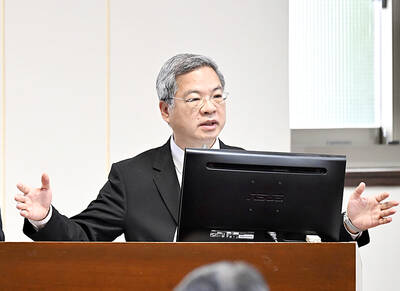
ABOVE LEGAL REQUIREMENT: The Ministry of Economic Affairs is prepared if LNG supply is disrupted, with more than the legal requirement of 11 days of inventory Taiwan has largely secured liquefied natural gas (LNG) supplies through May and arranged about half of June’s supply, Minister of Economic Affairs Kung Ming-hsin (龔明鑫) said yesterday. Since the Middle East conflict began on Feb. 28, Taiwan’s LNG inventories have remained more than 12 days, exceeding the legal requirement of 11 days, indicating no major supply concerns for domestic gas and electricity, Kung said at a meeting of the legislature’s Economics Committee in Taipei. The ministry aims to increase the figure to 14 days by the end of next year, he said. While one or two LNG or crude oil shipments for May

Taiwan’s food delivery market could undergo a major shift if Singapore-based Grab Holdings Ltd completes its planned acquisition of Delivery Hero SE’s Foodpanda business in Taiwan, industry experts said. Grab on Monday last week announced it would acquire Foodpanda’s Taiwan operations for US$600 million. The deal is expected to be finalized in the second half of this year, with Grab aiming to complete user migration to its platform by the first half of next year. A duopoly between Uber Eats and Foodpanda dominates Taiwan’s delivery market, a structure that has remained intact since the Fair Trade Commission (FTC) blocked Uber Technologies Inc’s


 RSS
RSS