


Vice Premier Lin Hsin-yi (林信義) said yesterday the Executive Yuan has given the Ministry of Economic Affairs and Ministry of Finance one week to come up with a proposal to reduce the tax on rice wine tax in an effort to stamp out bootlegging production.
Back room bootleggers make the poisoned hooch by using lethal industrial alcohol to cut costs and boost profits. The fake rice wine is then sold at "discount" prices to unsuspecting customers who then consume the toxic liquid.
Lin said that Taiwan has paid "too high a price" for the fake rice wine which has reportedly caused more than 10 deaths and hospitalized many others over the past few weeks.
Lin made the remarks while speaking to the legislature's Finance Committee. Although he spoke on financial reforms, the issue of fake rice wine took center stage in the question and answer session.
KMT Legislator Yang Chiung-ying (
He said that Japan encountered the same problem in the past with sake. Japan dealt with the issue by first cutting its tax rate. Then after 10 years of effort to settle the disputes, Japan managed to solicit a four-year grace period from the international trade body. That gave the country a total of 14 years to deal with the problem.
Lin said that the government would "do its utmost" during its consultations with the US and the EU on cutting its rice wine tax under the WTO framework.
To facilitate its entry into the WTO, Taipei agreed to set a high tax on rice wine, which is listed under the category of distilled liquor, of NT$150 per liter for the first year of WTO membership and NT$185 per liter in the second year.
Although Taiwan can request to have consultations with other nations to seek a cut in its rice wine taxes or a change in its formula for levying taxes on distilled alcohol under the WTO framework, it will face difficulties if it chooses to do so as any such changes would violate the "national treatment" principle and go against Taiwan's WTO accession commitments, one foreign business leader said.
"The idea of trying to re-open WTO negotiations [on this] would be a very time-consuming process that will not be productive," Richard Vuylsteke, executive director of the American Chamber of Commerce in Taipei (AmCham), told the Taipei Times.
Vuylsteke said that Taiwan should focus its efforts on shutting down illegal production facilities.
National treatment mandates that any citizen of a party to a contract that signs an agreement or a treaty can enjoy the same rights and legal protections as citizens of any other party to the contract.
Taiwan had also promised as part of its WTO accession commitments not to change the taxes it imposes on cigarettes and wine within 30 months of joining the organization, which occurred on Jan. 1 of this year.
Lin said the government is confident that so long as the people act in unison -- and the government has the full support of the legislature -- national solidarity will give the consultation team a big boost in its dealings with the WTO.
Lin said that the government hopes to adopt a price-taxation formula for rice wine instead of the quantity-taxation formula currently in use.
Lin cited China and South Korea as examples of other WTO members who are already using the price-taxation formula.
He said that the government will try to explain to the US and to the EU about the unique nature of rice wine in Taiwan and will use the rice wine bootlegging problem the nation is facing to support its argument.
Lin also said that the government has other contingencies in the event that the consultations fail, although he would not divulge what they are.
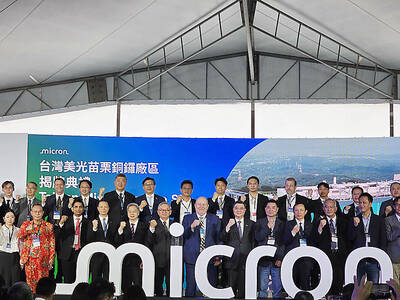
UNPRECEDENTED PACE: Micron Technology has announced plans to expand manufacturing capabilities with the acquisition of a new chip plant in Miaoli Micron Technology Inc unveiled a newly acquired chip plant in Miaoli County yesterday, as the company expands capacity to meet growing demand for advanced DRAM chips, including high-bandwidth memory chips amid the artificial intelligence boom. The plant in Miaoli County’s Tongluo Township (銅鑼), which Micron acquired from Powerchip Semiconductor Manufacturing Corp (力積電) for US$1.8 billion, is expected to make a sizeable capacity contribution to the company from fiscal 2028, the company said in a statement. It would be an extended production site of Micron’s large-scale manufacturing hub in Taichung, the company said. As the global semiconductor industry is racing to reach US$1 trillion

Singapore-based ride-hailing and delivery giant Grab Holdings Ltd has applied for regulatory approval to acquire the Taiwan operations of Germany-based Delivery Hero SE's Foodpanda in a deal valued at about US$600 million. Grab submitted the filing to the Fair Trade Commission on Friday last week, with the transaction subject to regulatory review and approval, the company said in a statement yesterday. Its independent governance structure would help foster a healthy and competitive market in Taiwan if the deal is approved, Grab said. Grab, which is listed on the NASDAQ, said in the filing that US-based Uber Technologies Inc holds about 13 percent of
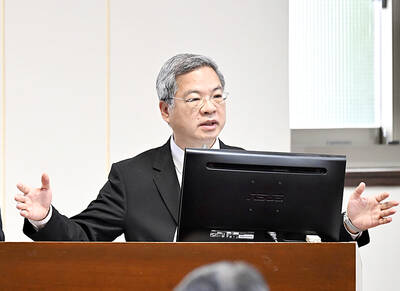
ABOVE LEGAL REQUIREMENT: The Ministry of Economic Affairs is prepared if LNG supply is disrupted, with more than the legal requirement of 11 days of inventory Taiwan has largely secured liquefied natural gas (LNG) supplies through May and arranged about half of June’s supply, Minister of Economic Affairs Kung Ming-hsin (龔明鑫) said yesterday. Since the Middle East conflict began on Feb. 28, Taiwan’s LNG inventories have remained more than 12 days, exceeding the legal requirement of 11 days, indicating no major supply concerns for domestic gas and electricity, Kung said at a meeting of the legislature’s Economics Committee in Taipei. The ministry aims to increase the figure to 14 days by the end of next year, he said. While one or two LNG or crude oil shipments for May

Taiwan’s food delivery market could undergo a major shift if Singapore-based Grab Holdings Ltd completes its planned acquisition of Delivery Hero SE’s Foodpanda business in Taiwan, industry experts said. Grab on Monday last week announced it would acquire Foodpanda’s Taiwan operations for US$600 million. The deal is expected to be finalized in the second half of this year, with Grab aiming to complete user migration to its platform by the first half of next year. A duopoly between Uber Eats and Foodpanda dominates Taiwan’s delivery market, a structure that has remained intact since the Fair Trade Commission (FTC) blocked Uber Technologies Inc’s


 RSS
RSS