


For 15 years, Dan Marino just kept earning more money. Soon after joining the Miami Dolphins in 1983 with a four-year, US$2.1 million contract, he became their star quarterback. By the time he retired after the 1999 season, he was earning US$6 million a year. Now come sthe hard part.
In the interim, the high-school-handsome quarterback with the tousled hair and perfect high-arc passes became one of the most popular players in pro football. His indomitable spirit, which kept him on the field when he was so badly injured that even walking seemed tough, helped make him a legend in South Florida.
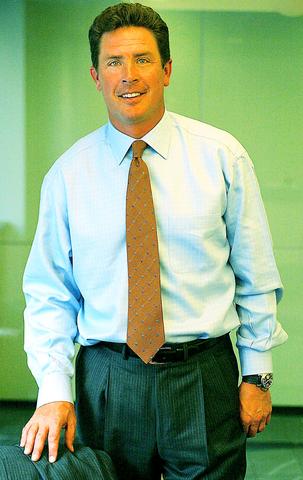
PHOTO: NY TIMES
Some sports legends make it to both the Hall of Fame and bankruptcy court. But not Dan Marino. In all the years he was mesmerizing fans with his comeback drives, his contracts totaled about US$50 million and he amassed a nest egg that associates now value at US$40 million to US$45 million. Although Marino declined to comment specifically, they say he has about US$23 million in liquid assets, US$15 million in personal real estate and several million dollars in private investments that include a golf course, office buildings and a bank.
He is still a big earner: as a co-host of "Inside the NFL" on HBO and "The NFL Today" on CBS, Marino probably takes home about US$2 million a year. And he continues to earn more than US$1 million a year from endorsements for Nabisco, part of Kraft Foods, as well as AutoNation, the car dealership chain, associates say.
The end of his playing career has already affected how Marino, 41, thinks about money. According to Demoff, two years ago Marino considered moving to a costlier home, with an estimated price of about US$14 million, on Jupiter Island, Florida. Though cost was only one factor, he ultimately decided against it.
Though he has hung onto much of his fortune, Marino does not compare himself with stars like John Elway, once quarterback for the Denver Broncos, who built a series of car dealerships. "John prides himself on being a businessman," Marino said. "I never did."
He can tick off some stocks he owns, but his first interest remains sports and his television programs.
He and his wife have done well in real estate, though, in part because prices in South Florida have risen so sharply. Their sun-washed yellow home, surrounded by bougainvillea, is not their only holding, though it is by far the costliest. One local real-estate agent valued it at US$8 million.
In 1991, they bought land on Jupiter Island, planning one day to build the beach house his wife wanted. "We paid about US$1 million for the lot, but it was a great investment," he said. The land is now probably worth about US$4 million, real-estate agents say. The couple also own a small house elsewhere on Jupiter, valued about US$1.5 million.
Two years ago, the Marinos saw that dream house, and contemplated selling the lot and the two houses they already owned.
But first Marino turned for advice to Demoff, who made a chart detailing how Marino's finances would change if he bought the house. At the time, Marino did not have two television deals, and Demoff concluded that with Marino's future earning power unsure, such a large purchase carried a certain risk.
"Once Dan saw that risk, he said, 'OK, I will do nothing -- I will start worrying more about the future,"' Demoff recalled.
Marino's request for a detailed economic analysis of the move was no surprise to his advisers. "Dan has always been someone who asked: `Am I doing OK?"' Demoff said. "He always worries."
Today about 60 percent of Marino's liquid portfolio is in stocks, and the balance in tax-free bonds. The money is managed by Frankel, who has worked with Marino since 1984. Over the last six years, the equity portfolio has risen 7 percent on an annualized basis, exceeding the S&P 500 by more than 1 percentage point a year.


Taiwanese firms have increased investment in the Philippines in recent years as Manila’s ties with Washington deepen and global supply chains continue to shift away from China, an expert at the Chung-Hua Institution for Economic Research (CIER, 中華經濟研究院) said yesterday. The Philippines had not been among Taiwanese investors’ top choices in Southeast Asia, CIER Taiwan ASEAN Studies Center director Kristy Hsu (徐遵慈) said at a seminar in Taipei. However, Taiwan’s investment in the country has grown significantly since the COVID-19 pandemic, reaching US $257 million last year, a high in recent years, she said. Although Taiwan’s total investment in the Philippines still lags

Intel Corp regards Taiwan Semiconductor Manufacturing Co (TSMC, 台積電) as a longstanding partner, as the US chipmaker would continue outsourcing production of advanced chips to TSMC, Intel chief executive officer Lip-Bu Tan (陳立武) said yesterday. “I don’t look at people as competitors. I look at the collaboration... Nvidia is also, you know, a good friend,” Tan told a news conference following his keynote speech at the Computex trade show in Taipei. “It’s a very trusted partnership for us... We are a big, top customer for them, and we’re going to continue doing that,” he said, referring to TSMC, the world’s largest foundry

Hon Hai Precision Industry Co (鴻海精密) yesterday said it would work with US chipmaker Intel Corp to jointly develop and deploy next-generation artificial intelligence (AI) infrastructure and intelligent computing platforms in a move to capture booming demand for AI computing systems. Hon Hai, also known as Foxconn Technology Group (富士康), said in a statement that the partnership would combine its global manufacturing scale, system integration expertise and AI data center deployment capabilities with Intel’s strengths in processor architecture, silicon technologies and software ecosystem. The companies said they plan to work on equipment used in AI data centers, including server racks powered by

Artificial intelligence (AI) agents would supplant smartphones as the center of people’s digital lives, fundamentally reshaping personal devices and driving a major computing upgrade cycle, Qualcomm Inc CEO Cristiano Amon said yesterday. In his keynote speech for this year’s Computex trade show in Taipei, Amon said that the rise of "agentic AI" — AI systems capable of reasoning, planning and carrying out tasks autonomously — would transform how people interact with technology across phones, PCs, vehicles and wearable devices. Describing the technology as the next major evolution in computing, Amon said that "2026 is the year of agents.” For decades, smartphones have sat


 RSS
RSS