


From an orbit 450km above Earth, a new satellite produces images clear enough to distinguish an SUV from a pickup, the lines on a tennis court and the shadows of a foursome on a golf course.
Mapmakers, archaeologists and cities struggling with urban sprawl are eager to obtain the super-sharp pictures from Quickbird, which recently began snapping the most detailed satellite images ever available to the public.
"We're one of the very first people in line," said Jerry Holden, a remote-sensing manager at the conservation group Ducks Unlimited, which hopes to use Quickbird images to monitor wetlands. "There are things like vegetation studies where you need the best resolution you can get."
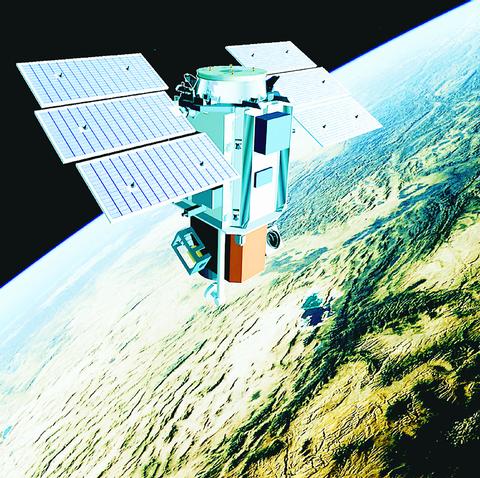
PHOTO: AP
Quickbird's cameras can pick up objects as small as half a meter. The next-best satellite available to the public, the Ikonos satellite launched in 1999 by Denver-based Space Imaging Inc, has a resolution of closer to 1m.
Other nations, notably Israel and Russia, have high-powered satellites, too, but none as sharp as Ikonos or Quickbird. US military satellites do produce sharper images, but those are off-limits to the public.
Quickbird was launched in October by Longmont-based DigitalGlobe after a predecessor failed to reach orbit a year earlier.
It began producing images in February and selling them through resellers in March. Direct sales to the public will begin by midyear.
Early images can distinguish the lanes of a swimming pool, school buses around the Washington monument, seams in the tarmac at Washington's Reagan National Airport and a traffic jam outside the Coliseum in Rome.
More importantly, experts say, the satellite can pick up details of coral reefs, environmental damage and the slow creep of urban growth.
"There are so many cities worldwide that do not have good maps at all," said Farouk El-Baz, the director of the Center for Remote Sensing at Boston University. "Things develop so drastically that the government cannot even follow the changes or even know about them."
Ted Scambos of the National Snow and Ice Data Center at the University of Colorado in Boulder hopes to use Quickbird to distinguish how crevasses in the Antarctic ice shelf fluctuate over time.
"There are some sort of collapse pits that you could actually see," Scambos said. "There are several areas where it might be useful."
Quickbird's imaging mechanism works much like a photocopier, sweeping its lens across the terrain below.
The images are about 16km by 16km in size and can cost anywhere from US$30 to more than US$185 per 1km2 for high-quality pictures. Several can be stitched together to form much larger mosaics of terrain.
Ikonos imagery is cheaper, at about US$18 for the lowest-priced picture. And Space Imaging has an archive of about 500,000 images that sell for US$7 per 1km2, though images are not as sharp.
The camera technology in Quickbird and Ikonos is almost identical.
But because DigitalGlobe was able to get a government license to produce the clearer images, it launched Quickbird into a lower orbit than Ikonos to pick up better detail.
Space Imaging now has a high-resolution license as well, and it plans to up the ante in 2005 with a satellite whose resolution will be about 45cm, slightly better than Quickbird's. DigitalGlobe has said it plans another satellite capable of taking sharper pictures as well.
Experts say the Quickbird's capabilities have been in military hands for as long as 15 years. It is believed American spy satellites can now detect objects as small as 12.5cm in size.
Quickbird will struggle with the same problems Ikonos faced, including weather.
"You can always try to make a computer faster but you just can't compensate for the Earth being 60 percent covered in cloud," Space Imaging spokesman Gary Napier said.
It remains to be seen how sharp an image the market will bear, or customers will need. Images are expensive, as is the storage of enormous imaging files on computers. Furthermore, licenses with the government require Quickbird and the future Ikonos satellites to hold images for 24 hours before selling them.
"I'm being a little patient and letting the market tell us where we want to go," said Herb Satterlee, Quickbird's president and chief executive.
That may wind up working in the satellite companies' favor.
Concerns have been raised over how another commercial satellite might threaten national security.
Like other US companies, the satellite operators may not sell to countries that sponsor terrorism or rogue states, and many other banned groups. The US government may also tell Quickbird or Ikonos operators to shutter their satellites completely in the name of national security. So far, the government has not invoked this clause, even after Sept. 11.
Ann Florini, a space policy expert with the Carnegie Endowment for International Peace, doubts the satellites will be of much use to terrorists.
"They would have to have such a technological infrastructure, such a system for data analysis, not to mention the military capability to put the information to use," she said. "The satellites themselves are really a trivial part of the equation."
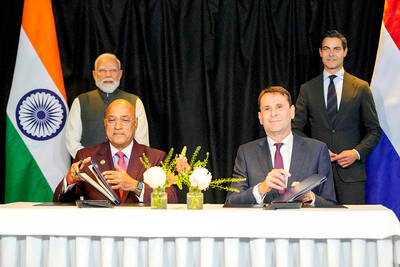
NEW MARKET: The partnership opens up India to the Dutch company, which already has a strong hold in the semiconductor market of South Korea, Taiwan and China ASML Holding NV entered into a partnership agreement with Tata Electronics Pvt Ltd aimed at ramping up India’s goal to develop domestic chip-manufacturing capabilities. The Dutch company’s technology would help power Tata Electronics’ planned 300 millimeter (mm) semiconductor foundry in Gujarat, according to a joint statement from the two companies on Saturday. The signing of a memorandum of understanding coincides with a visit by Indian Prime Minister Narendra Modi to the Netherlands, which is looking to deepen bilateral relations with New Delhi. ASML, whose top customers include Taiwan Semiconductor Manufacturing Co (台積電) and Samsung Electronics Co, makes lithography machines that can print
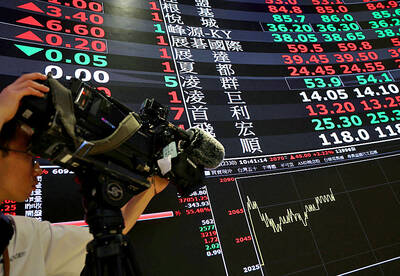
After several years flying high as Asia’s best Nvidia Corp proxy, Taiwan Semiconductor Manufacturing Co (TSMC, 台積電) is increasingly vying with other artificial intelligence (AI) stocks for investor attention. Stock traders are chasing a wider array of beneficiaries as mainstream usage of AI creates demand for hardware beyond the most-advanced chips TSMC makes for Nvidia. Subthemes from the deepening memory crunch to advances in robotics are also luring bids. At the same time, investment caps on single stocks are pushing funds to diversify, while retail investors long familiar with TSMC through its US depositary receipts are being offered a broader set of

TECH RELIANCE: Growth is increasingly reflecting an unequal K-shaped distribution, where technology sectors outperform and other industries struggle, an expert said Standard Chartered Bank has significantly raised its forecast for Taiwan’s economic growth to 9.5 percent this year, up from 7.6 percent previously, citing surging artificial intelligence (AI) demand driving exports, semiconductor production and investment. The upgrade reflects a sustained AI supercycle that continues to fuel demand for advanced chips and technology infrastructure, which form the backbone of Taiwan’s exports, the bank said in a report this week. “We raise our 2026 growth forecast to reflect a much stronger-than-expected first-quarter GDP figure,” Standard Chartered senior economist for greater China and Asia Tommy Wu (胡東安) said in the report. Driven largely by a 35.3 percent

Two of Taiwan’s international carriers, Starlux Airlines Co (星宇航空) and EVA Airways Corp (長榮航空), have retained the five-star airline rating awarded by international airline review organization Skytrax. Starlux was awarded the distinction for a second consecutive year, while EVA Air received it for the 11th straight year, Skytrax said in statements released yesterday and on Thursday last week, respectively. The five-star rating is considered one of the airline industry's highest honors and is awarded following professional audits of airline product and frontline service standards, Skytrax said. The ratings are based on in-depth assessments using unified global quality standards rather than customer review scores


 RSS
RSS