


Gloomy figures from Japan and South Korea sparked a massive sell-off on Asian markets yesterday as regional leaders agreed to set up an US$80 billion fund to fight the global economic crisis.
The agreement, reached as more than 40 Asian and European countries gathered in Beijing for talks on the worst financial crisis since the Great Depression, came as officials in Washington warned of a sharp rise in US unemployment.
The deal between South Korea, China, Japan and the 10 members of the ASEAN is the first major coordinated regional action since the financial turmoil erupted last month.
A spokesman for South Korean President Lee Myung-bak said the 13 leaders had pledged to work more closely on economic matters.
“[They] agreed on the need to strengthen regional cooperation and policy coordination in the face of the global financial crisis,” the spokesman said.
Few details were given, although a preliminary agreement reached in May stated that Japan, South Korea and China would contribute 80 percent of the fund, to be set up by next June, with ASEAN countries covering the remainder. It builds on the so-called Chiang Mai Initiative, in which the 13 nations set up bilateral contracts to supply funds through currency swap lines.
In spite of the announcement, Asian stock markets took another hammering, as fears grew that the financial crisis was taking a heavy toll on corporate earnings in the region.
Japan’s Nikkei stock index plunged 9.6 percent to end at its lowest level in more than five years after electronics giant Sony, considered a bellwether of the Japanese economy, issued a profit warning.
“Wall Street closed higher overnight, but it was only a marginal gain after massive selling. The direction of global markets has not changed,” said Daisuke Uno, chief market strategist of Sumitomo Mitsui Banking Corp.
“Looking at the volatility on Wall Street, the trend on overseas markets and the higher yen, it’s no surprise Tokyo share prices are falling,” Uno said.
Elsewhere in Asia, Sydney closed 2.6 percent lower, South Korea closed down 10.6 percent, Hong Kong was down almost 7 percent and Singapore lost 4.82 percent.
“The market seems to be still in panic,” Lee Kyung-soo, from Taurus Investment & Securities, told Dow Jones Newswires.
In New York, the Dow Jones Industrial Average rose 2.02 percent on Thursday after swings in both directions, while London rebounded 1.16 percent, Paris closed up 0.38 percent and Frankfurt shed 1.12 percent.
In Washington, the White House warned of a sharp rise in layoffs and unemployment stemming from the global economic crisis amid fresh warnings of a painful and lasting recession.
White House Spokeswoman Dana Perino said former US Federal Reserve chairman Alan Greenspan was right to warn, in testimony to a US congressional panel, of what he called “a significant rise in layoffs and unemployment.”
“We’re in for a rocky road on the employment front,” Perino told reporters.
Greenspan, who ended his 18-year stint as Fed chief before a years-long housing bubble burst, warned that a “once-in-a-century credit tsunami” would pummel consumer spending and jobs.
In Mumbai, India’s central bank kept its key interest rates steady, but declared it was ready to take “unconventional and swift” measures to deal with the global financial crisis.
The bank has injected billions of dollars into the financial system to spur lending and kick-start the economy.
In France, President Nicolas Sarkozy announced the creation of a US$100 billion euro (US$128 billion) sovereign wealth fund to protect strategic sectors of the economy from the global financial storm.
Declaring that the recent turmoil had killed off the “dictatorship of the market,” Sarkozy vowed to lead Europe toward a model in which the state will take a more active role in industry.
Governments around the world have unveiled rescue packages over the past month totaling more than US$3 trillion, including loan guarantees and cash injections, to restore confidence to banks and reverse a drop in lending.

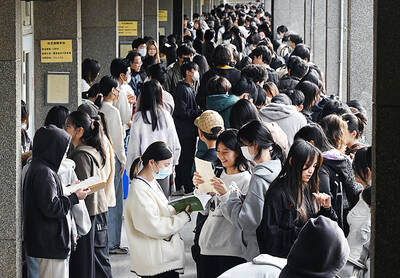
A global survey showed that 60 percent of Taiwanese had attained higher education, second only to Canada, the Ministry of the Interior said. Taiwan easily surpassed the global average of 43 percent and ranked ahead of major economies, including Japan, South Korea and the US, data from the Organisation for Economic Co-operation and Development (OECD) for 2024 showed. Taiwan has a high literacy rate, data released by the ministry showed. As of the end of last year, Taiwan had 20.617 million people aged 15 or older, accounting for 88.5 percent of the total population, with a literacy rate of 99.4 percent, the data

NEW LOW: The council in 2024 based predictions on a pessimistic estimate for the nation’s total fertility rate of 0.84, but last year that rate was 0.69, 17 percent lower An expected National Development Council (NDC) report expects the nation’s population to drop below 12 million by 2065, with the old-age dependency ratio to top 100 percent sooner than 2070, sources said yesterday. The council is slated to release its latest population projections in August, using an ultra-low fertility model, the sources said. The previous report projected that Taiwan’s population would fall to 14.37 million by 2070, but based on a new estimate of the total fertility rate (TFR) — the average number of children born to a woman over her lifetime — the population is expected to reach 12 million by

COUNTERING HOSTILITY: The draft bill would require the US to increase diplomatic pressure on China and would impose sanctions on those who sabotage undersea cable networks US lawmakers on Thursday introduced a bipartisan bill to bolster the resilience of Taiwan’s submarine cables to counter China’s hostile activities. The proposal, titled the critical undersea infrastructure resilience initiative act, was cosponsored by Republican representatives Mike Lawler and Greg Stanton, and Democratic Representative Dave Min. US Senators John Curtis and Jacky Rosen also introduced a companion bill in the US Senate, which has passed markup at the chamber’s Committee on Foreign Relations. The House’s version of the bill would prioritize the deployment of sensors to detect disruptions or potential sabotage in real-time and enhance early warning capabilities through global intelligence sharing frameworks,
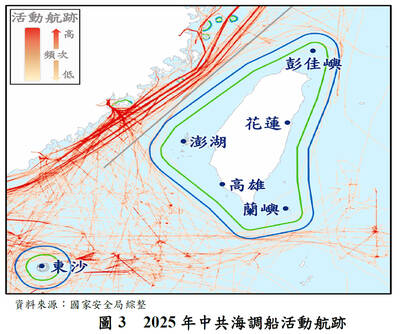
INTENSIFYING THREATS: Beijing’s tactics include massive attacks on the government service network, aircraft and naval vessel incursions and damaging undersea cables China is prepared to interfere in November’s nine-in-one local elections by launching massive attacks on the Taiwanese government’s service network (GSN), a report published by the National Security Bureau showed. The report was submitted to the Legislative Yuan ahead of the bureau’s scheduled briefing at the Foreign Affairs and National Defense Committee tomorrow. The national security team has identified about 13,000 suspicious Internet accounts and 860,000 disputed messages, the bureau said of China’s cognitive warfare against Taiwan. The disputed messages focus on major foreign affairs, national defense and economic issues, which were produced using generative artificial intelligence (AI) and distributed through Chinese


 RSS
RSS