


US consumer confidence, sapped by lengthening jobless queues, plummeted unexpectedly this month, a closely watched survey by the Conference Board showed Tuesday.
The survey-based consumer confidence index slumped 6.9 points from last month to a four-month low of 76.6 points this month, defying Wall Street analysts' forecasts of an improvement, the private research firm said.
"This morning's drop in consumer confidence was a cold slap in the face to all of those economists, including ourselves, that are looking for a second half rebound," said Wachovia Corp economist Mark Vitner.
Shares, which had been higher, turned tail when the figures were released. The Dow Jones Industrials Average of 30 top stocks fell 62.05 points or 0.67 percent to 9,204.46.
"The rising level of unemployment and sentiment that a turnaround in labor market conditions is not around the corner have contributed to deflating consumers' spirits this month," said the Conference Board survey chief, Lynn Franco. "Expectations are likely to remain weak until the job market becomes more favorable."
The US unemployment rate shot up unexpectedly to a nine-year high of 6.4 percent last month as businesses axed 30,000 jobs.
But consumer confidence -- critical because it can sway consumer spending, which accounts for two-thirds of US economic activity -- had been expected to hold firm.
Hopes for economic recovery have been boosted by figures for last month showing retail sales rose 0.5 percent, groundbreaking on new homes surged 3.7 percent, and industrial production rose 0.4 percent.
And only on Thursday, the Labor Department said first-time jobless benefit claimant numbers tumbled below 400,000 in the previous week for the first time in nearly six months.
"Wall Street's expectations of consumer confidence month after month are based on economic data. The only things consumers look at are jobs and their wallets, both of which are getting thinner," said John Challenger, chief executive of outplacement firm Challenger, Gray and Christmas.
"While it is too early to say the sky is falling, the job loss picture may worsen in the not too distant future," he warned.
"There is a silver lining, however. The drop in confidence may not impact consumer spending -- which has almost singlehandedly kept the economy afloat for the last two years," Challenger said, pointing to tax rebates as a likely boon to shoppers.
The Conference Board barometer is made up of two key components: the expectations index, which fell to 86.4 this month from 96.4 last month, and the present situation index, which fell to 61.9 from 64.2.
The Conference Board poll conflicted with a rival survey by the University of Michigan, which found a slight improvement in consumer confidence in early July. The Michigan survey, however, places less emphasis on people's feelings about jobs.


Taiwan has arranged for about 8 million barrels of crude oil, or about one-third of its monthly needs, to be shipped from the Red Sea this month to bypass the Strait of Hormuz and ease domestic supply pressures, CPC Corp, Taiwan (CPC, 台灣中油) said yesterday. The state-run oil company has worked with Middle Eastern suppliers to secure routes other than the Strait of Hormuz, through which about 20 percent of the world’s oil and liquefied natural gas typically passes, CPC chairman Fang Jeng-zen (方振仁) said at a meeting of the legislature’s Economics Committee in Taipei. Suppliers in Saudi Arabia have indicated they
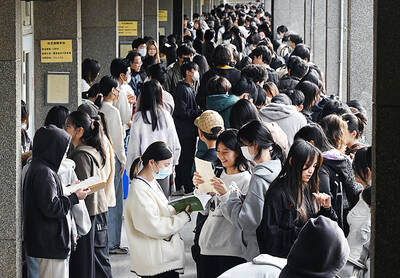
A global survey showed that 60 percent of Taiwanese had attained higher education, second only to Canada, the Ministry of the Interior said. Taiwan easily surpassed the global average of 43 percent and ranked ahead of major economies, including Japan, South Korea and the US, data from the Organisation for Economic Co-operation and Development (OECD) for 2024 showed. Taiwan has a high literacy rate, data released by the ministry showed. As of the end of last year, Taiwan had 20.617 million people aged 15 or older, accounting for 88.5 percent of the total population, with a literacy rate of 99.4 percent, the data

CCP ‘PAWN’? Beijing could use the KMT chairwoman’s visit to signal to the world that many people in Taiwan support the ‘one China’ principle, an academic said Chinese Nationalist Party (KMT) Chairwoman Cheng Li-wun (鄭麗文) yesterday arrived in China for a “peace” mission and potential meeting with Chinese President Xi Jinping (習近平), while a Taiwanese minister detailed the number of Chinese warships currently deployed around the nation. Cheng is visiting at a time of increased Chinese military pressure on Taiwan, as the opposition-dominated Legislative Yuan stalls a government plan for US$40 billion in extra defense spending. Speaking to reporters before going to the airport, Cheng said she was going on a “historic journey for peace,” but added that some people felt uneasy about her trip. “If you truly love Taiwan,

NEW LOW: The council in 2024 based predictions on a pessimistic estimate for the nation’s total fertility rate of 0.84, but last year that rate was 0.69, 17 percent lower An expected National Development Council (NDC) report expects the nation’s population to drop below 12 million by 2065, with the old-age dependency ratio to top 100 percent sooner than 2070, sources said yesterday. The council is slated to release its latest population projections in August, using an ultra-low fertility model, the sources said. The previous report projected that Taiwan’s population would fall to 14.37 million by 2070, but based on a new estimate of the total fertility rate (TFR) — the average number of children born to a woman over her lifetime — the population is expected to reach 12 million by


 RSS
RSS