


Shirley Snyder, a retired real-estate trust officer, says she rarely buys gifts at full price.
"I tend to wait until things go on sale," said Snyder, 56, as she hunted discount video discs at Seattle's Pacific Place Mall. "Most of the time, they do."
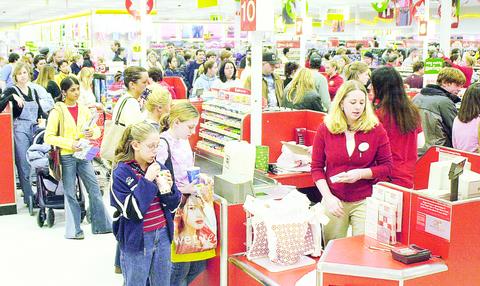
PHOTO: AP
Sales are something new for Herve Prudhomme. The 29-year-old Parisian said he was surprised to be handed a list of discounted items as he walked into the Habitat furniture store to finish his Christmas shopping Saturday. "The sales catch your eye."
With retailers from New York to Madrid struggling to boost sales in a stagnant global economy, discounts are a bigger hook worldwide to lure customers. The US remains the bargain epicenter as stores slash prices, advertise promotions, open early and close late. JC Penney Co and Federated Department Stores Inc, owner of Macy's and Bloomingdale's, offer more than 60 percent off clothing and jewelry.
UK and Hong Kong retailers use similar tactics. Germany and France, where legal restrictions are falling or under review, are warming up. Marionnaud Parfumeries, Europe's biggest retailer of perfumes, cut 15 percent off the prices of more than 95 percent of products at its stores in France.
The discounts may determine whether consumers, who account for more than two-thirds of US economic growth and more than half in Japan and Germany, keep spending. The US is set to expand 2.6 percent next year, according to the Organization for Economic Cooperation and Development, while Europe will grow 1.8 percent and Japan 0.8 percent.
Zero-percent financing on autos and two-for-one specials on toys, clothing and electronics make a difference, investors said.
"Clearly, people are more price-sensitive than they were in years when there was an economic boom," said Kim Galle of Pioneer Investments, whose US division manages about US$17 billion in assets, including shares of Wal-Mart Stores Inc, the world's largest retailer. "Good merchants have done a great job getting people to buy things."
Discounting can have drawbacks, economists say. Price cuts limit companies' ability to increase profits. This crimps investment, stunting one source of economic growth, and adds to concerns about a possible bout of deflation. Falling prices make it harder to pay for labor and raw materials.
"I think it's a very serious risk," Stephen S. Roach, chief economist at Morgan Stanley, said of the deflation threat. Roach said on Dec. 12 that next year's growth will be "sluggish."
The US, with few government restrictions, a tradition of discounting and software that determines when to discount, is the pacesetter. Kohl's Corp had a one-day sale that lowered the price of every item in its store. Wal-Mart's strategy of keeping prices low from the start compels competitors ranging from electronics chain Best Buy Co to Toys 'R' Us Inc to cut prices to retain customers.
Europe, which imposes more government restrictions aimed at protecting against predatory competition, is likely to lag the US for some time.
French law bars retailers from selling below cost and from advertising price cuts outside of government-set sales periods that begin at the end of January and June each year. Germany's laws have the effect of limiting price cuts to summer and winter sale periods, and for companies in insolvency proceedings.
In France, a government commission is considering revising the anti-discounting laws. Alban Eyssette, an analyst at Dexia Securities, sees little prospect for change.
Increasingly, companies are using so-called optimization software to judge when and how much to discount -- and reduce risks to profit. The programs use company data to predict the impact of proposed price cuts on sales, and they alert suppliers to adjust inventory and delivery for specific promotions
"American retailers have the luxury of making use of technology," said Julian Chu, who heads the retail practice of International Business Machines Corp's Institute for Business Value. "Europe is changing, but it'll take time. The need for this type of technology hasn't emerged as quickly in some countries where the rules don't allow for it."
In Japan, some retailers such as Sakuraya Co are offering Microsoft Corp.s Xbox video-game console at 20 percent off to undercut the price of Sony's PlayStation2, which has been outselling Xbox.
For Hong Kong's retailers, four years of declining prices, near-record unemployment and falling sales have made discounting more necessity than choice. The local branch of Japan's Seibu Department Stores Ltd held a pre-Christmas "private sale" offering discounts of up to 60 percent for holders of credit cards issued by HSBC Holdings Plc.
"Retailers have to work a lot harder," said Yu Pang-chun, chairman of the Hong Kong Retail Management Association. "There is a lot more promotion in terms of discounting and in-store promotions, gifts with purchases and VIP days."
The discounts haven't been enough. Hong Kong's retail sales have fallen for 15 of the last 16 months from year-earlier levels.
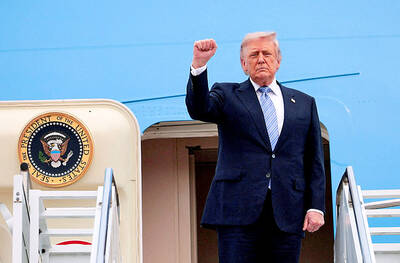
US-CHINA SUMMIT: MOFA welcomed US reassurance of no change in its Taiwan policy; Trump said he did not comment when Xi talked of opposing independence US President Donald Trump yesterday said he has not made a decision on whether to move forward with a major arms package for Taiwan after hearing concerns about it from Chinese President Xi Jinping (習近平). Trump’s comments on Taiwan came as he flew back to Washington after wrapping up critical talks in which both leaders said important progress was made in stabilizing US-China relations even as deep differences persist between the world’s two biggest powers on Iran and Taiwan. “I will make a determination,” Trump said, adding: “I’ll be making decisions. But, you know, I think the last thing we need right
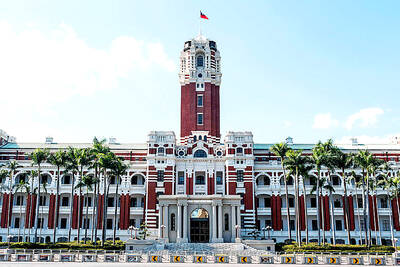
SECURITY: Taipei presses the US for arms supplies, saying the arms sales are not only a reflection of the US security commitment to Taiwan but also serve as a mutual deterrent against regional threats Taiwan is committed to preserving the cross-strait “status quo” and contributing to regional peace and stability, the Presidential Office said yesterday. “It is an undeniable fact that the Republic of China is a sovereign and independent democratic nation,” Presidential Office spokeswoman Karen Kuo (郭雅慧) reiterated, adding that Beijing has no right to claim sovereignty over Taiwan. The statements came after US President Donald Trump warned against Taiwanese independence. Trump wrapped up a state visit to Beijing on Friday, during which Chinese President Xi Jinping (習近平) had pressed him not to support Taiwan. Taiwan depends heavily on US security backing to deter China from carrying
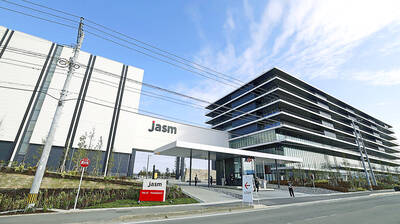
The subsidiary of Taiwan Semiconductor Manufacturing Co (TSMC, 台積電) in Kumamoto, Japan, turned a profit in the first quarter of this year, marking the first time the first fab of the unit has become profitable since mass production started at the end of 2024. According to the contract chipmaker’s financial statement released on Friday, Japan Advanced Semiconductor Manufacturing Inc (JASM), a joint venture running the fab in Kumamoto, posted NT$951 million (US$30.19 million) in profit in the January-to-March period, compared with a loss of NT$1.39 billion in the previous quarter, and a loss of NT$3.25 billion in the first quarter of
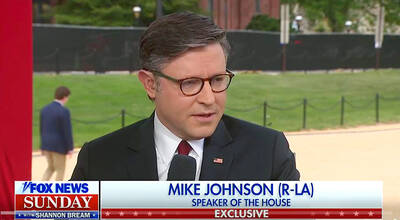
RESOLUTE BACKING: Two Republican senators are planning to introduce legislation that would impose immediate sanctions on China if it attempts to invade Taiwan US House of Representatives Speaker Mike Johnson on Sunday reaffirmed US congressional support for Taiwan, saying the US and “all freedom-loving people” have a stake in preventing China from seizing Taiwan by force. Johnson made the remarks in an interview with Fox News Sunday on US President Donald Trump’s summit with Chinese President Xi Jinping (習近平) last week. In an interview that aired on Friday on Fox News, just as Trump wrapped up a high-stakes visit to China, he said he has yet to green-light a new US$14 billion arms package to Taiwan and that it “depends on China.” “It’s a very good


 RSS
RSS