


An outspoken blogger from Chechnya who had criticized Chechen leader Ramzan Kadyrov has been found brutally murdered in France, several of his acquaintances have said, in the latest killing of a Chechen dissident in Europe.
Imran Aliev, 44, was found dead late last week in a hotel room in the city of Lille. He had been stabbed repeatedly in the neck.
Accounts of Aliev’s murder were confirmed by a Chechen opposition journalist who knew Aliev, and by one other Chechen living in Europe who asked not to be named because of concerns for his safety.
The police have not yet named any suspects, although police sources have told French media that they suspect the motive might be political.
Chechens living in exile who have fought or spoken out against Kadyrov — the ruthless leader appointed by Russian President Vladimir Putin — have often been targeted for assassination.
Last year, a former Chechen rebel commander was shot twice in the head in a targeted killing in Berlin’s Kleiner Tiergarten. The suspected assassin is Russian.
Aliev, who settled in Belgium after leaving Chechnya, was described as an eccentric figure who often published YouTube videos critical of the Chechen government under the pseudonym Mansur Stariy, or “Old Mansur.”
“He was murdered especially cruelly,” wrote Musa Taipov, a Chechen opposition journalist based in Strasbourg, France, who said he was in regular contact with Aliev.
In a Facebook post, Taipov described Aliev as a “difficult but honest” acquaintance who was managing a difficult illness with painkillers and would sometimes issue “not entirely proper declarations.”
“Some people, they offended. For others, they were ‘funny,’” Taipov wrote.
He sometimes urged Aliev to delete the YouTube videos and “most of the time he agreed,” Taipov said.
Thousands of refugees from Chechnya live in Europe. Many fled the two wars that devastated the region from the 1990s, while others escaped the brutal crackdown against dissent under Kadyrov, who has headed the region since 2007 and runs it as a near-fiefdom.
The trail of assassinations of prominent Chechens in Europe and the Middle East stretches back more than a decade, and includes former rebel commanders and government critics. Increasingly, the attacks have targeted people who posed no real political danger to Kadyrov, but merely took to Instagram or YouTube accounts to voice their dissatisfaction with Chechnya’s leaders in Grozny.
“I have no doubt that [Aliev] was on a list of people who have been sentenced to death,” said Tumso Abdurakhmanov, a video blogger living in Europe who has received threats from allies of Kadyrov for his criticism on YouTube of Chechnya’s government.
Abdurakhmanov said that before Aliev’s murder, he had received information that a hitman from Chechnya had been dispatched to Europe, and shared the details of the man’s itinerary with German police.
Abdurakhmanov said he initially believed that the hitman was targeting him. He declined to reveal the source of that information.
However, Taipov said in an interview he was skeptical that Kadyrov was behind the killing.
He said that Aliev had received a wave of threats last month from natives of Ingushetia, another region of Russia, because of insulting remarks concerning a border conflict with Chechnya.
Aliev had even been put under police protection, Taipov said, and might have been lured to Lille because it was just beyond the jurisdiction of Belgian police.
“There is no logic to this murder, either in the motivations or in the way it was carried out,” he said.
The murder of an unidentified man at the Hotel Coq Hardi near Lille train station was first reported on Jan. 30 by La Voix du Nord, a local newspaper.
The newspaper did not identify Alie, but on Monday evening, Agence France-Presse reported that the victim was Aliev, citing sources in the French police who added that he was traveling with another man “of the same nationality.”


Showcasing phallus-shaped portable shrines and pink penis candies, Japan’s annual fertility festival yesterday teemed with tourists, couples and families elated by its open display of sex. The spring Kanamara Matsuri near Tokyo features colorfully dressed worshipers carrying a trio of giant phallic-shaped objects as they parade through the street with glee. The festival, as legend has it, honors a local blacksmith in the Edo Period (1603-1868) who forged an iron dildo to break the teeth of a sharp-toothed demon inhabiting a woman’s vagina that had been castrating young men on their wedding nights. A 1m black steel phallus sits in the courtyard of

JAN. 1 CLAUSE: As military service is voluntary, applications for permission to stay abroad for over three months for men up to age 45 must, in principle, be granted A little-noticed clause in sweeping changes to Germany’s military service policy has triggered an uproar after it emerged that the law requires men aged up to 45 to get permission from the armed forces before any significant stay abroad, even in peacetime. The legislation, which went into effect on Jan. 1 aims to bolster the military and demands all 18-year-old men fill out a questionnaire to gauge their suitability to serve in the armed forces, but stops short of conscription. If the “modernized” model fails to pull in enough recruits, parliament will be compelled to discuss the reintroduction of compulsory service, German
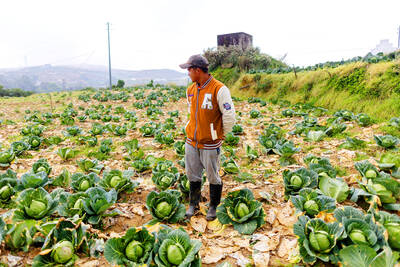
Filipino farmers like Romeo Wagayan have been left with little choice but to let their vegetables rot in the field rather than sell them at a loss, as rising oil prices linked to the Iran war drive up the cost of harvesting, labor and transport. “There’s nothing we can do,” said Wagayan, a 57-year old vegetable farmer in the northern Philippine province of Benguet. “If we harvest it, our losses only increase because of labor, transportation and packing costs. We don’t earn anything from it. That’s why we decided not to harvest at all,” he said. Soaring costs caused by the Middle East

Hungarian Prime Minister Viktor Orban’s officially declared wealth is fairly modest: some savings and a jointly owned villa in Budapest. However, voters in what Transparency International deems the EU’s most corrupt country believe otherwise — and they might make Orban pay in a general election this Sunday that could spell an end to his 16-year rule. The wealth amassed by Orban’s inner circle is fueling the increasingly palpable frustration of a population grappling with sluggish growth, high inflation and worsening public services. “The government’s communication machine worked well as long as our economic situation remained relatively good,” said Zoltan Ranschburg, a political analyst


 RSS
RSS