


Women ran in record numbers this year, and Native Americans, Muslims, Latinos, immigrants, millennials and LGBT candidates have already made history with their campaigns.
Here are the key trailblazing candidates who are diversifying US politics and have won their races:
Alexandria Ocasio-Cortez is the youngest woman elected to the US Congress.
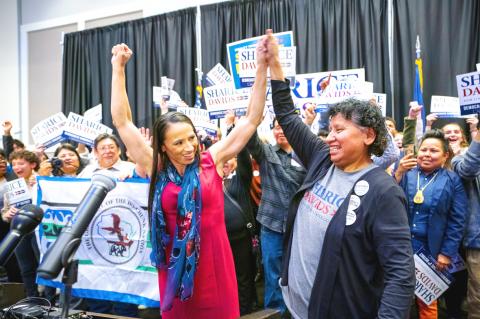
Photo: EPA-EFE
Ocasio-Cortez’s surprise victory in the June congressional primary in New York shook up Washington and the Democratic Party.
The progressive challenger and Democratic-Socialist unseated a powerful 10-term New York congressman, running with a campaign ad that said: “Women like me aren’t supposed to run for office.”
Now age 29, she has become the youngest woman ever elected to Congress. Elise Stefanik previously held the record when she was elected at age 30 in 2014.
Ocasio-Cortez is the daughter of a Puerto Rican mother and a Bronx-born father and grew up in a working-class community. She ran a grassroots campaign that took on the “Queens Democratic party machine” and championed progressive proposals, such as the abolition of the Immigration Customs Enforcement (ICE), a single-payer healthcare plan and tuition-free college.
Ayanna Pressley is the first black House of Representatives member from Massachusetts.
Pressley was the first black woman to serve on the Boston City Council and made history again after defeating the 10-term Representative Michael Capuano in the primary.
She did not face a challenger in the general election.
“These times demanded more from our leaders and from our party. These times demanded an approach to governing that was bold, uncompromising and unafraid. It’s not just good enough to see the Democrats back in power, but it matters who those Democrats are,” she said in her victory speech in September.
Rashida Tlaib and Ilhan Omar are the first Muslim congresswomen.
Tlaib ran unopposed in her race to represent Michigan’s 17th District and has become the nation’s first Palestinian-American woman in Congress, and one of two Muslim women elected on Tuesday.
She is a Democratic-Socialist who served on the state legislature from 2009 to 2014 and ran her congressional primary campaign supporting Medicare for all, a US$15 minimum wage and abolishing ICE.
Tlaib was famously escorted from a rally for then-US presidential candidate Donald Trump in 2016 as she shouted questions at the candidate, asking him if he had ever read the constitution.
Omar, also the first Somali-American in Congress, is a former refugee who spent the past four years as a state legislator.
There, she pushed a progressive agenda, including a US$15 minimum wage and subsidizing higher education costs for low-income students.
Her congressional platform has included the cancelation of student debt, banning private prisons and aggressive funding cuts to military spending.
In 2016, she became the first Somali-American state legislator in the country.
Jared Polis is the first openly gay man elected governor.
As the Democratic nominee for governor in Colorado, Polis ran on a left-wing platform, which included single-payer healthcare, repeal of the death penalty, universal full-day preschool and stronger gun laws.
Polis, who declared victory late on Tuesday night, has long been outspoken in favor of marijuana legalization.
Kate Brown, who is bisexual, became the first openly LGBT person elected governor in 2016 when she won her Oregon race, while Jim McGreevey, a Democrat and former New Jersey governor, came out while in office in 2004.
Sharice Davids and Deb Haaland are the first Native American congresswomen.
An attorney and former mixed martial arts fighter, Davids became the first Native American congresswoman and the first lesbian congresswoman from Kansas.
Raised by a single mother US Army veteran and a member of the Ho-Chunk Nation based in Wisconsin, Davids was a fellow in the White House under former US president Barack Obama.
In New Mexico, Haaland became the first Native American woman to chair a state political party.
A citizen of the Pueblo of Laguna tribe, Haaland is a longtime activist who ran on a progressive platform, including Medicare for all, a US$15 minimum wage and the impeachment of Trump.
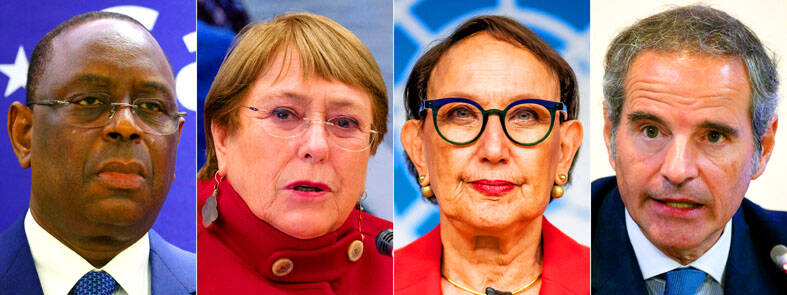
Four contenders are squaring up to succeed Antonio Guterres as secretary-general of the UN, which faces unprecedented global instability, wars and its own crushing budget crisis. Chile’s Michelle Bachelet, Argentina’s Rafael Grossi, Costa Rica’s Rebeca Grynspan and Senegal’s Macky Sall are each to face grillings by 193 member states and non-governmental organizations for three hours today and tomorrow. It is only the second time the UN has held a public question-and-answer, a format created in 2016 to boost transparency. Ultimately the five permanent members of the UN’s top body, the Security Council, hold the power, wielding vetoes over who leads the

South Korea’s air force yesterday apologized for a 2021 midair collision involving two fighter jets, a day after auditors said the pilots were taking selfies and filming during the flight and held them responsible for the accident. “We sincerely apologize to the public for the concern caused by the accident that occurred in 2021,” an air force spokesman told a news conference, adding that one of the pilots involved had been suspended from flying duties, received severe disciplinary action and has since left the military. The apology followed a report released on Wednesday by the South Korean Board of Audit and Inspection,

An earthquake registering a preliminary magnitude of 7.7 off northern Japan on Monday prompted a short-lived tsunami alert and the advisory of a higher risk of a possible mega-quake for coastal areas there. The Cabinet Office and the Japan Meteorological Agency said there was a 1% chance for a mega-quake, compared to a 0.1% chance during normal times, in the next week or so following the powerful quake near the Chishima and Japan trenches. Officials said the advisory was not a quake prediction but urged residents in 182 towns along the northeastern coasts to raise their preparedness while continuing their daily lives. Prime

About 240 Indians claiming descent from a Biblical tribe landed at Tel Aviv airport on Thursday as part of a government operation to relocate them to Israel. The newcomers passed under a balloon arch in blue and white, the colors of the Israeli flag, as dozens of well-wishers welcomed them with a traditional Jewish song. They were the first “bnei Menashe” (“sons of Manasseh”) to arrive in Israel since the government in November last year announced funding for the immigration of about 6,000 members of the community from the states of Manipur and Mizoram in northeast India. The community claims to descend from


 RSS
RSS