


The fallout from London’s devastating tower block blaze continued on Sunday with the government announcing 60 high-rises have failed safety tests, as an insurance body said they had warned officials of the fire risks.
The massive operation to test tower blocks follows the Grenfell Tower inferno earlier this month that is presumed to have killed 79 people after it spread at shocking speed.
Suspicion has fallen on the cladding installed on the outside of Grenfell and urgent checks have found such material used on 60 other residential buildings has failed fire tests.

Photo: AFP
“All landlords and fire and rescue services for these local authorities have been alerted to the results and we are in touch with all of them to support and monitor follow-up action,” local government minister Sajid Javid said.
The new figure is a significant jump from the 34 high-rise buildings in England deemed unsafe by the government on Saturday.
While many people have been able to stay in their homes despite the fire risk, thousands of residents from 650 flats in north London were evacuated on Saturday.
An inspection showed four of the five Chalcots Estate towers in Camden were at risk over cladding, fire doors, gas pipes and insulation, prompting a chaotic evacuation with temporary accommodation offered in a local leisure center and hotels.
Despite the safety fears, about 200 residents have refused to leave their homes, some of whom suffer from agoraphobia, local authority leader Georgia Gould said.
“I’m going myself back to the blocks to knock on doors and have those conversations,” she told BBC television of her efforts to convince residents to leave.
Gould refused to be drawn on whether there was a deadline to evacuate residents, saying: “The last thing I want to do is force people out of their homes.”
It is up to each local authority to decide whether to evacuate residents from blocks which have failed fire tests, a spokesman for the communities and local government department told reporters.
As tests continue to avoid a repeat of the horror which broke out at the Grenfell Tower on June 14, the Association of British Insurers (ABI) said it had warned of the risks posed by cladding in feedback to a government policy document.
“In our response to the government’s housing white paper in May this year we drew attention to the fact that external cladding made from combustible material can cause fire to spread,” ABI spokesman Malcolm Tarling told reporters by e-mail.
The same government department which is now spearheading the safety checks ran a consultation between February and last month, requesting feedback on its “white paper” policy document on overhauling the housing sector.
A spokeswoman for the department for communities and local government was not immediately able to comment on the ABI’s feedback, which has not yet been published.
As the charred skeleton of the 24-story Grenfell block looms over the west of the city, London MP David Lammy said trust has hit “rock bottom” as many in the local community believe more than 79 people were killed.
“Survivors cannot believe that the death toll has not risen. Speaking to people on the ground, there is huge suspicion of a cover-up,” he said.
Police have said that the number of victims could rise still, with detective Fiona McCormack on Friday saying a full forensic search could take until the end of the year.
All “complete bodies” have been removed from the wreckage, but there remains “a terrible reality that we might not find or identify everyone who died due to the intense heat,” she said.


When a hiker fell from a 55m waterfall in wild New Zealand bush, rescuers were forced to evacuate the badly hurt woman without her dog, which could not be found. After strangers raised thousands of dollars for a search, border collie Molly was flown to safety by a helicopter pilot who was determined to reunite the pet and the owner. A week earlier, an emergency rescue helicopter found the woman with bruises and lacerations after a fall at a rocky spot at the waterfall on the South Island’s West Coast. She was airlifted on March 24, but they were forced to
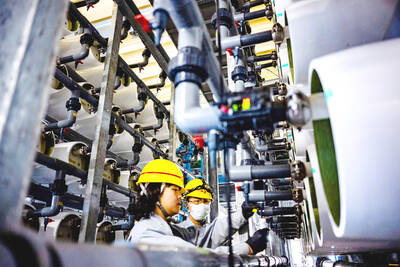
HIGH HOPES: The power source is expected to have a future, as it is not dependent on the weather or light, and could be useful for places with large desalination facilities A Japanese water plant is harnessing the natural process of osmosis to generate renewable energy that could one day become a common power source. The possibility of generating power from osmosis — when water molecules pass from a less salty solution to a more salty one — has long been known. However, actually generating energy from that has proved more complicated, in part due the difficulty of designing the membrane through which the molecules pass. Engineers in Fukuoka, Japan, and their private partners think they might have cracked it, and have opened what is only the world’s second osmotic power plant. It generates
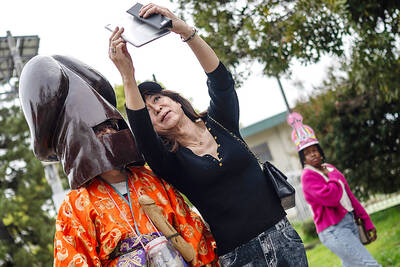
Showcasing phallus-shaped portable shrines and pink penis candies, Japan’s annual fertility festival yesterday teemed with tourists, couples and families elated by its open display of sex. The spring Kanamara Matsuri near Tokyo features colorfully dressed worshipers carrying a trio of giant phallic-shaped objects as they parade through the street with glee. The festival, as legend has it, honors a local blacksmith in the Edo Period (1603-1868) who forged an iron dildo to break the teeth of a sharp-toothed demon inhabiting a woman’s vagina that had been castrating young men on their wedding nights. A 1m black steel phallus sits in the courtyard of

Hundreds of Filipinos and tourists flocked to a sun-bleached field north of Manila yesterday, on Good Friday, to witness one of the country’s most blood-soaked displays of religious fervor, undeterred by rising fuel prices. Scores of bare-chested flagellants with covered faces walked barefoot through the dusty streets of Pampanga Province’s San Fernando as they flogged their backs with bamboo whips in the scorching heat. Agence France-Presse (AFP) journalists said they saw devotees deliberately puncturing their skin with glass shards attached to a small wooden paddle to ensure their bleeding during the ritual, a way to atone for sins and seek miracles from


 RSS
RSS