


Iraqi Major General Najm al-
Jubbouri, a top commander in the offensive against the Islamic State (IS) group in the Iraqi city of Mosul, peered through binoculars at flames after his men shot dead an IS suicide bomber.
It was a small victory for a man whose war against Muslim extremists is deeply personal.
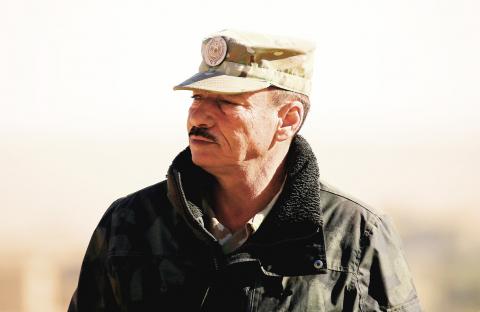
Photo: Reuters
“You are heroes,” he said through a walkie-talkie as Iraqi forces cleared another village, hoping to open a new route to the militants’ stronghold of Mosul. “You are heroes.”
Last year, Iraqi Prime Minister Haider al-Abadi asked al-Jubbouri to return home from the US to help lead the fight against the IS, which swept through Mosul and other parts of northern Iraq in 2014 and imposed a reign of terror.
Al-Jubbouri is upbeat as he paces on the rooftop of a house that serves as a makeshift command center, surveying the battlefield and tightly managing advances.
However, he is acutely aware of what the IS is capable of.
Last year, he watched an IS video broadcast on social media which showed the drowning of prisoners who were locked inside a steel cage and slowly lowered to their deaths in a pool.
Some of the victims were al-Jubbouri’s cousins, he said.
“My relatives and citizens suffered a lot from al-Qaeda and ISIS. I decided to return back here. In Mosul, ISIS killed a lot from my tribe and from my friends,” he told reporters, using a common acronym for the Islamic State.
Al-Jubbouri left his family and his job at the National Defense University in the US behind and put on his military fatigues again at home.
Eager to avenge the deaths of his relatives and help stabilize Iraq, al-Jubbouri is trying to figure out ways to overcome the complex challenges of fighting the IS in Mosul, home to about 1 million people.
Iraqi forces cannot move heavy weapons and tanks through Mosul’s narrow streets, and the IS is using civilians as human shields to slow government advances, said al-Jubbouri, who served in former Iraqi president Saddam Hussein’s army for decades.
In the desert just beyond al-
Jubbouri are two army trucks mounted with machine guns, primed to attack any suicide bombers in vehicles who try to approach the makeshift command center, which is surrounded by bodyguards.
“We want to remove the cancer [of the Islamic State] from the body and this is a very difficult mission inside Mosul,” al-Jubbouri said.
Al-Jubbouri, who moved to the US in 2008, is acutely aware of the dangers posed by Muslim militants, and the sectarian animosities which have destabilized Iraq.
As mayor of the northwestern Iraqi city Tel Afar from 2005 to 2008, he cleared out al-Qaeda fighters and promoted reconciliation between Sunnis and Shiites.
Iraq has been struggling to find a formula for stability since a US-led invasion toppled Saddam in 2003.
Even if the IS is defeated in Mosul, Iraqi leaders must ensure that the same ethnic and sectarian hostilities which helped the group establish a widespread presence in the country do not creep up again.
The group initially won over Sunni supporters because that sect felt marginalized by the Shiite-led government in Baghdad.
Al-Jubbouri called for an end to a governing system which allocates top posts based on sects.
“It won’t be rosy. Many difficulties,” he said. “Some politicians will not like to change because many of them would lose their positions.”
For now, he is focused on the fight against the IS.
Al-Jubbouri said Iraqi forces had set a six-month timetable for the Mosul campaign.
However, he is confident of victory by the end of this year, predicting the group will collapse.
So far, Iraqi forces have captured about 60 percent of eastern Mosul, and the western part of Iraq’s second-biggest city could prove far more dangerous.
“In the beginning, everyday we faced between 60 and 70 car bombs. Now we are facing about two or three,” al-Jubbouri said, as his forces fired mortar bombs and rockets at an asphalt factory where militants strapped with explosives were positioned.

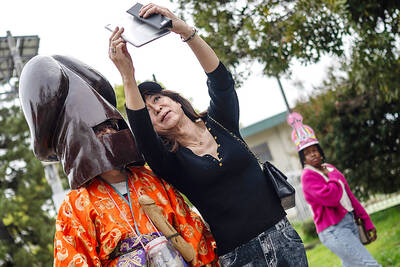
Showcasing phallus-shaped portable shrines and pink penis candies, Japan’s annual fertility festival yesterday teemed with tourists, couples and families elated by its open display of sex. The spring Kanamara Matsuri near Tokyo features colorfully dressed worshipers carrying a trio of giant phallic-shaped objects as they parade through the street with glee. The festival, as legend has it, honors a local blacksmith in the Edo Period (1603-1868) who forged an iron dildo to break the teeth of a sharp-toothed demon inhabiting a woman’s vagina that had been castrating young men on their wedding nights. A 1m black steel phallus sits in the courtyard of

JAN. 1 CLAUSE: As military service is voluntary, applications for permission to stay abroad for over three months for men up to age 45 must, in principle, be granted A little-noticed clause in sweeping changes to Germany’s military service policy has triggered an uproar after it emerged that the law requires men aged up to 45 to get permission from the armed forces before any significant stay abroad, even in peacetime. The legislation, which went into effect on Jan. 1 aims to bolster the military and demands all 18-year-old men fill out a questionnaire to gauge their suitability to serve in the armed forces, but stops short of conscription. If the “modernized” model fails to pull in enough recruits, parliament will be compelled to discuss the reintroduction of compulsory service, German
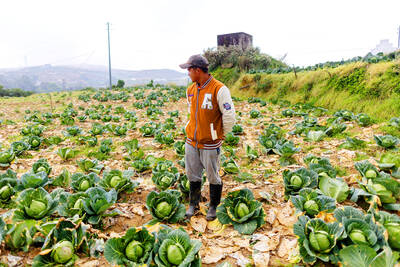
Filipino farmers like Romeo Wagayan have been left with little choice but to let their vegetables rot in the field rather than sell them at a loss, as rising oil prices linked to the Iran war drive up the cost of harvesting, labor and transport. “There’s nothing we can do,” said Wagayan, a 57-year old vegetable farmer in the northern Philippine province of Benguet. “If we harvest it, our losses only increase because of labor, transportation and packing costs. We don’t earn anything from it. That’s why we decided not to harvest at all,” he said. Soaring costs caused by the Middle East

Hungarian Prime Minister Viktor Orban’s officially declared wealth is fairly modest: some savings and a jointly owned villa in Budapest. However, voters in what Transparency International deems the EU’s most corrupt country believe otherwise — and they might make Orban pay in a general election this Sunday that could spell an end to his 16-year rule. The wealth amassed by Orban’s inner circle is fueling the increasingly palpable frustration of a population grappling with sluggish growth, high inflation and worsening public services. “The government’s communication machine worked well as long as our economic situation remained relatively good,” said Zoltan Ranschburg, a political analyst


 RSS
RSS