


Chinese authorities detained 13 people over the collapse of scaffolding at a power plant construction site that killed 74 workers, as a preliminary investigation zeroed in on how the building company had rushed the job.
Most of the dead had been working on the interior concrete wall of a massive circular cooling tower 70m up when the scaffolding collapsed on Thursday morning, resulting in one of China’s most serious industrial accidents in years.
In a statement issued yesterday, the State Council of the People’s Republic of China said early findings suggested that a shortened time frame for the power plant project, hasty construction and mismanagement played a role in the disaster, without giving details.
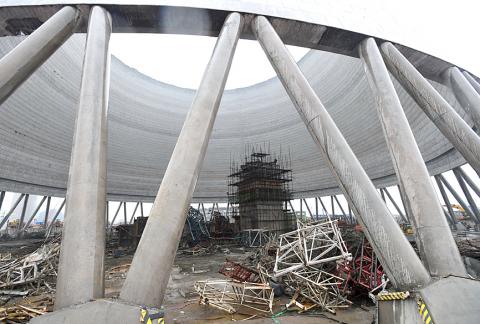
Photo: Reuters
Although authorities did not disclose details about the 13 detentions, the focus of the investigation has turned to the power plant’s operator, Jiangxi Ganneng, and a major engineering firm, Hebei Yineng, which has taken on multiple high-profile power plant projects and has a history of workplace fatalities.
Yineng has won contracts to build plants in more than a dozen provinces and in Turkey and Malaysia, according to previous interviews given by executives.
In 2012, seven Yineng builders in a cooling tower in China’s Yunnan Province tumbled to their deaths after scaffolding collapsed. Three years before that, two workers died after a vehicle accidentally backed into a scaffolding support beam at a Yineng-built cooling tower in China’s Guangdong Province.
Several of the company’s publicly listed telephone lines and a mobile phone number for the company’s legal representative rang unanswered on Friday.
The company’s Web sites could not be opened.
Chinese state media reports said the accident occurred during a change of work shifts, possibly accounting for the high death toll. Workers had also been toiling around-the-clock in three shifts to make progress on the project ahead of the arrival of bitter winter weather, according to local media interviews with surviving employees.
The 1,000 megawatt coal-fired plant had been designated a priority project by the province, likely adding to the pressure on workers.
The deadly accident has taken on added political significance in recent days after Chinese President Xi Jinping (習近平) urged local governments to hold those responsible accountable and the Chinese State Council established a special committee to investigate.
China has suffered several major work-safety accidents in recent years blamed on weak regulatory oversight, systemic corruption and pressure to boost production amid a slowing economy.


Showcasing phallus-shaped portable shrines and pink penis candies, Japan’s annual fertility festival yesterday teemed with tourists, couples and families elated by its open display of sex. The spring Kanamara Matsuri near Tokyo features colorfully dressed worshipers carrying a trio of giant phallic-shaped objects as they parade through the street with glee. The festival, as legend has it, honors a local blacksmith in the Edo Period (1603-1868) who forged an iron dildo to break the teeth of a sharp-toothed demon inhabiting a woman’s vagina that had been castrating young men on their wedding nights. A 1m black steel phallus sits in the courtyard of

JAN. 1 CLAUSE: As military service is voluntary, applications for permission to stay abroad for over three months for men up to age 45 must, in principle, be granted A little-noticed clause in sweeping changes to Germany’s military service policy has triggered an uproar after it emerged that the law requires men aged up to 45 to get permission from the armed forces before any significant stay abroad, even in peacetime. The legislation, which went into effect on Jan. 1 aims to bolster the military and demands all 18-year-old men fill out a questionnaire to gauge their suitability to serve in the armed forces, but stops short of conscription. If the “modernized” model fails to pull in enough recruits, parliament will be compelled to discuss the reintroduction of compulsory service, German
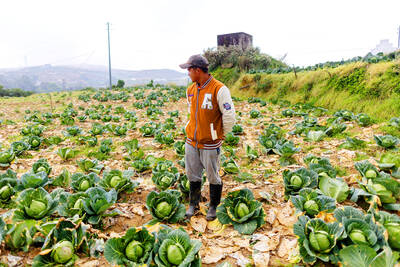
Filipino farmers like Romeo Wagayan have been left with little choice but to let their vegetables rot in the field rather than sell them at a loss, as rising oil prices linked to the Iran war drive up the cost of harvesting, labor and transport. “There’s nothing we can do,” said Wagayan, a 57-year old vegetable farmer in the northern Philippine province of Benguet. “If we harvest it, our losses only increase because of labor, transportation and packing costs. We don’t earn anything from it. That’s why we decided not to harvest at all,” he said. Soaring costs caused by the Middle East

Hungarian Prime Minister Viktor Orban’s officially declared wealth is fairly modest: some savings and a jointly owned villa in Budapest. However, voters in what Transparency International deems the EU’s most corrupt country believe otherwise — and they might make Orban pay in a general election this Sunday that could spell an end to his 16-year rule. The wealth amassed by Orban’s inner circle is fueling the increasingly palpable frustration of a population grappling with sluggish growth, high inflation and worsening public services. “The government’s communication machine worked well as long as our economic situation remained relatively good,” said Zoltan Ranschburg, a political analyst


 RSS
RSS