


Beijing’s air quality fell short of national standards on 179 days last year. That is one reason why the world’s biggest coal consumer is likely to stick with its plan to clean up its energy supply — regardless of what US president-elect Donald Trump does in the US.
“At the current stage of China’s economic growth, the industries and the models that the nation has developed all face constraints related to the environment and resources,” said Xuan Xiaowei (宣曉偉), a senior research fellow at a government think tank called the Development Research Center of the State Council. “Environmental pollution is so serious. Can it work without green development?”
By any account, China must curb environmental pollution to keep its public happy. About 80 percent of the 338 Chinese cities regularly monitored by the Ministry of Environmental Protection failed to meet official standards last year, it said.

Photo: AP
Resentment about worsening pollution has created cottage industries of everything from smartphone applications to low-cost monitoring devices to keep track of air quality.
Responding to a groundswell of public anger about smog levels, Chinese President Xi Jinping (習近平) threatened last year to punish polluters with an “iron hand.” He also promoted green energy.
“The government has placed a very high priority on measures to help curb pollution,” said Dong Liansai (董連賽), a Greenpeace East Asia climate and energy campaigner.
China has been the biggest clean-energy investor since 2012, spending US$384.7 billion in that period on clean sources of energy, such as wind and solar power, and it is holding onto that lead.
According to data compiled by Bloomberg New Energy Finance, China invested US$48.1 billion in new clean energy projects so far this year, compared with US$9.6 billion in Japan and US$32.6 billion in the US.
China accounted for US$21.9 billion of the US$61.1 billion in global green bond sales this year, the data showed.
The nation, which last year sold less than US$1 billion of the debt whose proceeds are earmarked for environmental projects, is accelerating regulation to channel funds toward reducing pollution, Moody’s Investors Service said in a recent report.
The results of all that spending are gradually beginning to appear. Coal accounted for 64.4 percent of total energy consumption last year, down 1.7 percentage points from the previous year, while the share of non-fossil fuels rose by 0.8 percentage points to 12 percent, the government said in January.
“Investing in cleaner energy will help China to gain economic benefits and improve the transition of its energy structure,” said Zheng Xinye (鄭新業), associate dean at the School of Economics at the Renmin University of China in Beijing.
China accounts for nine of the world’s 10 biggest solar manufacturers, according to Bloomberg New Energy Finance (BNEF) data. Almost eight out of every 10 panels worldwide are made in the country.
Since 2012, China’s solar capacity has surged more than sevenfold, while wind has almost doubled amid a push by the nation to generate 15 percent of its power from renewable energy and nuclear by 2020, according to data compiled by Bloomberg.
China surpassed Germany as the country with the most installed solar capacity after record additions last year. The nation’s total wind capacity was almost double that of the US last year.
“Global warming is actually happening, no matter who the president is,” said Qian Jing (錢晶), a vice president of Chinese solar-panel maker JinkoSolar Holding Co. “No matter how the US’s climate policies change, China should take the lead.”
China’s push to develop renewables has lifted many companies, creating huge global players. Xinjiang Goldwind Science & Technology Co installed the most wind power in the world last year, becoming the first Chinese company to take the top spot in BNEF’s global onshore-wind rankings.
Trina Solar Ltd became the world’s largest solar panel-maker in 2014. The Changzhou, China-based company also says it is setting records with its technology, saying in October that it reached a record 19.86 percent efficiency for a low-cost form of polysilicon module.
China’s leadership in climate negotiations was on full display over the past two weeks at UN climate talks, when ministers and government officials from almost 200 countries gathered in Marrakech, Morocco.
While Trump’s past assertion that global warming is a hoax created by China to make US manufacturing non-competitive left many delegates obsessing over what future role the US will play, Beijing pressed ahead with the case to take action on global warming.
Xi then told leaders of the APEC forum in Lima, Peru, on Saturday that he aimed to boost global trade and provide a level playing field for foreign companies. Days earlier, Beijing indirectly chided Trump for his views on global warming, which the president-elect has called a Chinese hoax to hurt US manufacturing.
“Why not keep supporting green development?” said Sophie Lu, head of China research for London-based BNEF. “If China stays green, it maintains both moral leadership abroad and helps to support” green industries, which it dominates.
China’s domestic economy is restructuring and its investment into more coal capacity does not make money any more, Lu said.
“Instead, it needs to focus on new economy sectors, which depends on happy or productive workers living in healthy and clean cities,” she said.


Showcasing phallus-shaped portable shrines and pink penis candies, Japan’s annual fertility festival yesterday teemed with tourists, couples and families elated by its open display of sex. The spring Kanamara Matsuri near Tokyo features colorfully dressed worshipers carrying a trio of giant phallic-shaped objects as they parade through the street with glee. The festival, as legend has it, honors a local blacksmith in the Edo Period (1603-1868) who forged an iron dildo to break the teeth of a sharp-toothed demon inhabiting a woman’s vagina that had been castrating young men on their wedding nights. A 1m black steel phallus sits in the courtyard of

JAN. 1 CLAUSE: As military service is voluntary, applications for permission to stay abroad for over three months for men up to age 45 must, in principle, be granted A little-noticed clause in sweeping changes to Germany’s military service policy has triggered an uproar after it emerged that the law requires men aged up to 45 to get permission from the armed forces before any significant stay abroad, even in peacetime. The legislation, which went into effect on Jan. 1 aims to bolster the military and demands all 18-year-old men fill out a questionnaire to gauge their suitability to serve in the armed forces, but stops short of conscription. If the “modernized” model fails to pull in enough recruits, parliament will be compelled to discuss the reintroduction of compulsory service, German
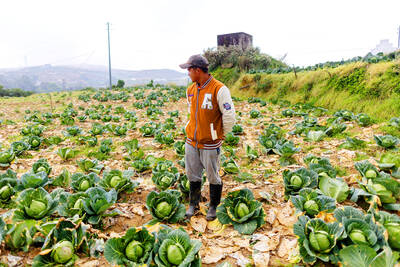
Filipino farmers like Romeo Wagayan have been left with little choice but to let their vegetables rot in the field rather than sell them at a loss, as rising oil prices linked to the Iran war drive up the cost of harvesting, labor and transport. “There’s nothing we can do,” said Wagayan, a 57-year old vegetable farmer in the northern Philippine province of Benguet. “If we harvest it, our losses only increase because of labor, transportation and packing costs. We don’t earn anything from it. That’s why we decided not to harvest at all,” he said. Soaring costs caused by the Middle East
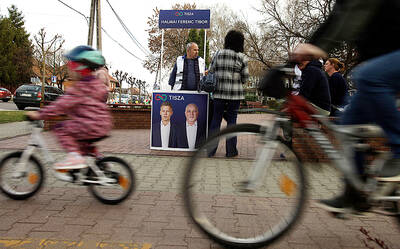
Hungarian Prime Minister Viktor Orban’s officially declared wealth is fairly modest: some savings and a jointly owned villa in Budapest. However, voters in what Transparency International deems the EU’s most corrupt country believe otherwise — and they might make Orban pay in a general election this Sunday that could spell an end to his 16-year rule. The wealth amassed by Orban’s inner circle is fueling the increasingly palpable frustration of a population grappling with sluggish growth, high inflation and worsening public services. “The government’s communication machine worked well as long as our economic situation remained relatively good,” said Zoltan Ranschburg, a political analyst


 RSS
RSS