


Automakers’ latest projections for rapid growth of China’s “green” car market have added to concerns of worsening smog as the uptake of electric vehicles powered by coal-fired grids races ahead of a switch to sources of cleaner energy.
Volkswagen AG plans 15 “new-energy” models over three to five years, its China chief told a “green car” conference in Beijing on Saturday last week, predicting — like the Chinese government has — that the nation’s production of electric and plug-in hybrid vehicles would grow almost six times to 2 million annually by 2020.
At the same event, BYD Co’s chairman told reporters that the Chinese automaker’s sales of electric vehicles would double in each of the next three years.
The government has been promoting electric vehicles to cut the smog that frequently envelops Chinese cities, helping sales quadruple last year and making China the biggest market, Chinese Minister of Finance Lou Jiwei (樓繼偉) said at the conference.
Less than 1 percent of passenger cars are now “new energy,” but the pace of growth raises their potential to worsen smog.
A series of studies by Tsinghua University, whose alumni includes Chinese President Xi Jinping (習近平), showed that electric vehicles charged in China produce two to five times as much particulate matter and chemicals that contribute to smog versus gasoline cars. Hybrid vehicles fare little better.
“International experience shows that cleaning up the air doesn’t need to rely on electric vehicles,” said An Feng, director of the Los Angeles-based Innovation Center for Energy and Transportation. “Clean up the power plants.”
China plans to convert the grid to renewable fuel or clean-coal tech as part of efforts to cut carbon emissions by 60 percent by 2020.
That will speed the “green impact” of electric vehicles, Tsinghua University professor of environmental science Huo Hong said.
However, that goal will be “really difficult to achieve,” he said.
Tsinghua’s studies question the wisdom of aggressively promoting vehicles that the university said could not be considered environmentally friendly for at least a decade in many areas of China unless grid reform accelerates.
China’s industry, environment and science ministries, which devise most “new-energy” vehicle policies, did not respond to requests for comment.
BYD and Volkswagen declined to immediately comment.
To promote “new-energy” vehicles, the Chinese government has offered various incentives in recent years, including tax breaks, and set targets such as having 5 million such vehicles on the road by 2020 — more than 8 times the current number.
Authorities in some cities particularly affected by smog have gone further. Beijing and Tianjin have exempted “new-energy” vehicles from limits on the number of new cars granted license plates and exempted them from driving restrictions that other cars face on certain days of the week.
This month, the industrial Hebei Province decreed that all new residential complexes must have car-charging facilities.
In western Beijing, 62-year-old retired truck and taxi driver Zhang Zhijun bought a BYD Tang hybrid last month and plans to trade in his gasoline-engine Toyota Corolla for an electric car for short rides like taking his grandson to school.
“Right now smog is very heavy in China. This way, if everyone does their part, it will definitely cut down on pollution,” Zhang said.
However, Beijing, Tianjin and Hebei are all more than 90 percent reliant on coal for energy, Tsinghua’s research showed.
Huo and academics say that, at the very least, the proliferation of electric vehicles pushes more sources of pollution away from heavily populated urban centers.
Whatever the impact, Qin Lihong, president of startup electric automaker NextEV, said cleaning the grid would be the quickest route to clear skies.
“It’s much easier for society to make hundreds of power plants better than change the hundreds of millions of cars in thousands of cities,” he said.


When a hiker fell from a 55m waterfall in wild New Zealand bush, rescuers were forced to evacuate the badly hurt woman without her dog, which could not be found. After strangers raised thousands of dollars for a search, border collie Molly was flown to safety by a helicopter pilot who was determined to reunite the pet and the owner. A week earlier, an emergency rescue helicopter found the woman with bruises and lacerations after a fall at a rocky spot at the waterfall on the South Island’s West Coast. She was airlifted on March 24, but they were forced to
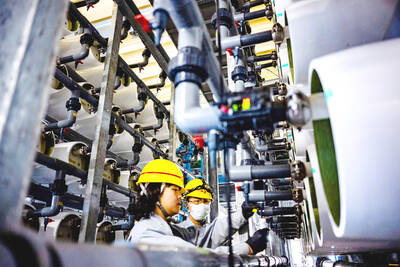
HIGH HOPES: The power source is expected to have a future, as it is not dependent on the weather or light, and could be useful for places with large desalination facilities A Japanese water plant is harnessing the natural process of osmosis to generate renewable energy that could one day become a common power source. The possibility of generating power from osmosis — when water molecules pass from a less salty solution to a more salty one — has long been known. However, actually generating energy from that has proved more complicated, in part due the difficulty of designing the membrane through which the molecules pass. Engineers in Fukuoka, Japan, and their private partners think they might have cracked it, and have opened what is only the world’s second osmotic power plant. It generates

Hundreds of Filipinos and tourists flocked to a sun-bleached field north of Manila yesterday, on Good Friday, to witness one of the country’s most blood-soaked displays of religious fervor, undeterred by rising fuel prices. Scores of bare-chested flagellants with covered faces walked barefoot through the dusty streets of Pampanga Province’s San Fernando as they flogged their backs with bamboo whips in the scorching heat. Agence France-Presse (AFP) journalists said they saw devotees deliberately puncturing their skin with glass shards attached to a small wooden paddle to ensure their bleeding during the ritual, a way to atone for sins and seek miracles from

Showcasing phallus-shaped portable shrines and pink penis candies, Japan’s annual fertility festival yesterday teemed with tourists, couples and families elated by its open display of sex. The spring Kanamara Matsuri near Tokyo features colorfully dressed worshipers carrying a trio of giant phallic-shaped objects as they parade through the street with glee. The festival, as legend has it, honors a local blacksmith in the Edo Period (1603-1868) who forged an iron dildo to break the teeth of a sharp-toothed demon inhabiting a woman’s vagina that had been castrating young men on their wedding nights. A 1m black steel phallus sits in the courtyard of


 RSS
RSS