


Here is a softer side to the disruptive weather phenomenon known as El Nino: An enormous blanket of colorful flowers has carpeted Chile’s Atacama Desert, the most arid in the world.
The cyclical warming of the central Pacific Ocean might be causing droughts and floods in various parts of the world, but in the vast desert of northern Chile it has also caused a vibrant explosion of thousands of species of flowers with an intensity not seen in decades.
Yellows, reds, purples and whites have covered the normally stark landscapes of the Atacama, where temperatures top 40oC this time of year.
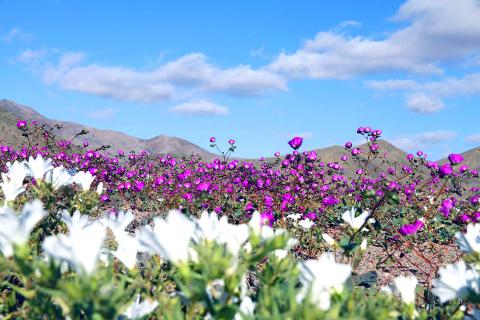
Photo: AFP
From violet-and-white Chilean bell flowers, or “countryside sighs” (Nolana paradoxa), and red “lion claws” (Bomarea ovallei) to yellow Rhodophiala rhodolirion, they have filled the normally pale desert valleys with rivers of color.
“This year has been particularly special, because the amount of rainfall has made this perhaps the most spectacular of the past 40 or 50 years,” University of Atacama desert specialist Raul Cespedes said.
El Nino, which wreaks havoc on world weather patterns every two to seven years, has hit particularly hard this year, causing unusually heavy rainfall in the world’s driest desert.
That has caused dormant flower bulbs and rhizomes — underground stems that grow horizontally — to germinate.
“When you think of the desert, you think of total dryness, but there’s a latent ecosystem here just waiting for certain conditions to arise,” Cespedes said.
The desert flowers are perhaps nature’s consolation for what has been a devastating year for Atacama.
They first bloomed in March, after heavy rains that caught the region by surprise and caused massive floods that killed more than 30 people.
They are now blooming for the second time this year, at the outset of the southern hemisphere’s summer.
“This is a very unusual phenomenon. Because of the floods in March there was an exceptional winter bloom, which had never before been recorded ... and then there was another bloom in spring,” Chilean National Tourism Service Director for the Atacama region Daniel Diaz said.
“Two flowerings a year is very unusual in the most arid desert in the world, and that’s something we’ve been able to enjoy this spring, along with people from all over the world. There’s a lot of interest in seeing it,” he told reporters.
The region has seen a 40 percent increase in tourists since the flowers began blooming.
“It is so unusual, yet so real,” said British tourist Edward Zannahand, who made a special stop in Atacama on what he described as a road trip around the world.


Showcasing phallus-shaped portable shrines and pink penis candies, Japan’s annual fertility festival yesterday teemed with tourists, couples and families elated by its open display of sex. The spring Kanamara Matsuri near Tokyo features colorfully dressed worshipers carrying a trio of giant phallic-shaped objects as they parade through the street with glee. The festival, as legend has it, honors a local blacksmith in the Edo Period (1603-1868) who forged an iron dildo to break the teeth of a sharp-toothed demon inhabiting a woman’s vagina that had been castrating young men on their wedding nights. A 1m black steel phallus sits in the courtyard of

JAN. 1 CLAUSE: As military service is voluntary, applications for permission to stay abroad for over three months for men up to age 45 must, in principle, be granted A little-noticed clause in sweeping changes to Germany’s military service policy has triggered an uproar after it emerged that the law requires men aged up to 45 to get permission from the armed forces before any significant stay abroad, even in peacetime. The legislation, which went into effect on Jan. 1 aims to bolster the military and demands all 18-year-old men fill out a questionnaire to gauge their suitability to serve in the armed forces, but stops short of conscription. If the “modernized” model fails to pull in enough recruits, parliament will be compelled to discuss the reintroduction of compulsory service, German
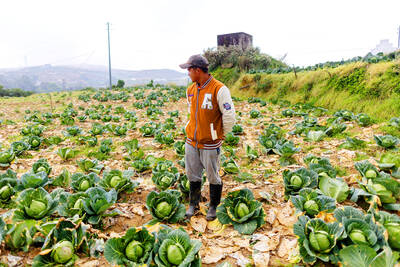
Filipino farmers like Romeo Wagayan have been left with little choice but to let their vegetables rot in the field rather than sell them at a loss, as rising oil prices linked to the Iran war drive up the cost of harvesting, labor and transport. “There’s nothing we can do,” said Wagayan, a 57-year old vegetable farmer in the northern Philippine province of Benguet. “If we harvest it, our losses only increase because of labor, transportation and packing costs. We don’t earn anything from it. That’s why we decided not to harvest at all,” he said. Soaring costs caused by the Middle East
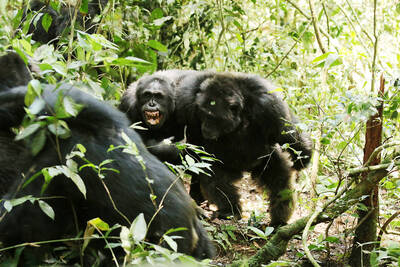
For two decades, researchers observed members of the Ngogo chimpanzee group of Kibale National Park in Uganda spend their days eating fruits and leaves, resting, traveling and grooming in their tropical rainforest abode, but this stable community then fractured and descended into years of deadly violence. The researchers are now describing the first clearly documented example of a group of wild chimpanzees splitting into two separate factions, with one launching a series of coordinated attacks against the other. Adult males and infants were targeted, with 28 deaths. “Biting, pounding the victim with their hands, dragging them, kicking them — mostly adult males,


 RSS
RSS