


British scientists announced trials on a 15-minute Ebola test in Guinea, while French President Francois Hollande became the first Western leader to visit a country devastated by the epidemic.
The prototype is six times faster than current tests and aims to speed up diagnosis, the London-based global research charity Wellcome Trust and Britain’s Department for International Development said in a statement.
“A reliable, 15-minute test that can confirm cases of Ebola would be a key tool for effective management of the Ebola outbreak, allowing patients to be identified, isolated and cared for as soon as possible,” Wellcome Trust spokesperson Val Snewin said.
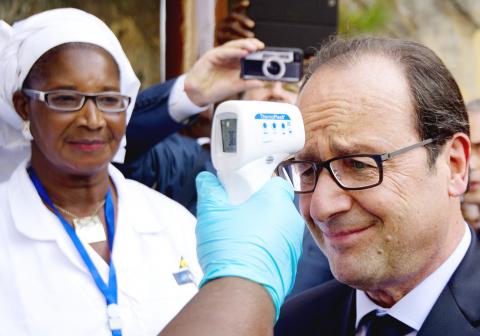
Photo: Reuters
She said the test was designed to be suitable for remote field hospitals, where electricity and cold storage are often scarce.
The trials, to be led by researchers from Dakar’s Pasteur Institute at an Ebola treatment center in Conakry in the coming weeks, will come as a welcome boon in Guinea, which has lost 1,200 people to Ebola.
The biggest Ebola epidemic on record has claimed about 5,700 lives in Guinea, Liberia and Sierra Leone since the beginning of the year, according to the WHO.
Hollande pledged his support for Guinea after arriving in the former French colony on Friday.
He said he was bringing with him a message of solidarity to healthcare workers who “take risks to ensure the highest quality care,” and a message of confidence, because “it was very important to tell the world that Guinea is still alive, still fighting.”
He also wanted to call for vigilance, he said, because “the battle against Ebola isn’t won.”
The visit is the first by a French president since 1999, and comes after France pledged 100 million euros (US$125 million) toward the fight against the epidemic in Guinea.
The money will help finance several care centers as well as 200 beds, some of which are reserved for health workers caring for the sick. France has also pledged to set up two training centers for health workers, one in France and one in Guinea.
Hollande visited healthcare workers at Conakry’s Donka Hospital, which hosts the city’s Doctors Without Borders Ebola treatment unit, alongside Guinean President Alpha Conde.
Before entering, both men followed the protocol of washing their hands and having their temperatures taken.
The French leader is also due to sign a cooperation agreement with Guinean authorities for the creation of a Pasteur Institute in Conakry by the end of 2016, the global medical research organization said on Thursday.
“For the people of Guinea, the arrival of President Hollande is a very, very important sign,” Conde said. “If the president of a country as important as France can come to Guinea, that means anyone can come to Guinea.”


When a hiker fell from a 55m waterfall in wild New Zealand bush, rescuers were forced to evacuate the badly hurt woman without her dog, which could not be found. After strangers raised thousands of dollars for a search, border collie Molly was flown to safety by a helicopter pilot who was determined to reunite the pet and the owner. A week earlier, an emergency rescue helicopter found the woman with bruises and lacerations after a fall at a rocky spot at the waterfall on the South Island’s West Coast. She was airlifted on March 24, but they were forced to
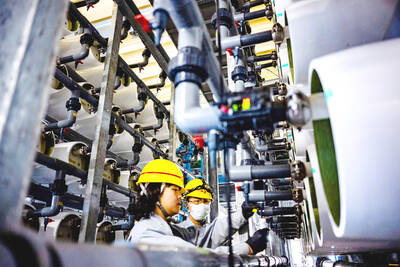
HIGH HOPES: The power source is expected to have a future, as it is not dependent on the weather or light, and could be useful for places with large desalination facilities A Japanese water plant is harnessing the natural process of osmosis to generate renewable energy that could one day become a common power source. The possibility of generating power from osmosis — when water molecules pass from a less salty solution to a more salty one — has long been known. However, actually generating energy from that has proved more complicated, in part due the difficulty of designing the membrane through which the molecules pass. Engineers in Fukuoka, Japan, and their private partners think they might have cracked it, and have opened what is only the world’s second osmotic power plant. It generates
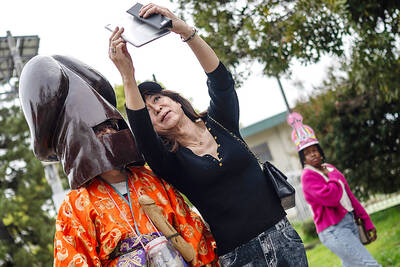
Showcasing phallus-shaped portable shrines and pink penis candies, Japan’s annual fertility festival yesterday teemed with tourists, couples and families elated by its open display of sex. The spring Kanamara Matsuri near Tokyo features colorfully dressed worshipers carrying a trio of giant phallic-shaped objects as they parade through the street with glee. The festival, as legend has it, honors a local blacksmith in the Edo Period (1603-1868) who forged an iron dildo to break the teeth of a sharp-toothed demon inhabiting a woman’s vagina that had been castrating young men on their wedding nights. A 1m black steel phallus sits in the courtyard of

JAN. 1 CLAUSE: As military service is voluntary, applications for permission to stay abroad for over three months for men up to age 45 must, in principle, be granted A little-noticed clause in sweeping changes to Germany’s military service policy has triggered an uproar after it emerged that the law requires men aged up to 45 to get permission from the armed forces before any significant stay abroad, even in peacetime. The legislation, which went into effect on Jan. 1 aims to bolster the military and demands all 18-year-old men fill out a questionnaire to gauge their suitability to serve in the armed forces, but stops short of conscription. If the “modernized” model fails to pull in enough recruits, parliament will be compelled to discuss the reintroduction of compulsory service, German


 RSS
RSS