


French special forces and local troops raided an army base on Friday in northern Niger, ending a hostage seizure by Islamist fighters who had staged twin suicide bombings that killed at least 20 people.
The dawn raid came after Signatories in Blood, a jihadist group that claimed Thursday’s blasts, threatened to continue attacking Niger until the country withdraws its forces from neighboring Mali, where they are part of a French-led military campaign against Islamists.
A French defense ministry official said two “terrorists” had been killed in the raid on a building at the Agadez army base, where Islamist fighters had holed up after the bombings and were holding a group of trainee soldiers hostage.
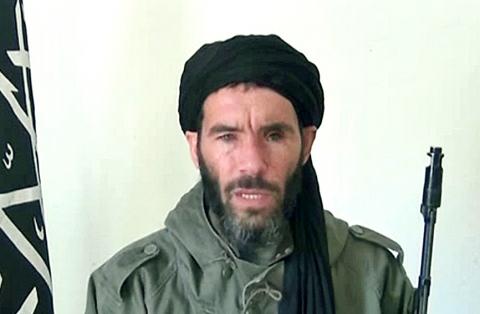
Photo: AFP
An elected official in Agadez, the main city in Niger’s mostly desert north, gave a higher toll, saying three “terrorists” and three hostages had been killed, as well as a civilian caught in the crossfire.
French Defence Minister Jean-Yves Le Drian confirmed France had taken part in the raid.
“The situation has stabilized as we speak, especially in Agadez, where our special forces intervened to back the Niger forces,” he said on France’s BFMTV.
Signatories in Blood, founded by veteran Algerian jihadist Mokhtar Belmokhtar, first grabbed worldwide attention in January when it seized an Algerian gas plant in a brazen attack that left 38 hostages dead.
Belmokhtar had been reported dead last month by Chadian President Idriss Deby, who said the one-eyed extremist had been killed in fighting with Chadian troops in northeastern Mali.
However, the jihadist group’s spokesman el-Hassen Ould Khalil was quoted as saying by a Mauritanian news agency that “it was Belmokhtar himself who supervised the operational plans” in the Niger attacks.
The group also warned of “further operations” in Niger and threatened France and other countries involved in what it called the “Crusader campaign” in Mali.
Thursday’s attack at the Agadez army base left 18 soldiers and one civilian dead, officials said.
French nuclear group Areva said a near-simultaneous suicide bombing at its majority-owned uranium mine in northern Arlit had killed one and injured 14 employees.
Adding to the differing death toll figures in Agadez since Thursday’s violence, Nigerien Defence Minister Mahamadou Karidjo, speaking on public radio, said a total of 24 troops and eight Islamist assailants had died in the fighting.
Areva president and chief executive officer Luc Oursel traveled to Niger on Friday to express his support for the victims and confirm the company’s commitment to the country.
“My visit here is a testament to the strength of our engagement in Niger,” he said in a statement.
An Areva employee said questions were still being asked as to how the attack could have happened considering “the impressive military and security apparatus” that was in place.
Meanwhile, Niger’s public television network broadcast images of the destruction at the military base, including pieces of the suicide bombers’ flesh strewn across the ground, debris from a four-by-four they blew up and roofs torn from buildings at the base.
Agadez residents said they were still reeling from the attacks, the first of their kind in the impoverished former French colony.
Signatories in Blood was the second group to claim the attacks.
The Movement for Oneness and Jihad in West Africa (MUJAO), one of three Islamist groups that seized northern Mali last year before French-led troops drove them out, also claimed responsibility on Thursday.
Signatories in Blood claimed the two groups had worked together and said Malian, Sudanese and Sahrawi or Western Saharan nationals had taken part.

Kouri Richins, a Utah mother who published a children’s book about grief after the death of her husband is to serve a life sentence for his murder without the possibility of parole, a judge ruled on Wednesday. Richins was convicted in March of aggravated murder for lacing a cocktail given to her husband, Eric Richins, with five times the lethal dose of fentanyl at their home near Park City in 2022. A jury also found her guilty of four other felonies, including insurance fraud, forgery and attempted murder for trying to poison her husband weeks earlier on Feb. 14, 2022, with a

DELA ROSA CASE: The whereabouts of the senator, who is wanted by the ICC, was unclear, while President Marcos faces a political test over the senate situation Philippine authorities yesterday were seeking confirmation of reports that a top politician wanted by the International Criminal Court (ICC) had fled, a day after gunfire rang out at the Philippine Senate where he had taken refuge fearing his arrest. Senator Ronald “Bato” dela Rosa, the former national police chief and top enforcer of former Philippine president Rodrigo Duterte’s “war on drugs,” has been under Senate protection and is wanted for crimes against humanity, the same charges Duterte is accused of. “Several sources confirmed that the senator, Senator Bato, is no longer in the Senate premises, but we are still getting confirmation,” Presidential

HELP DENIED? The US Department of State said that the Cuban leadership refuses to allow the US to provide aid to Cubans, ‘who are in desperate need of assistance’ US Secretary of State Marco Rubio on Wednesday said that Cuba’s leadership must change, as Washington renewed an offer of US$100 million in aid if the communist nation agrees to cooperate. Cuba has been suffering severe economic tumult led by an energy shortage that plunged 65 percent of the country into darkness on Tuesday. Cuba’s leaders have blamed US sanctions, but Rubio, a Cuban American and critic of the government established by Fidel Castro, said the system was to blame, including corruption by the military. “It’s a broken, nonfunctional economy, and it’s impossible to change it. I wish it were different,” he told

Myanmar yesterday published a parliamentary bill proposing the death sentence for those who detain or violently coerce people into working in online scam centers. Internet fraud factories have flourished in Myanmar, part of Southeast Asia’s scam economy, targeting Internet users worldwide with romance and cryptocurrency investment cons. The multibillion-dollar black market attracts many willing employees, but repatriated foreigners have also reported being trafficked to sites in Myanmar and tortured by scam center operators. The draft legislation would allow capital punishment for “violence, torture, unlawful arrest and detention, or cruel treatment against another person for the purpose of forcing them to commit online scams.” The


 RSS
RSS