


Ukraine’s jailing of former Ukrainian prime minister Yulia Tymoshenko was a politically motivated violation of her rights, the European Court of Human Rights ruled yesterday.
A Ukrainian ambassador stormed out of the courthouse in response to the ruling in a case that has strained the country’s ties with the EU and the US.
An architect of Ukraine’s 2004 pro-democracy Orange Revolution, Tymoshenko was sentenced to seven years in prison in October 2011 after being convicted of exceeding her powers as prime minister while negotiating a gas contract with Russia.
Tymoshenko has said her jailing was intended to keep her out of politics and that her rights were violated when she was first jailed in August 2011. The EU court agreed unanimously that her jailing was “for other reasons” than those permissible by law.
“It was not a criminal prosecution. There was another aim of that prosecution and everyone knows that that was a politically motivated prosecution,” said Serhiy Vlasenko, Tymoshenko’s lawyer.
He said the court found “the prosecution of Mrs Tymoshenko in Ukraine had nothing to do with the law, had nothing to do with democratic standards, had nothing to do with a criminal prosecution.”
It is unclear how a decision by the European court would be legally binding in Ukraine.
In Kiev, Nazar Kulchitsky, the Ukranian representative with the European Court of Human Rights, told the Interfax news agency that the government needs time to study the ruling, but suggested it might appeal. Both sides have three months to do so.
Tymoshenko and her allies charged that her jailing was masterminded by Ukrainian President Viktor Yanukovych to keep her out of politics, out of last year’s parliamentary elections and out of the 2015 presidential election.
Yanukovych has said that this was a legal matter he cannot interfere with. Over the weekend, a presidential pardon commission said it would not consider a motion to pardon Tymoshenko while other legal cases against her are ongoing — including some that could take years to resolve.


Showcasing phallus-shaped portable shrines and pink penis candies, Japan’s annual fertility festival yesterday teemed with tourists, couples and families elated by its open display of sex. The spring Kanamara Matsuri near Tokyo features colorfully dressed worshipers carrying a trio of giant phallic-shaped objects as they parade through the street with glee. The festival, as legend has it, honors a local blacksmith in the Edo Period (1603-1868) who forged an iron dildo to break the teeth of a sharp-toothed demon inhabiting a woman’s vagina that had been castrating young men on their wedding nights. A 1m black steel phallus sits in the courtyard of

JAN. 1 CLAUSE: As military service is voluntary, applications for permission to stay abroad for over three months for men up to age 45 must, in principle, be granted A little-noticed clause in sweeping changes to Germany’s military service policy has triggered an uproar after it emerged that the law requires men aged up to 45 to get permission from the armed forces before any significant stay abroad, even in peacetime. The legislation, which went into effect on Jan. 1 aims to bolster the military and demands all 18-year-old men fill out a questionnaire to gauge their suitability to serve in the armed forces, but stops short of conscription. If the “modernized” model fails to pull in enough recruits, parliament will be compelled to discuss the reintroduction of compulsory service, German
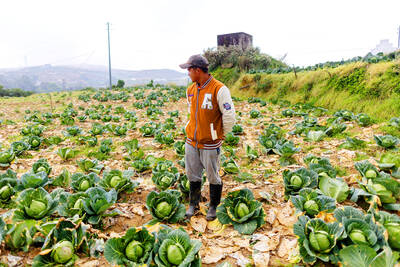
Filipino farmers like Romeo Wagayan have been left with little choice but to let their vegetables rot in the field rather than sell them at a loss, as rising oil prices linked to the Iran war drive up the cost of harvesting, labor and transport. “There’s nothing we can do,” said Wagayan, a 57-year old vegetable farmer in the northern Philippine province of Benguet. “If we harvest it, our losses only increase because of labor, transportation and packing costs. We don’t earn anything from it. That’s why we decided not to harvest at all,” he said. Soaring costs caused by the Middle East

For two decades, researchers observed members of the Ngogo chimpanzee group of Kibale National Park in Uganda spend their days eating fruits and leaves, resting, traveling and grooming in their tropical rainforest abode, but this stable community then fractured and descended into years of deadly violence. The researchers are now describing the first clearly documented example of a group of wild chimpanzees splitting into two separate factions, with one launching a series of coordinated attacks against the other. Adult males and infants were targeted, with 28 deaths. “Biting, pounding the victim with their hands, dragging them, kicking them — mostly adult males,


 RSS
RSS