


When the gas and electricity go off, a textiles factory in Rawalpindi is forced to burn wood to manufacture bed sheets, a sign of just how abysmal Pakistan’s energy crisis has become.
Forget Taliban attacks, chronic power outages are arguably the single biggest voter complaint, casting a long shadow over next month’s historic elections and tying political parties into knots of promises that are unlikely be met.
At the Kohinoor plant in Rawalpindi, a garrison city near the capital Islamabad, the generators are as big as homes, the machines sit idle for up to 14 hours a day and there is little hope of reprieve when Pakistan’s 85 million registered voters go the ballot box on May 11.
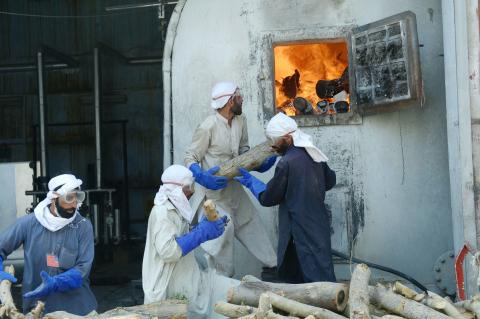
Photo: AFP
“It’s ridiculous” said Taufique Sayeed Saigol, director of the factory, which employs 4,000 people — 2,000 fewer than it used to — catering to an ever dwindling overseas client base.
In Pakistan, depending on where you live, there is no electricity for between eight and 16 hours a day. Most say the cuts are twice what they were five years ago when the Pakistan People’s Party (PPP) came to power in 2008.
“Yesterday the outage was roughly 10-and-a-half hours, and it stopped six times ... to restart a machine takes a long time. So the total loss yesterday was 13 to 14 hours,” Saigol said.
The factory needs gas to process, print and bleach fabric, but there is no gas four days a week, so instead they have set up a wood oven.
Production has declined and the company has lost valuable contracts, such as Wal-Mart Stores in the US.
The cause of the crisis is two-fold.
First, the country does not produce enough electricity. There is a shortfall of at least 2,400 megawatts a day in winter, more in summer when demand peaks.
Second, the government does not pay power generation companies for the electricity it does consume. The companies in turn cannot pay their overheads or afford to import power, and the supply stalls.
So-called circular debt reached at least US$4.4 billion in 2011-2012 and power cuts shaved 3 to 4 percent off GDP in the financial year 2010-2011, according to the government’s Planning Commission.
Pakistan also owes more than US$4 billion to the IMF in the next two years, its remaining debt from a loan to avert a balance of payments crisis in 2008.
The Asian Development Bank (ADB) says the energy crisis alone has deprived the country of 2 growth percentage points.
Werner Liepach, the director of the ADB in Pakistan, says the only solution is to go back to the IMF, which has conditioned further loans on tax reform, considered too unpalatable in the past.
Yet politicians on the campaign trail either ignore the enormity of the crisis or make unrealistic promises that airbrush pesky details.
“By and large, they all say the same thing,” Liepach said.
“They want to resolve the crisis. The issue is not what needs to be done, the issue is how to do it and I don’t think there is any clear roadmap,” he added.
The Pakistan Muslim League-N (PML-N) party of former Pakistani prime minister Nawaz Sharif, expected to win and traditionally supported by industrialists, say they can solve the crisis in two years.
The party has been running the regional government in Punjab for the last five years, where it too has presided over worsening cuts.
Imran Khan, the cricket hero whose Pakistan Tehreek-e-Insaf party is tipped for a breakthrough performance on an anti-corruption ticket, sets a five-year deadline to end the problem.
The PPP claims it needs just two-and-a-half years to end power shortages, begging the question as to why five years in office was not enough.
“I don’t believe anyone. No one does anything. They make promises and after two days they forget,” said taxi driver Muhammad Shahid, lining up for compressed natural gas, a popular alternative to gasoline, which is also in short supply.
Saigol is tight-lipped about his own voting intentions, but he does seem to know who his 4,000 staff and their families will not vote for.
“Do you think they will vote for someone who did not solve that crisis?” he said.


Showcasing phallus-shaped portable shrines and pink penis candies, Japan’s annual fertility festival yesterday teemed with tourists, couples and families elated by its open display of sex. The spring Kanamara Matsuri near Tokyo features colorfully dressed worshipers carrying a trio of giant phallic-shaped objects as they parade through the street with glee. The festival, as legend has it, honors a local blacksmith in the Edo Period (1603-1868) who forged an iron dildo to break the teeth of a sharp-toothed demon inhabiting a woman’s vagina that had been castrating young men on their wedding nights. A 1m black steel phallus sits in the courtyard of

JAN. 1 CLAUSE: As military service is voluntary, applications for permission to stay abroad for over three months for men up to age 45 must, in principle, be granted A little-noticed clause in sweeping changes to Germany’s military service policy has triggered an uproar after it emerged that the law requires men aged up to 45 to get permission from the armed forces before any significant stay abroad, even in peacetime. The legislation, which went into effect on Jan. 1 aims to bolster the military and demands all 18-year-old men fill out a questionnaire to gauge their suitability to serve in the armed forces, but stops short of conscription. If the “modernized” model fails to pull in enough recruits, parliament will be compelled to discuss the reintroduction of compulsory service, German
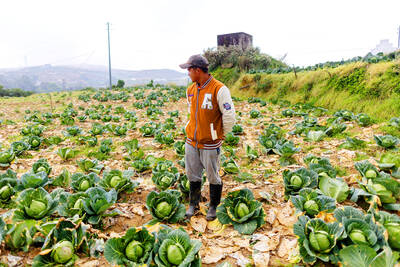
Filipino farmers like Romeo Wagayan have been left with little choice but to let their vegetables rot in the field rather than sell them at a loss, as rising oil prices linked to the Iran war drive up the cost of harvesting, labor and transport. “There’s nothing we can do,” said Wagayan, a 57-year old vegetable farmer in the northern Philippine province of Benguet. “If we harvest it, our losses only increase because of labor, transportation and packing costs. We don’t earn anything from it. That’s why we decided not to harvest at all,” he said. Soaring costs caused by the Middle East

For two decades, researchers observed members of the Ngogo chimpanzee group of Kibale National Park in Uganda spend their days eating fruits and leaves, resting, traveling and grooming in their tropical rainforest abode, but this stable community then fractured and descended into years of deadly violence. The researchers are now describing the first clearly documented example of a group of wild chimpanzees splitting into two separate factions, with one launching a series of coordinated attacks against the other. Adult males and infants were targeted, with 28 deaths. “Biting, pounding the victim with their hands, dragging them, kicking them — mostly adult males,


 RSS
RSS