


Woolly mammoths stomp through the Siberian tundra as the giant moa strides the forest floor of New Zealand and Tasmania’s dog-like “tigers” stalk their prey under the cover of night.
This is not a snapshot of times past, nor next year’s sequel to Steven Spielberg’s Jurassic Park. Instead, it is a scenario that some biogeneticists see as plausible in our own lifetimes: the resurrection of species driven to extinction.
On Thursday it will be 60 years since Francis Crick and James Watson published their paper unveiling the structure of DNA, the double-helix genetic code for life.
Today, some experts believe that by harnessing this breakthrough knowledge, the first extinct species could be revived within years. They could be cloned from genetic material teased from preserved tissues, with the reprogrammed egg implanted in a cousin species.
“For the gastric frog it would take maybe a year or two years. For a mammoth maybe 20, 30 years, maybe sooner,” evolutionary geneticist Hendrik Poinar of Canada’s McMaster University said of ongoing “de-extinction” efforts.
In 2009, researchers announced they had cloned a bucardo, also called a Pyrenean ibex, using DNA taken from the last member of this family of mountain goats before she died in 2000. This was the first cloned animal born from an extinct subspecies, but the success was mixed — the kid died within 10 minutes from a lung abnormality.
Just last month, a University of New South Wales team said it had cloned embryos of the gastric-brooding frog, which died out in 1983 and was named for its weird reproductive technique of swallowing its eggs, brooding them in its stomach and then spitting out the offspring. The embryos died within a few days.
In Japan, geneticists said in 2011 they planned to use DNA from frozen carcasses to resurrect within six years the woolly mammoth which died out during the last Ice Age.
And in Britain, Oxford University scientists have obtained genetic data from museum-held remains of the dodo, the flightless bird hunted to extinction by 1680.
Scientists believe reconstruction would be feasible for most animals for which DNA has survived, possibly going back 200,000 years — a limit that would exclude a Jurassic Park-like revival of the dinosaurs.
The DNA sample would have to be well preserved and techniques would have to improve to reduce the risk of deformity, miscarriage and premature death, a characteristic of animal cloning today.
“I could envision that if there were no laws preventing it and the ethics had been worked, out, swathes of land in Siberia repopulated with mammoths and cave lions,” Poinar said.
London School of Economics sociologist Carrie Friese fears that ethics have been left by the wayside in the rush to resurrect. Many animals went extinct exactly because their natural habitats were destroyed, she said.
Lacking a broad gene pool to adapt to the wild, their cloned progeny could find themselves doomed to life as museum exhibits. Nor would they have authentic parents to socialize them or teach them to how to fly, forage or hunt.
“An animal is more than its genome,” Friese said. “How does a dodo learn to be a dodo?”
Stanford University bioethicist Hank Greely is one of those who enthusiastically favor species resurrection. However, he also cautioned against inflicting inappropriate, excessive pain and suffering in the scientific quest.
Others say de-extinction efforts divert time and money from preserving endangered species.
Transparent debate, not scientific stealth or hubris, offers the only path through this minefield, Poinar said.


Showcasing phallus-shaped portable shrines and pink penis candies, Japan’s annual fertility festival yesterday teemed with tourists, couples and families elated by its open display of sex. The spring Kanamara Matsuri near Tokyo features colorfully dressed worshipers carrying a trio of giant phallic-shaped objects as they parade through the street with glee. The festival, as legend has it, honors a local blacksmith in the Edo Period (1603-1868) who forged an iron dildo to break the teeth of a sharp-toothed demon inhabiting a woman’s vagina that had been castrating young men on their wedding nights. A 1m black steel phallus sits in the courtyard of

JAN. 1 CLAUSE: As military service is voluntary, applications for permission to stay abroad for over three months for men up to age 45 must, in principle, be granted A little-noticed clause in sweeping changes to Germany’s military service policy has triggered an uproar after it emerged that the law requires men aged up to 45 to get permission from the armed forces before any significant stay abroad, even in peacetime. The legislation, which went into effect on Jan. 1 aims to bolster the military and demands all 18-year-old men fill out a questionnaire to gauge their suitability to serve in the armed forces, but stops short of conscription. If the “modernized” model fails to pull in enough recruits, parliament will be compelled to discuss the reintroduction of compulsory service, German
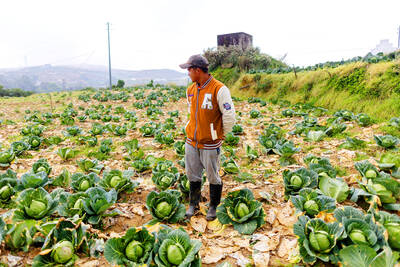
Filipino farmers like Romeo Wagayan have been left with little choice but to let their vegetables rot in the field rather than sell them at a loss, as rising oil prices linked to the Iran war drive up the cost of harvesting, labor and transport. “There’s nothing we can do,” said Wagayan, a 57-year old vegetable farmer in the northern Philippine province of Benguet. “If we harvest it, our losses only increase because of labor, transportation and packing costs. We don’t earn anything from it. That’s why we decided not to harvest at all,” he said. Soaring costs caused by the Middle East

Hungarian Prime Minister Viktor Orban’s officially declared wealth is fairly modest: some savings and a jointly owned villa in Budapest. However, voters in what Transparency International deems the EU’s most corrupt country believe otherwise — and they might make Orban pay in a general election this Sunday that could spell an end to his 16-year rule. The wealth amassed by Orban’s inner circle is fueling the increasingly palpable frustration of a population grappling with sluggish growth, high inflation and worsening public services. “The government’s communication machine worked well as long as our economic situation remained relatively good,” said Zoltan Ranschburg, a political analyst


 RSS
RSS