


Myanmar’s government has appointed a commission led by opposition leader Aung San Suu Kyi to investigate the recent violent dispersal of peaceful protesters at a copper mine and advise whether the project should continue.
State television announced on Saturday that the 30-member commission was created by a presidential order.
Security forces on Thursday ousted protesters at the Letpadaung mine near Monywa in northwestern Myanmar. Dozens of villagers and Buddhist monks were hurt, mostly with burns they said were caused by incendiary devices. The crackdown was the biggest use of force against demonstrators since the reformist government of Burmese President Thein Sein took office last year.
The protesters say the mine is causing environmental, social and health problems. The project is a joint venture between a Chinese firm and a company controlled by Myanmar’s military.
The appointment of Aung San Suu Kyi, a Nobel Peace Prize laureate, to head the probe gives it credibility that the army-backed government lacks, even though political and economic liberalization under Thein Sein has won praise from Western governments, which have eased sanctions imposed on the previous military government because of its poor record on human and civil rights.
Many in Myanmar remain suspicious of the military and regard China as an aggressive and exploitative investor that helped support its rule.
Aung San Suu Kyi visited the area after the crackdown, meeting with mining company officials, activists and injured protesters, as well as security officials.
In speeches to residents, she said the use of force was not justified, but also suggested that protesters might have to compromise on the mine issue because Myanmar was honor-bound to respect contracts, even if they were done under the previous military regime.
Government officials have said repeatedly that shutting down the project could scare off much-needed foreign investment.
Monks were among the most seriously wounded protesters, many with severe burns, and fellow monks have been holding protests to demand an apology from the authorities.
Monks are widely admired for their social activism as well as for their spiritual beliefs in deeply religious Myanmar.
The previous military government cracked down violently on monks who were leading pro-democracy protests in 2007 that came to be known as the “saffron revolution,” from the color of their robes.
In a possible sign of government nervousness about possible unrest, police in Yangon on Saturday night detained a prominent former activist monk, Shin Gambira, his mother said.
Shin Gambira, whose lay name is Nyi Nyi Lwin, played a prominent role in the 2007 demonstrations until he was arrested. He was released from prison in January.
It was unclear whether his detention on Saturday was related to protests in Yangon against the crackdown at the Letpadaung mine.
State television also reported that a group of police paid respects to senior Buddhist monks in Monywa on Saturday and “expressed sorrow over the accidental injury caused by tear gas during the handling of protest,” explaining that they were carrying out their duties.
Many monks said they were not satisfied with the police expression of regret.
“We will not accept this kind of apology. They did not invite any monks who were involved in the protest or injured in the crackdown but only apologized to senior monks who did not even visit the injured monks,” said U Pandita, a monk from the Monywa monastery.
U Pandita welcomed the creation of Aung San Suu Kyi’s investigating commission, but said authorities must reveal who ordered the crackdown.
“Buddha teaches us to forgive, but how we can forgive without an apology to us?” said Shin Nanda Thara of the Bawdi Mandaing Monastery in Pakkoku township. “It’s like treating the wound with the wrong medicine.”
The announcement said the commission is tasked with assessing the reasons for the protests against the mine, the handling of the protests and whether the mine should continue to operate. It is to submit its findings by Dec. 31.

Kouri Richins, a Utah mother who published a children’s book about grief after the death of her husband is to serve a life sentence for his murder without the possibility of parole, a judge ruled on Wednesday. Richins was convicted in March of aggravated murder for lacing a cocktail given to her husband, Eric Richins, with five times the lethal dose of fentanyl at their home near Park City in 2022. A jury also found her guilty of four other felonies, including insurance fraud, forgery and attempted murder for trying to poison her husband weeks earlier on Feb. 14, 2022, with a
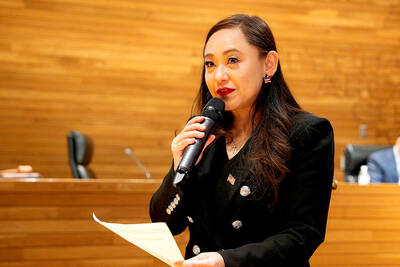
‘PERSONAL MISTAKES’: Eileen Wang has agreed to plead guilty to the felony, which comes with a maximum sentence of 10 years in federal prison A southern California mayor has agreed to plead guilty to acting as an illegal agent for the Chinese government and has resigned from her city position, officials said on Monday. Eileen Wang (王愛琳), mayor of Arcadia, was charged last month with one count of acting in the US as an illegal agent of a foreign government. She was accused of doing the bidding of Chinese officials, such as sharing articles favorable to Beijing, without prior notification to the US government as required by law. The 58-year-old was elected in November 2022 to a five-person city council, from which the mayor is selected
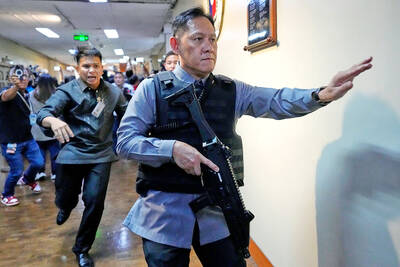
DELA ROSA CASE: The whereabouts of the senator, who is wanted by the ICC, was unclear, while President Marcos faces a political test over the senate situation Philippine authorities yesterday were seeking confirmation of reports that a top politician wanted by the International Criminal Court (ICC) had fled, a day after gunfire rang out at the Philippine Senate where he had taken refuge fearing his arrest. Senator Ronald “Bato” dela Rosa, the former national police chief and top enforcer of former Philippine president Rodrigo Duterte’s “war on drugs,” has been under Senate protection and is wanted for crimes against humanity, the same charges Duterte is accused of. “Several sources confirmed that the senator, Senator Bato, is no longer in the Senate premises, but we are still getting confirmation,” Presidential
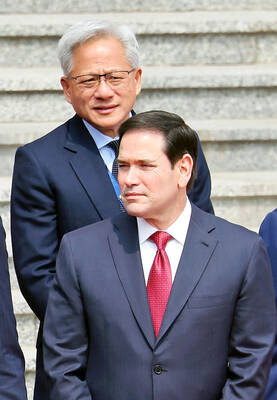
HELP DENIED? The US Department of State said that the Cuban leadership refuses to allow the US to provide aid to Cubans, ‘who are in desperate need of assistance’ US Secretary of State Marco Rubio on Wednesday said that Cuba’s leadership must change, as Washington renewed an offer of US$100 million in aid if the communist nation agrees to cooperate. Cuba has been suffering severe economic tumult led by an energy shortage that plunged 65 percent of the country into darkness on Tuesday. Cuba’s leaders have blamed US sanctions, but Rubio, a Cuban American and critic of the government established by Fidel Castro, said the system was to blame, including corruption by the military. “It’s a broken, nonfunctional economy, and it’s impossible to change it. I wish it were different,” he told


 RSS
RSS