


Watch out China and Canada, “Made in America” has an attractive ring to it these days.
Four years after the height of the financial crisis, marked by a drastic drop in salaries, the US is again finding favor among manufacturers.
Out on the campaign trail ahead of the Nov. 6 elections, US President Barack Obama has picked up on the point to convince voters that the US economy is back on track.
“After years of undercutting the competition, now it’s getting more expensive to do business in places like China,” he said in May, adding that both wages and shipping costs were up in the single-party state known for attracting foreign firms that often subsequently cut jobs back home.
“American workers are getting more and more efficient. Companies located here are becoming more and more competitive. So for a lot of businesses, it’s now starting to make sense to bring jobs back home,” Obama said.
According to a Boston Consulting Group survey, and referenced by Obama, 48 percent of executives at companies with US$10 billion or more in revenues said they plan to bring back production to the US from China — or are considering it.
Officials at 106 firms from a range of industries responded to the poll, released in April.
“Companies are realizing that the economics of manufacturing are swinging in favor of the US, for goods to be sold both at home and to major export markets,” Harold Sirkin, a BCG senior partner, said. “This trend is likely to accelerate starting around 2015.”
With weeks to go before balloting begins, both the president and his Republican rival, Mitt Romney, have taken aim at China, with Obama seeking WTO action against Chinese auto subsidies.
Romney has vowed a much tougher line on China if he wins, including declaring that Beijing is manipulating its currency to make its exports artificially cheaper.
Obama has renewed his charge that Romney, as a multimillionaire businessman at his private equity firm Bain Capital, was an early pioneer in advising US corporations to outsource blue-collar jobs to low wage economies overseas.
Politics aside, the tendency to relocate is a long process centered on growth prospects in the US and “a lot of manufacturers have made a strong point of being closer to their customers,” Adam Fleck, an economist at Morningstar, said.
Not to be forgotten is the prospect of cheap and abundant energy thanks to a shale gas boom in the US.
Among those who have made the move are construction equipment maker Terex and Agco, a manufacturer of agricultural machines, according to Fleck.
Even giants such as General Electric (GE) and Caterpillar, while they may not have reduced their China production, are more likely now than a few years ago to expand their operations stateside.
“Since 2009, GE has announced plans to create more than 15,500 American jobs and is building 15 new factories in the US,” company spokesman Sebastien Duchamp said.
He said that the firm had added 10,000 jobs last year alone.
Salary cuts in a number of sectors aimed at preserving jobs, especially in the car industry, have also prompted large US businesses to repatriate production from Canada to south of the border.


When a hiker fell from a 55m waterfall in wild New Zealand bush, rescuers were forced to evacuate the badly hurt woman without her dog, which could not be found. After strangers raised thousands of dollars for a search, border collie Molly was flown to safety by a helicopter pilot who was determined to reunite the pet and the owner. A week earlier, an emergency rescue helicopter found the woman with bruises and lacerations after a fall at a rocky spot at the waterfall on the South Island’s West Coast. She was airlifted on March 24, but they were forced to
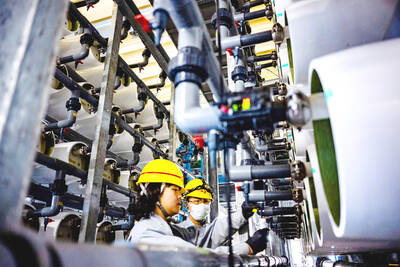
HIGH HOPES: The power source is expected to have a future, as it is not dependent on the weather or light, and could be useful for places with large desalination facilities A Japanese water plant is harnessing the natural process of osmosis to generate renewable energy that could one day become a common power source. The possibility of generating power from osmosis — when water molecules pass from a less salty solution to a more salty one — has long been known. However, actually generating energy from that has proved more complicated, in part due the difficulty of designing the membrane through which the molecules pass. Engineers in Fukuoka, Japan, and their private partners think they might have cracked it, and have opened what is only the world’s second osmotic power plant. It generates

Showcasing phallus-shaped portable shrines and pink penis candies, Japan’s annual fertility festival yesterday teemed with tourists, couples and families elated by its open display of sex. The spring Kanamara Matsuri near Tokyo features colorfully dressed worshipers carrying a trio of giant phallic-shaped objects as they parade through the street with glee. The festival, as legend has it, honors a local blacksmith in the Edo Period (1603-1868) who forged an iron dildo to break the teeth of a sharp-toothed demon inhabiting a woman’s vagina that had been castrating young men on their wedding nights. A 1m black steel phallus sits in the courtyard of

JAN. 1 CLAUSE: As military service is voluntary, applications for permission to stay abroad for over three months for men up to age 45 must, in principle, be granted A little-noticed clause in sweeping changes to Germany’s military service policy has triggered an uproar after it emerged that the law requires men aged up to 45 to get permission from the armed forces before any significant stay abroad, even in peacetime. The legislation, which went into effect on Jan. 1 aims to bolster the military and demands all 18-year-old men fill out a questionnaire to gauge their suitability to serve in the armed forces, but stops short of conscription. If the “modernized” model fails to pull in enough recruits, parliament will be compelled to discuss the reintroduction of compulsory service, German


 RSS
RSS