


As the streets of Gaza exploded with celebration on Friday night with masked Hamas militants marching defiantly to cheer the resignation of Egyptian president Hosni Mubarak, Israelis reacted with quiet and deep concern because the regional leader on whom they had relied most was suddenly gone.
The government of Israeli Prime Minister Benjamin Netanyahu maintained the same studied silence it has sustained for more than two weeks on the assumption that nothing it said could serve its interests: If it praised the pro-democracy movement, it would be seen as disloyal to its ally, Mubarak. If it favored Mubarak, it would be dismissed as a supporter of dictatorships.
However, behind the scenes, officials willing to share their thoughts anonymously expressed worry because they believed that whoever followed Mubarak would be less friendly to Israel.
“We don’t know who will be running things in the coming months in Egypt, but we have to keep two things in mind,” one top official said. “The first is that the only example we have of this kind of thing in the region is Iran in 1979. You can’t take that out of your mind. The second is that if Egypt pulls back in any way from its peace with Israel, it will discourage anyone else in the region, including the Palestinians, from stepping forward. So the regional implications for us are significant.”
The official said it was more likely than not that Egypt would maintain its peace treaty with Israel and added that, in any case, relations with Israel would probably not be among the first concerns of the incoming Egyptian authorities.
Egyptian Vice President Omar Suleiman, the former head of Egyptian intelligence, has longstanding relations with Israel and is respected there. However, his role seems subordinate, at best, to the military council that appears to be running Egypt. Still, relations between the Israeli and Egyptian defense establishments have long been cordial. However, officials worry that cooperative efforts could slow or halt.
Last week, Netanyahu did speak publicly in Jerusalem about Egypt before a group called the European Friends of Israel. He laid out three possible situations if Mubarak resigned.
“There are many possible outcomes beyond the liberal, democratic models that we take for granted in our own countries,” he said.
“First, Egyptians may choose to embrace the model of a secular reformist state with a prominent role for the military. There is a second possibility that the Islamists exploit the influence to gradually take the country into a reverse direction — not towards modernity and reform, but backward,” he said.
“And there’s still a third possibility — that Egypt would go the way of Iran, where calls for progress would be silenced by a dark and violent despotism that subjugates its own people and threatens everyone else,” he said.
Benjamin Ben-Eliezer, a former Israeli defense minister who is a longtime friend of Mubarak, said by telephone — and on Israeli television — that he had spoken with Mubarak hours before his Thursday night speech to the nation. Mubarak, he said, seemed to know he had no choice but to leave and Ben-Eliezer agreed. However, Mubarak saw great peril ahead.
“He spoke about a snowball that was starting to roll, which would not leave a single Arab state untouched in either the Middle East or North Africa,” Ben-Eliezer said. “He spoke of his disappointment with the Americans. He said: ‘You will have to grow accustomed to one fact — that you’re going to live in a radical Islamic world, and no one can promise what will happen tomorrow.’ For me, he was one of the pillars of the peace process.”
Israel’s strategic outlook -relies in some fashion on its three--decade peace with Egypt. Thanks to the treaty, its military has minimal presence on its southern border, freeing it up for actions to the east and north; about 40 percent of Israel’s natural gas is imported from Egypt; Egypt has been supportive and helpful in negotiating with the Palestinians; and Egypt has played a big role in stopping the smuggling of weapons and militants into Gaza, and in helping Israel in its blockade policy aimed at squeezing Hamas.
The other regional countries that have diplomatic relations with Israel — Jordan and Turkey — have cooled significantly in recent years, especially after Israel’s 2006 war in Lebanon and its 2008 to 2009 war in Gaza.
The marches in Gaza on Friday, a rare open display by armed uniformed militants on the streets, showed that the Egyptian policy toward Hamas would probably change and that it had, in fact, already loosened. The border has been breached repeatedly in the past two weeks by Hamas, which has brought back its militants from Egyptian prisons. Hamas officials are calling on Egypt to open its border with Gaza completely.
And last weekend, a gas pipeline in the Sinai exploded, apparently as a result of sabotage, disrupting the supply to Israel and Jordan.
The marchers in Gaza chanted against Mubarak and against Palestinian President Mahmoud Abbas, whom they consider a traitor. One of Israel’s fears is that the decline of Mubarak will strengthen Hamas and weaken the more moderate Palestinian Authority.
Eli Shaked, a former Israeli ambassador to Cairo, gave a bleak analysis of Egypt’s prospects to move toward democracy, saying by telephone that it had too few institutions, educated people and political parties to move to a democratic system. He feared that the only force organized enough to take over was the Muslim Brotherhood, which he described as anti-US, anti-Israel and anti-peace.

Kouri Richins, a Utah mother who published a children’s book about grief after the death of her husband is to serve a life sentence for his murder without the possibility of parole, a judge ruled on Wednesday. Richins was convicted in March of aggravated murder for lacing a cocktail given to her husband, Eric Richins, with five times the lethal dose of fentanyl at their home near Park City in 2022. A jury also found her guilty of four other felonies, including insurance fraud, forgery and attempted murder for trying to poison her husband weeks earlier on Feb. 14, 2022, with a
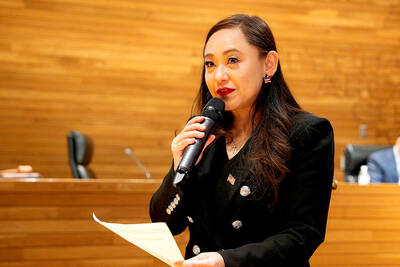
‘PERSONAL MISTAKES’: Eileen Wang has agreed to plead guilty to the felony, which comes with a maximum sentence of 10 years in federal prison A southern California mayor has agreed to plead guilty to acting as an illegal agent for the Chinese government and has resigned from her city position, officials said on Monday. Eileen Wang (王愛琳), mayor of Arcadia, was charged last month with one count of acting in the US as an illegal agent of a foreign government. She was accused of doing the bidding of Chinese officials, such as sharing articles favorable to Beijing, without prior notification to the US government as required by law. The 58-year-old was elected in November 2022 to a five-person city council, from which the mayor is selected

DELA ROSA CASE: The whereabouts of the senator, who is wanted by the ICC, was unclear, while President Marcos faces a political test over the senate situation Philippine authorities yesterday were seeking confirmation of reports that a top politician wanted by the International Criminal Court (ICC) had fled, a day after gunfire rang out at the Philippine Senate where he had taken refuge fearing his arrest. Senator Ronald “Bato” dela Rosa, the former national police chief and top enforcer of former Philippine president Rodrigo Duterte’s “war on drugs,” has been under Senate protection and is wanted for crimes against humanity, the same charges Duterte is accused of. “Several sources confirmed that the senator, Senator Bato, is no longer in the Senate premises, but we are still getting confirmation,” Presidential
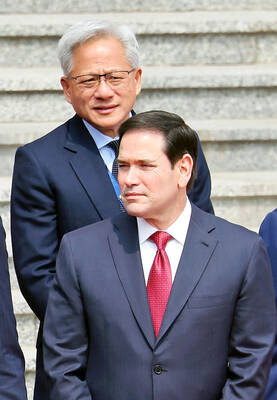
HELP DENIED? The US Department of State said that the Cuban leadership refuses to allow the US to provide aid to Cubans, ‘who are in desperate need of assistance’ US Secretary of State Marco Rubio on Wednesday said that Cuba’s leadership must change, as Washington renewed an offer of US$100 million in aid if the communist nation agrees to cooperate. Cuba has been suffering severe economic tumult led by an energy shortage that plunged 65 percent of the country into darkness on Tuesday. Cuba’s leaders have blamed US sanctions, but Rubio, a Cuban American and critic of the government established by Fidel Castro, said the system was to blame, including corruption by the military. “It’s a broken, nonfunctional economy, and it’s impossible to change it. I wish it were different,” he told


 RSS
RSS