


A storm system moved toward the Gulf of Mexico oil spill area yesterday, forcing response crews to head inland for safety and halting work to plug the ruptured BP well.
Tropical depression Bonnie sent crews packing aboard 11 offshore platforms, a container ship and two rigs, as the evacuation also suspended at least 28 percent of Gulf oil production.
Officials said a cap that has kept oil from escaping the blown out BP well since last Thursday would stay in place, after a week of tests suggested pressure would not force oil out through new leaks.
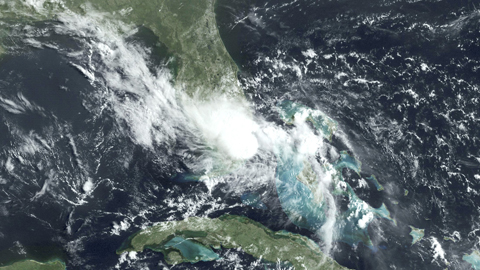
PHOTO: REUTERS
Thad Allen, the US official overseeing the spill response, said the evacuation would set back efforts to finally “kill” the leaking well by several days, and could leave the cap unmonitored until the storm passes.
With the safety of workers at the well site a top concern, Allen said the rough weather had forced crews to collect boom and return ships to shore and some of the 2,000-strong crew responding to the spill headed back to land.
“The intention right now is to put the vessels in a safe place so they can return as quickly as possible to resume their operations,” he told reporters.
He said officials estimated that “if we abandon the scene, it would be 48 hours before we would be back on.”
The oncoming storm has forced a halt to the process of concreting the casing on the first of two relief wells.
Once concrete can be set, a process expected to take two days, officials hope to perform a “static kill” to plug the well by injecting heavy drilling mud and cement through the cap at the top.
The final operation to cement the reservoir through a relief well will take another week, Allen said.
Crews began preparing for the storm on Thursday, after forecasters said Bonnie could affect the entire northern Gulf Coast.
Bonnie struck south Florida as a tropical storm early on Friday, weakening into a tropical depression before it headed out over the Gulf, where the US National Hurricane Center (NHC) forecast it would strengthen again.
The center of the depression was about 135km southwest of Sarasota, Florida, early yesterday, the center said. While not expected to grow into a hurricane, Bonnie has renewed concern about severe storms hampering oil clean-up operations and worsening conditions along the coast, where 1,012km of shoreline have been oiled across all five US states on Gulf Coast.
The NHC predicted Bonnie would hit the northern Gulf Coast late yesterday, raising water levels by up to 1.5m above ground level.
Allen said the storm might be mild enough to allow some vessels to remain at the well site.
“The seismic survey vessels, the acoustic vessels and the vessels operating the ROVs [underwater robots] will stay as long as possible, and if conditions allow it they will remain through the passage of the storm,” he said.
But if the ships are forced to depart, engineers will have no real-time information about the state of the wellbore below the sealing cap.
Hydrophones will take recordings, but Allen said the information could only be analyzed after the fact.
Separately, a former rig worker told federal investigators that an alarm that should have alerted Deepwater Horizon workers to a deadly build-up of gas had been muted months before the April 20 explosion that sank the rig.
The system, which uses lights and alarms to warn of fire or high levels of toxic or explosive gases, had been “inhibited,” Mike Williams, the chief electronics technician on the rig, told a hearing looking into the disaster.
Rig owner Transocean sought to rebut Williams’s testimony, insisting the configuration was “intentional” and conformed to maritime practice.

‘CROSSING THE LINE’: China’s embassy in Seoul criticized US Forces Korea Commander General Xavier Brunson, asking if his ‘hostile’ remarks were authorized by Washington South Korea and the US are in talks over recent public remarks by the commander of US Forces Korea, Seoul’s presidential office said yesterday, after the comments drew sharp criticism from China. In a recent podcast interview, US Forces Korea Commander General Xavier Brunson described South Korea as “the dagger in the heart of Asia” from China’s east coast, prompting the Chinese embassy in Seoul to say that he had “truly crossed the line.” The interview came amid growing speculation that Washington might seek to expand the role of US Forces Korea in countering the growing regional influence of China, a key

Through the noise of rushing papers and whirring belts at a print factory in Kyoto, two creators watch their photo essay come to life in broadsheet form — part of an effort to win new audiences in the age of artificial intelligence (AI). Despite the decline of the publishing industry, self-publication and handmade “zine” magazines are growing in popularity in Japan, reflecting the nation’s enduring love of paper in the digital era. While speaking to Agence France-Presse at the plant, his hands black with ink, one of the creators, Kazuma Obara, said: “I think [paper] is a medium that engages all five

Australian researchers have trained lab-grown brain cells on a silicon computer chip to play the 1990s shooter game Doom and said they are just scratching the surface of what the neurons could be capable of doing. It is the science-fiction work of biotech boffins at Cortical Labs, who researched and developed the technology that harnesses the workings of the brain’s networking system. Each so-called “biological computer” contains about 200,000 living human brain cells, grown from stem cells that were harvested from blood donations. Having mastered the simple computer game Pong, where a paddle is moved up and down to send a ball

France experienced its hottest spring on record, the French weather service said on Tuesday, after an exceptional early heat wave that also broke highs for the season in England and Wales. Meteo-France said the average nationwide temperature over March to May was 13.8°C — about 1.7°C above the norm, and surpassing records set in 2011 and 2020. “The warmest spring since records began in 1900,” it said in a bulletin. All three months were warmer than average, but the onset of an “unprecedented heatwave” late last month pushed the mercury to highs typically seen at the height of the summer. “Our country had never


 RSS
RSS