


Indonesia yesterday began enforcing its newly ratified penal code, replacing a Dutch-era criminal law that had governed the country for more than 80 years and marking a major shift in its legal landscape.
Since proclaiming independence in 1945, the Southeast Asian country had continued to operate under a colonial framework widely criticized as outdated and misaligned with Indonesia’s social values. Efforts to revise the code stalled for decades as lawmakers debated how to balance human rights, religious norms and local traditions in the world’s most populous Muslim-majority nation.
The 345-page Indonesian Penal Code, known as the KUHP, was passed in 2022. It criminalizes sex outside marriage, which applies to citizens and foreign visitors, and reintroduces penalties for insulting the president and state institutions. It comes into force following a three-year transition period.
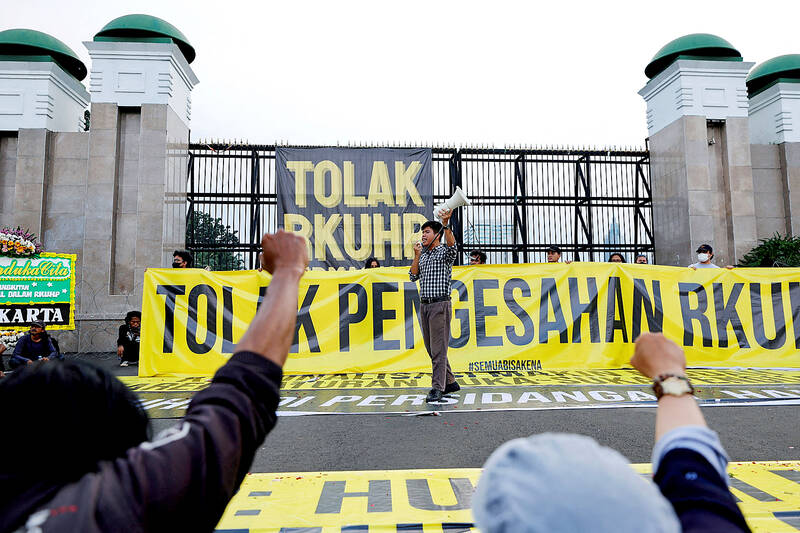
Photo: Reuters
Indonesian Deputy Minister of Law Edward Hiariej has defended the reforms as a modernization effort that shifts Indonesia’s criminal justice paradigm toward corrective, restorative and rehabilitative justice.
“The new criminal code prioritizes repairing harm and social reintegration, rather than relying solely on punishment,” Hiariej said during a briefing on the new penal code on Thursday.
Indonesia is also preparing a new criminal procedural law aimed at addressing procedural inefficiencies and improving human rights protections.
Together, the reforms represent a comprehensive overhaul of the justice system, Hiariej said.
Under the amended code, sex outside marriage is punishable by up to one year in prison, while cohabitation carries a six-month sentence. However, adultery cases can only proceed following a complaint by a spouse, parents or children — a safeguard the government says prevents arbitrary enforcement, including against tourists.
Rights groups remain skeptical.
The Human Rights Watch warned that the morality-based provisions could lead to invasions of privacy and selective enforcement.
The code also restores a ban on insulting a sitting president or vice president, state institutions and the national ideology. Cases must be reported by the president and carry penalties of up to three years in prison for “attacking the honor or dignity” of state leaders.
Amnesty International Indonesia executive director Usman Hamid described the KUHP as “a significant blow” to civil liberties.
“This overreaching criminal code will entrench obstacles to freedom of speech while criminalizing legitimate and peaceful dissent,” Hamid said, warning it could open the door to abuse of power.
The new code also expands an existing blasphemy law, maintaining prison sentences of up to five years for deviations from the core teachings of Indonesia’s six officially recognized religions. It preserves penalties of up to 10 years for associating with Marxist-Leninist organizations and four years for spreading communist ideology.
Some advocates welcomed lawmakers’ decision to drop a proposed article that would have criminalized gay sex, following opposition from civil society groups. The move was hailed as a rare positive outcome for Indonesia’s LGBTQ community.
The revised code retains the death penalty, despite calls from rights groups to abolish capital punishment. However, it introduces a 10-year probationary period, after which death sentences may be commuted to life imprisonment or 20 years if the convict demonstrates good behavior.
It also maintains a ban on abortion while formalizing existing exceptions for life-threatening medical conditions and pregnancies resulting from rape, provided the fetus is less than 12 weeks old.
Legal experts said the KUHP reflects a fundamental change in how punishment is applied.
Hiariej said that public opinion still often favors harsh penalties, a mindset he described as rooted in outdated notions of retribution.
“This is a legacy of the law of retaliation,” he said, contrasting it with modern systems that emphasize harm repair and reintegration.

Through the noise of rushing papers and whirring belts at a print factory in Kyoto, two creators watch their photo essay come to life in broadsheet form — part of an effort to win new audiences in the age of artificial intelligence (AI). Despite the decline of the publishing industry, self-publication and handmade “zine” magazines are growing in popularity in Japan, reflecting the nation’s enduring love of paper in the digital era. While speaking to Agence France-Presse at the plant, his hands black with ink, one of the creators, Kazuma Obara, said: “I think [paper] is a medium that engages all five
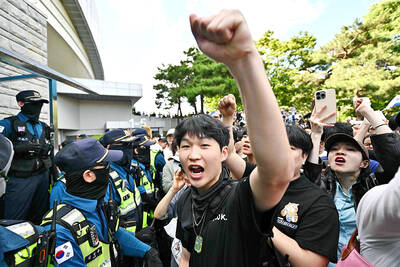
‘ABSURD MISTAKE’: The election commission said that there had been a failure to anticipate turnout after 14 polling stations ran short of ballot papers South Korean riot police yesterday cleared protesters from a Seoul polling station after a 35-hour blockade sparked by a shortage of ballot papers during local elections earlier this week. Wednesday’s election was the first nationwide vote since South Korean President Lee Jae-myung took office following the ouster of Yoon Suk-yeol over his short-lived martial law declaration. Lee’s ruling Democratic Party swept most races, but failed to flip the crucial Seoul mayoral seat. The South Korean National Election Commission apologized, blaming a failure to anticipate turnout after 14 polling stations in Seoul ran short of ballot papers. Some polling stations stayed open until 10pm to

Australian researchers have trained lab-grown brain cells on a silicon computer chip to play the 1990s shooter game Doom and said they are just scratching the surface of what the neurons could be capable of doing. It is the science-fiction work of biotech boffins at Cortical Labs, who researched and developed the technology that harnesses the workings of the brain’s networking system. Each so-called “biological computer” contains about 200,000 living human brain cells, grown from stem cells that were harvested from blood donations. Having mastered the simple computer game Pong, where a paddle is moved up and down to send a ball

France experienced its hottest spring on record, the French weather service said on Tuesday, after an exceptional early heat wave that also broke highs for the season in England and Wales. Meteo-France said the average nationwide temperature over March to May was 13.8°C — about 1.7°C above the norm, and surpassing records set in 2011 and 2020. “The warmest spring since records began in 1900,” it said in a bulletin. All three months were warmer than average, but the onset of an “unprecedented heatwave” late last month pushed the mercury to highs typically seen at the height of the summer. “Our country had never


 RSS
RSS