


The US and Russia swapped 14 spies with precision, but one piece of the puzzle remains: The alleged spy who disappeared after posting bail in Cyprus.
Did he flee on his own? Get away with help from the Russians? Trick local residents into unwittingly aiding an escape? The public doesn’t even know his true name.
The alleged paymaster of the Russian spy ring was arrested on June 29 in Cyprus on an Interpol warrant while trying to board a flight to Budapest, two days after his 10 alleged co-conspirators were arrested in the US. His companion, a beautiful younger woman, was allowed to fly out.
But the case dissolved into confusion hours later when the suspect, who called himself Christopher Metsos, vanished after handing over a Canadian passport and was released on bail. Police escorted him to a bank, where he took out 27,000 euros (US$33,000) to pay the bail. Late that afternoon, he returned to a hotel and was never seen again.
Metsos was “Defendant No. 1” in the criminal complaint that also named 10 Russian agents in the US, all of whom were deported to Russia in exchange for four prisoners accused of spying for the West.
The brisk exchange of spies on Friday at Vienna’s airport was the culmination of an idea hatched more than a month ago at the White House, weeks before the Russian sleeper agents were even arrested on June 27.
No evidence has emerged that events surrounding the Metsos mystery were linked to plans for a spy swap. US officials had said they were disappointed with his apparent escape. The Greek Cypriot government, in turn, said US officials were slow to provide documents that would have made clear the importance of the suspect in their grasp.
The Interpol warrant, based on information from the US, did not list espionage in the charges against him.
If Metsos fled Cyprus, the key question is to what extent, if any, he received assistance.
Canada said Metsos was using the identity of a dead Canadian boy, a fact that suggests he could have had access to other false documents enabling him to leave the country with ease.
Metsos is believed to have several aliases, and spoke English, Russian and Spanish, a security official said, speaking on condition of anonymity because he was not allowed to speak to the media.
The alleged spy was last seen in a hotel in downtown Larnaca, where he placed the “Do not disturb” sign on the doorknob. Hotel staff said he took a shower but did not sleep in the bed, had two suitcases that disappeared with him, and no one saw him leave.
Cyprus is loaded with possible international exit routes. Those include the airport on the edge of Larnaca; another airport in Paphos, a coastal town 90 minutes’ drive to the west; Larnaca’s marina or several other ports along the Greek Cypriot southern coast, home to thousands of private boats and ferries to Greece and elsewhere.
One way to disappear would be to cross into the diplomatically isolated Turkish Cypriot north, whose airport only has direct air links with Turkey.
Unlike his alleged co-conspirators, Metsos did not live in the US, according to the FBI. Instead, he allegedly delivered cash to agents there, on one occasion, burying a package believed to contain money north of New York that was retrieved by another agent two years later.
Metsos flew into Cyprus from Vienna on June 17. Larnaca residents who met him described him as quiet and unremarkable, walking around the city in shorts with the woman with whom he planned to fly to Hungary. Hungarian police have said they have no information on her.
It is not known where he has been living recently — but experts widely believe Russia is his final destination.
“He’s got nowhere else to go,” said Pavel Felgenhauer, a military analyst in Moscow. “Perhaps he’s here already.”

Through the noise of rushing papers and whirring belts at a print factory in Kyoto, two creators watch their photo essay come to life in broadsheet form — part of an effort to win new audiences in the age of artificial intelligence (AI). Despite the decline of the publishing industry, self-publication and handmade “zine” magazines are growing in popularity in Japan, reflecting the nation’s enduring love of paper in the digital era. While speaking to Agence France-Presse at the plant, his hands black with ink, one of the creators, Kazuma Obara, said: “I think [paper] is a medium that engages all five
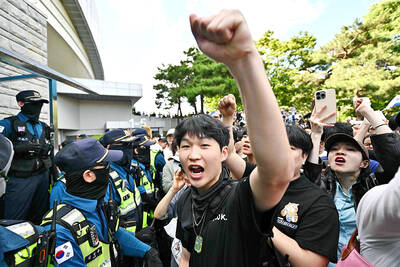
‘ABSURD MISTAKE’: The election commission said that there had been a failure to anticipate turnout after 14 polling stations ran short of ballot papers South Korean riot police yesterday cleared protesters from a Seoul polling station after a 35-hour blockade sparked by a shortage of ballot papers during local elections earlier this week. Wednesday’s election was the first nationwide vote since South Korean President Lee Jae-myung took office following the ouster of Yoon Suk-yeol over his short-lived martial law declaration. Lee’s ruling Democratic Party swept most races, but failed to flip the crucial Seoul mayoral seat. The South Korean National Election Commission apologized, blaming a failure to anticipate turnout after 14 polling stations in Seoul ran short of ballot papers. Some polling stations stayed open until 10pm to

Australian researchers have trained lab-grown brain cells on a silicon computer chip to play the 1990s shooter game Doom and said they are just scratching the surface of what the neurons could be capable of doing. It is the science-fiction work of biotech boffins at Cortical Labs, who researched and developed the technology that harnesses the workings of the brain’s networking system. Each so-called “biological computer” contains about 200,000 living human brain cells, grown from stem cells that were harvested from blood donations. Having mastered the simple computer game Pong, where a paddle is moved up and down to send a ball

France experienced its hottest spring on record, the French weather service said on Tuesday, after an exceptional early heat wave that also broke highs for the season in England and Wales. Meteo-France said the average nationwide temperature over March to May was 13.8°C — about 1.7°C above the norm, and surpassing records set in 2011 and 2020. “The warmest spring since records began in 1900,” it said in a bulletin. All three months were warmer than average, but the onset of an “unprecedented heatwave” late last month pushed the mercury to highs typically seen at the height of the summer. “Our country had never


 RSS
RSS