


The first time Wan Yannan took drugs eight years ago, she was a recent nursing graduate with a coveted job at a hospital — a life that went up in a puff of heroin smoke.
Now a tired-looking 28, Wan lost her boyfriend, her job and was nearly cut off by her family after getting hooked and then suffering repeated relapses despite years of treatment at Chinese rehabilitation centers.
“All I wanted was drugs. The first thing I thought when I woke up each day was getting money for drugs. My life was pitch-dark,” Wan said.
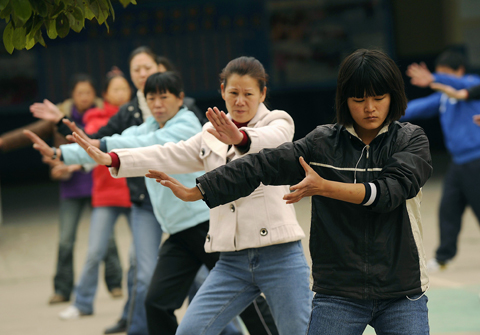
PHOTO: AFP
Now in her fifth stint in rehab in the southwestern city of Kunming, Yunnan Province, Wan is one of many Chinese struggling to kick the habit as drug use rises amid allegations of sub-par and even abusive treatment at state facilities.
Wan’s current home is the Kunming Municipal Compulsory Rehabilitation Center in Yunnan Province — on the front lines of China’s drug scourge as it borders the heroin-producing “Golden Triangle,” where Burma, Laos and Thailand meet.
The 21-year-old center, which claims to be China’s oldest, largest and most modern facility, provided reporters a rare glimpse inside.
Treatment consists of a mixture of Chinese herbal medicines to help addicts detoxify, followed by “purifying” martial arts exercises and “skills training” for future jobs.
The 20 hectare site consists of a living area for its 2,500 addicts with the pleasant name “Harmonious Home,” and vegetable gardens where they grow some of their own food.
Areas where most addicts appeared to be, however, were off-limits, with little explanation. Reporters were unable to witness treatment in action at the police-run center.
One fact is not hidden: the facility’s general failure to prevent relapse.
Xia Jianxun, a police official who serves as the center’s spokesman, said the relapse rate of its addicts — known as “trainees” — was 75 percent. It took two decades for the center to bring that down from 86 percent.
“That was a huge effort,” Xia said, while noting that relapse rates are high worldwide.
Drug use was virtually eliminated after the Communist rise to power in 1949, but the scourge has returned since the country began opening up to the world again three decades ago.
The number of criminal drug cases rose to 77,000 last year, up 26 percent from 2008, according to official figures.
China has 1.3 million registered drug addicts — independent estimates say the actual number is far higher — with more than 170,000 people in rehab centers.
But state media reports have said relapse rates are as high as 90 percent.
In a January report, Human Rights Watch blamed a rehabilitation system it says is marked by sub-standard and even punitive treatment.
Many former addicts interviewed by the New York-based watchdog group said they suffered human rights violations such as forced labor, confinement and other abuses.
“I think the key structural problem is this is a medical issue, a medical problem which has been turned over to the police. They are the institution being asked to make medical decisions,” said Phelim Kine, an Asia researcher for Human Rights Watch. The result is “a spiral in which you can repeat the whole situation again.”
Xia said he knew nothing of those charges, and none of the “trainees” put forward by the Kunming center — all of whom were there “voluntarily” — claimed any such abuses. Center officials monitored every interview.
But the pain of relapse is evident and common.
Yang Likun came back to the center on her own two years after her fourth relapse. Now 34, she looks a decade older after 12 years of heroin abuse.
Trained as a dancer, she hopes to teach dance to children someday, and even marry, but fears leaving the center’s cocoon and risking another backslide.
She said many young Chinese first try drugs out of a fascination with a habit they see as a sign of modern prosperity and decadence, and that not enough is done in China to warn them about the dangers.
“I didn’t know it was addictive and by the time I found that out, it was too late,” she said.


Showcasing phallus-shaped portable shrines and pink penis candies, Japan’s annual fertility festival yesterday teemed with tourists, couples and families elated by its open display of sex. The spring Kanamara Matsuri near Tokyo features colorfully dressed worshipers carrying a trio of giant phallic-shaped objects as they parade through the street with glee. The festival, as legend has it, honors a local blacksmith in the Edo Period (1603-1868) who forged an iron dildo to break the teeth of a sharp-toothed demon inhabiting a woman’s vagina that had been castrating young men on their wedding nights. A 1m black steel phallus sits in the courtyard of

JAN. 1 CLAUSE: As military service is voluntary, applications for permission to stay abroad for over three months for men up to age 45 must, in principle, be granted A little-noticed clause in sweeping changes to Germany’s military service policy has triggered an uproar after it emerged that the law requires men aged up to 45 to get permission from the armed forces before any significant stay abroad, even in peacetime. The legislation, which went into effect on Jan. 1 aims to bolster the military and demands all 18-year-old men fill out a questionnaire to gauge their suitability to serve in the armed forces, but stops short of conscription. If the “modernized” model fails to pull in enough recruits, parliament will be compelled to discuss the reintroduction of compulsory service, German
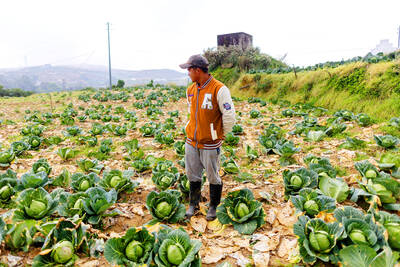
Filipino farmers like Romeo Wagayan have been left with little choice but to let their vegetables rot in the field rather than sell them at a loss, as rising oil prices linked to the Iran war drive up the cost of harvesting, labor and transport. “There’s nothing we can do,” said Wagayan, a 57-year old vegetable farmer in the northern Philippine province of Benguet. “If we harvest it, our losses only increase because of labor, transportation and packing costs. We don’t earn anything from it. That’s why we decided not to harvest at all,” he said. Soaring costs caused by the Middle East

For two decades, researchers observed members of the Ngogo chimpanzee group of Kibale National Park in Uganda spend their days eating fruits and leaves, resting, traveling and grooming in their tropical rainforest abode, but this stable community then fractured and descended into years of deadly violence. The researchers are now describing the first clearly documented example of a group of wild chimpanzees splitting into two separate factions, with one launching a series of coordinated attacks against the other. Adult males and infants were targeted, with 28 deaths. “Biting, pounding the victim with their hands, dragging them, kicking them — mostly adult males,


 RSS
RSS