


Three Guantanamo Bay detainees whose deaths were ruled a suicide in 2006 apparently had been transported from their cells hours before their deaths to a secret site on the island, an article in Harper’s magazine said.
The published account released on Monday raises serious questions about whether the three detainees actually died by hanging themselves in their cells and suggests the US government is covering up details of what precisely happened in the hours before the deaths on the night of June 9, 2006.
In response to the report, the US Justice Department said on Monday that it had thoroughly reviewed the allegations and found no evidence of wrongdoing.
Harper’s reported that the deaths of the three detainees, or the events that led directly to their deaths, most likely occurred at a previously undisclosed facility not fat from the main Guantanamo Bay prison complex.
Harper’s based much of its account on interviews with several prison guards, who said they knew of the existence of the “black” site and that they saw three detainees removed from Camp Delta several hours before the deaths were reported and said the prisoners were transported in a white van toward the secret site.
Those who knew of the black facility referred to it as “Camp No,” reported the magazine, quoting Army Sergeant Joe Hickman, one of the guards.
Anyone who asked if the black site existed would be told, “No, it doesn’t,” the magazine reported, quoting Hickman.
The article will be published in the magazine’s March issue.
After the terror attacks on US soil on Sept. 11, 2001, the CIA set up a number of so-called “black” sites around the world, where harsh interrogations of terrorism-era suspects took place. The Harper’s article suggested such a site at Guantanamo Bay may have belonged to the CIA or to the US military’s Joint Special Operations Command.
The three Guantanamo detainees were Salah Ahmed Al-Salami, 37, of Yemen; Mani Shaman Al-Utaybi, 30, and Yasser Talal Al-Zahrani, 22, both of Saudi Arabia.
The article says that at a 7am meeting on June 10, 2006, with 50 or so soldiers and sailors, Army Colonel Michael Bumgarner said that the three men had died by swallowing rags, causing them to choke to death. Bumgarner was a commander at Guantanamo Bay.
According to the magazine, Bumgarner went on to say that the news media would be guided to report something different — that the three prisoners had committed suicide by hanging themselves in their cells.
On Monday, in response to the article, Bumgarner said in an e-mail that “this blatant misrepresentation of the truth infuriates me.”


When a hiker fell from a 55m waterfall in wild New Zealand bush, rescuers were forced to evacuate the badly hurt woman without her dog, which could not be found. After strangers raised thousands of dollars for a search, border collie Molly was flown to safety by a helicopter pilot who was determined to reunite the pet and the owner. A week earlier, an emergency rescue helicopter found the woman with bruises and lacerations after a fall at a rocky spot at the waterfall on the South Island’s West Coast. She was airlifted on March 24, but they were forced to
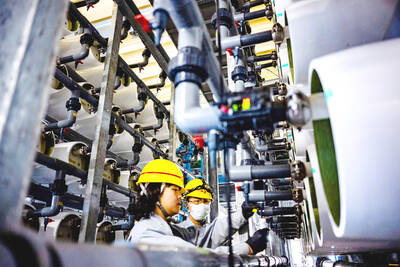
HIGH HOPES: The power source is expected to have a future, as it is not dependent on the weather or light, and could be useful for places with large desalination facilities A Japanese water plant is harnessing the natural process of osmosis to generate renewable energy that could one day become a common power source. The possibility of generating power from osmosis — when water molecules pass from a less salty solution to a more salty one — has long been known. However, actually generating energy from that has proved more complicated, in part due the difficulty of designing the membrane through which the molecules pass. Engineers in Fukuoka, Japan, and their private partners think they might have cracked it, and have opened what is only the world’s second osmotic power plant. It generates
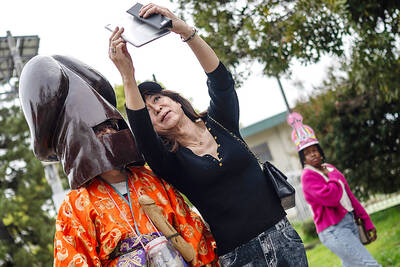
Showcasing phallus-shaped portable shrines and pink penis candies, Japan’s annual fertility festival yesterday teemed with tourists, couples and families elated by its open display of sex. The spring Kanamara Matsuri near Tokyo features colorfully dressed worshipers carrying a trio of giant phallic-shaped objects as they parade through the street with glee. The festival, as legend has it, honors a local blacksmith in the Edo Period (1603-1868) who forged an iron dildo to break the teeth of a sharp-toothed demon inhabiting a woman’s vagina that had been castrating young men on their wedding nights. A 1m black steel phallus sits in the courtyard of
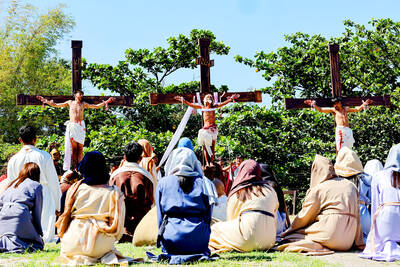
Hundreds of Filipinos and tourists flocked to a sun-bleached field north of Manila yesterday, on Good Friday, to witness one of the country’s most blood-soaked displays of religious fervor, undeterred by rising fuel prices. Scores of bare-chested flagellants with covered faces walked barefoot through the dusty streets of Pampanga Province’s San Fernando as they flogged their backs with bamboo whips in the scorching heat. Agence France-Presse (AFP) journalists said they saw devotees deliberately puncturing their skin with glass shards attached to a small wooden paddle to ensure their bleeding during the ritual, a way to atone for sins and seek miracles from


 RSS
RSS