


Cash-rich US researchers have again dominated this year’s Nobel awards, but it seems identifying the nationality of laureates is not an exact science, and change may be on the way.
On the face of things, the US would top an Olympic-style medals table of Nobel prize wins. Eleven of this year’s 13 laureates are citizens of the US, winning five of the six Nobel awards up for grabs.
Even US President Barack Obama pocketed a prize.
Since the end of World War II, the US has scooped up 89 Nobel awards for medicine, 74 for physics, 58 for chemistry and dozens more for economics, peace and literature, beating its closest contenders in Britain, France and Germany.
Unsurprisingly then, the rest of the world is left to ask how the US does it. The answer may be, in part, “It doesn’t.”
A look at the curricula vitae of this year’s Nobel science winners — which make up four of the six awards — shows a complex patchwork of academics criss-crossing the globe to reach the top their profession.
“You have to ask where they studied,” said Sharon Bertsch McGrayne, an American who has written a book profiling female Nobel laureates.
“Many of our scientists have done their post-docs in Europe,” she said, pointing to high migration levels among top scientists.
This year’s crop of laureates shows just how difficult it is to determine the nationality of globe-trotting laureates, especially based on Nobel citations which use citizenship at the time of award.
Charles Kao (高錕), who shared this year’s prize for physics for his work in developing fiber optics, is a US citizen, but he was born in Shanghai, educated in London and now lives in Hong Kong.
Venkatraman Ramakrishnan, who shared the prize for chemistry, was born in India, works in Britain, but has US citizenship.
Australian-born Elizabeth Blackburn is also a US citizen, but studied at the universities of Melbourne and Cambridge before a post doctoral degree at Yale.
Willard Boyle, who won also shared the physics prize for his work on semiconductors, is Canadian and studied at Montreal’s McGill University, but now has US citizenship.
Obama — despite claims by his most vociferous critics — is among the most unquestionably American of the laureates.
Research from Britain’s University of Warwick, published last January, shows scientific migration is common, and vastly beneficial to the US.
“Nearly half of the world’s most-cited physicists work outside their country of birth,” the study said.
A survey of 158 of the most highly cited physicists showed systematic migration to nations with large research and development spending, most notably the US.
“At birth, 29.7 percent of physicists are in the USA. This increases to 43.4 percent at first degree, to 55.1 percent at PhD, and to 67.1 percent presently,” the report said. “In 1987-2006, for example, five out of fourteen of all UK-educated laureates had moved to the USA by the time they won the Nobel prize.”
Still, the US can claim to have forged the institutes and universities that attract top-flight researchers for award-winning research.
US State Department figures show that every year the US issues more than 35,000 visas for exceptional scientists and others who flock to well-funded institutes.
But the real key to US Nobel dominance, according to Roger Geiger, a professor of education at Pennsylvania State University, is cash — particularly the massive influx of cash to the US education system after World War II.
“We were funding research when others were not, or when others could not,” he said pointing to post-war Europe’s economic malaise.
That advantage has stuck.
Today, Harvard University’s endowment alone is worth around US$27 billion, roughly equal to Costa Rica’s GDP.
Still, Harvard’s nest egg has shrunk by US$10 billion since the start of the fiscal year thanks to a financial crisis that Geiger says will erode US universities’ attraction.
“The crisis has been longer and more deeply felt in the United States, that will have an impact,” he said.
At the same time, European and Asian universities are increasing the type of innovative research that wins awards.
“Other countries have recognized the importance of this type of competition,” said Geiger who sees change already taking place.
“The rest of the world is competing, the law of numbers says they will catch up. If you look at publication and citation counts, Nobel prizes are a lagging indicator,” Geiger said.
In some disciplines, the playing field has already been leveled.
Europeans still dominate the Fields Medal for mathematics or the Pritzker Prize for architecture, both areas which can require less research funding.
An American has not won the Nobel Prize for Literature since Toni Morrison’s award 16 years ago.

‘CROSSING THE LINE’: China’s embassy in Seoul criticized US Forces Korea Commander General Xavier Brunson, asking if his ‘hostile’ remarks were authorized by Washington South Korea and the US are in talks over recent public remarks by the commander of US Forces Korea, Seoul’s presidential office said yesterday, after the comments drew sharp criticism from China. In a recent podcast interview, US Forces Korea Commander General Xavier Brunson described South Korea as “the dagger in the heart of Asia” from China’s east coast, prompting the Chinese embassy in Seoul to say that he had “truly crossed the line.” The interview came amid growing speculation that Washington might seek to expand the role of US Forces Korea in countering the growing regional influence of China, a key

Through the noise of rushing papers and whirring belts at a print factory in Kyoto, two creators watch their photo essay come to life in broadsheet form — part of an effort to win new audiences in the age of artificial intelligence (AI). Despite the decline of the publishing industry, self-publication and handmade “zine” magazines are growing in popularity in Japan, reflecting the nation’s enduring love of paper in the digital era. While speaking to Agence France-Presse at the plant, his hands black with ink, one of the creators, Kazuma Obara, said: “I think [paper] is a medium that engages all five

Australian researchers have trained lab-grown brain cells on a silicon computer chip to play the 1990s shooter game Doom and said they are just scratching the surface of what the neurons could be capable of doing. It is the science-fiction work of biotech boffins at Cortical Labs, who researched and developed the technology that harnesses the workings of the brain’s networking system. Each so-called “biological computer” contains about 200,000 living human brain cells, grown from stem cells that were harvested from blood donations. Having mastered the simple computer game Pong, where a paddle is moved up and down to send a ball
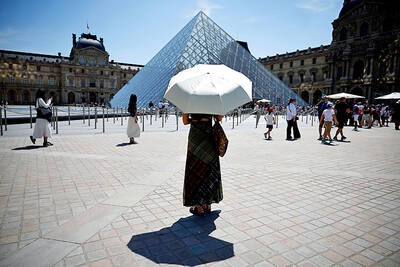
France experienced its hottest spring on record, the French weather service said on Tuesday, after an exceptional early heat wave that also broke highs for the season in England and Wales. Meteo-France said the average nationwide temperature over March to May was 13.8°C — about 1.7°C above the norm, and surpassing records set in 2011 and 2020. “The warmest spring since records began in 1900,” it said in a bulletin. All three months were warmer than average, but the onset of an “unprecedented heatwave” late last month pushed the mercury to highs typically seen at the height of the summer. “Our country had never


 RSS
RSS