


Nicaraguan President Daniel Ortega said Honduras’ interim government could try to provoke a border military incident “to distract attention” from international efforts to restore ousted president Manuel Zelaya.
Ortega cited no evidence in making the claims, which come as Honduras’ coup-installed leader dampened hopes for a negotiated solution to the country’s crisis, capping days of mixed signals by saying firmly that there’s no way the ousted president could return to power.
“There is a danger that, to try to distract attention from the internal conflict they themselves created, they might organize a group of people with military training to attack a Honduran army position, for that to serve as a pretext for a retaliation against Nicaragua,” Ortega said in a speech in Managua, the Nicaraguan capital.
Ortega, who has been hosting Zelaya and a few hundred of his supporters camped out near the Honduran border, did not offer details on when such a provocation might occur.
“But they shouldn’t think they would have a cakewalk in Nicaragua,” Ortega said.
The two countries’ border was the scene of much of the fighting in the 1980s Contra war, in which US-backed rebels fought Ortega’s Sandinista government.
“We are not talking about an army that doesn’t have a history of aggression against Nicaragua,” Ortega said.
Ortega said his country “is preparing for war because we want peace.”
Marking a tougher stance, riot police fired tear gas and arrested supporters of Zelaya who blocked a main artery leading into the Honduran capital on Friday.
Interim president Roberto Micheletti said that his government would no longer tolerate street blockades that regularly snarl traffic in Tegucigalpa and other cities.
Micheletti’s Foreign Ministry said in a statement it “reserves the right” to cancel visas for US diplomatic personnel in Honduras, in retaliation for Washington’s decision this week to revoke the diplomatic visas of four Honduran officials. However the government did not take any immediate steps against US diplomats.
Zelaya’s return has been a key demand of crisis mediator and Costa Rican President Oscar Arias, who also has proposed amnesty for the coup plotters and other measures as part of a compromise deal.
But on Friday, a judge in Honduras issued yet another set of arrest warrants against Zelaya and three other former officials for alleged falsification of public records, fraud and abuse of authority. The charges are related to the alleged misappropriation of US$2 million in government funds to pay for ads by Zelaya’s administration in January.
The interim government previously announced Zelaya faces charges of treason, usurping the powers of other branches of government, abuse of authority and trying to undermine Honduras’ system of government.

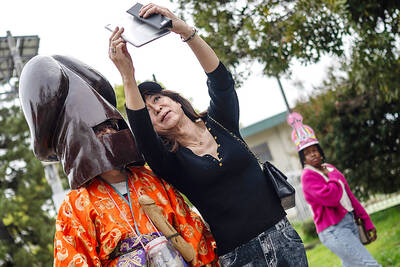
Showcasing phallus-shaped portable shrines and pink penis candies, Japan’s annual fertility festival yesterday teemed with tourists, couples and families elated by its open display of sex. The spring Kanamara Matsuri near Tokyo features colorfully dressed worshipers carrying a trio of giant phallic-shaped objects as they parade through the street with glee. The festival, as legend has it, honors a local blacksmith in the Edo Period (1603-1868) who forged an iron dildo to break the teeth of a sharp-toothed demon inhabiting a woman’s vagina that had been castrating young men on their wedding nights. A 1m black steel phallus sits in the courtyard of

HIGH HOPES: The power source is expected to have a future, as it is not dependent on the weather or light, and could be useful for places with large desalination facilities A Japanese water plant is harnessing the natural process of osmosis to generate renewable energy that could one day become a common power source. The possibility of generating power from osmosis — when water molecules pass from a less salty solution to a more salty one — has long been known. However, actually generating energy from that has proved more complicated, in part due the difficulty of designing the membrane through which the molecules pass. Engineers in Fukuoka, Japan, and their private partners think they might have cracked it, and have opened what is only the world’s second osmotic power plant. It generates

JAN. 1 CLAUSE: As military service is voluntary, applications for permission to stay abroad for over three months for men up to age 45 must, in principle, be granted A little-noticed clause in sweeping changes to Germany’s military service policy has triggered an uproar after it emerged that the law requires men aged up to 45 to get permission from the armed forces before any significant stay abroad, even in peacetime. The legislation, which went into effect on Jan. 1 aims to bolster the military and demands all 18-year-old men fill out a questionnaire to gauge their suitability to serve in the armed forces, but stops short of conscription. If the “modernized” model fails to pull in enough recruits, parliament will be compelled to discuss the reintroduction of compulsory service, German

Hundreds of Filipinos and tourists flocked to a sun-bleached field north of Manila yesterday, on Good Friday, to witness one of the country’s most blood-soaked displays of religious fervor, undeterred by rising fuel prices. Scores of bare-chested flagellants with covered faces walked barefoot through the dusty streets of Pampanga Province’s San Fernando as they flogged their backs with bamboo whips in the scorching heat. Agence France-Presse (AFP) journalists said they saw devotees deliberately puncturing their skin with glass shards attached to a small wooden paddle to ensure their bleeding during the ritual, a way to atone for sins and seek miracles from


 RSS
RSS