


Even in the state of The Sopranos and On the Waterfront, where corruption seems institutionalized, the arrest of a neophyte mayor in office a mere three weeks stands out.
Voters might wonder how Hoboken Mayor Peter Cammarano, no grizzled politician but a 32-year-old lawyer with a promising political career, could be accused of taking US$25,000 in bribes after watching so many politicians follow the same road to jail.
Authorities said that what he told a government witness wearing a wire — a purported real-estate developer whom Cammarano assured he would treat “like a friend” — not only led to his arrest but also added a new chapter to New Jersey’s culture of corruption.
Stanley Renshon, a psychoanalyst and City University of New York political science professor, says it’s really not that surprising.
“Politics has a lot of temptation because it has to do with power. People are attracted to the power. Ambition is like a loose cannon —it can be dangerous,” Renshon said.
New Jersey, the setting for the HBO mob drama The Sopranos and the 1954 Marlon Brando classic On the Waterfront, about crookedness on the docks, has long been known for government corruption. But over the last five years, hundreds of government officials from both major parties have been charged with crimes involving betrayal of public trust: taking bribes, getting no-show jobs to boost state pension benefits or lavishly spending public money on themselves.
Thursday’s arrests snared 43, including three mayors, two state assemblymen, five rabbis and many other public officials. It also brought fresh attention to the city known as Frank Sinatra’s hometown, one of US’ earliest settlements and more recently a nightlife mecca for the young and hip.
Cammarano insisted he was innocent on Friday, calling the charges “completely baseless,” and he said he would remain in office.
He became mayor only three weeks before his arrest after a bitterly contested mayoral election that forced a runoff, which he won by only 161 votes.
The FBI said Cammarano was so confident about his supporters pre-election that he was caught joking he could secure most of the vote of those born and raised in Hoboken even if he were “uh, indicted.”
He is the second of the city’s last three mayors to face criminal charges. Former mayor Anthony Russo was sentenced in 2005 to 30 months in prison for accepting bribes in exchange for city contracts between 1994 and 2001, nearly his entire time as mayor.
Cammarano’s arrest comes at a tough time for Hoboken. A tripling in property values over the last decade and financial industry layoffs have hit the city hard, flooding the real-estate market with homes for sale or rent.
Blessed with a sweeping view of Manhattan, it is a historic city. Settled by the Dutch in the 1600s, the first working steam locomotive in the US was tested there in the early 1800s. It was also the site of the US’ first brewery, the first ice cream cone, the first zipper and the first ferry service. One of the first organized baseball games was played there in 1845.
The FBI’s corruption probe came to Hoboken just as the then-mayoral candidate was desperate for cash to compete in the May runoff election.
The FBI says in a criminal complaint filed in federal court in Newark that Cammarano wanted to please its informant, who posed as a developer looking to build a high-rise. The agency quotes Cammarano as an encouraging, if not enthusiastic, recipient of the informant’s cash offers in return for help getting property easements to build in Hoboken.
The federal complaint against Cammarano says he repeatedly gushes to the FBI’s fake developer that he can speed necessary construction permits.
“I promise you ... you’re gonna be, you’re gonna be treated like a friend. I’ll be there,” Cammarano was quoted as saying.
“So, if you sponsor it, boom?” the fake developer said.
“Yeah,” Cammarano said.
At the time, Cammarano wasn’t even in office. But the complaint said he had already broken the world up into three categories: “There’s the people who were with us, and that’s you guys. There’s the people who climbed on board in the runoff. They can get in line. And then there are the people who were against us the whole way. They get ground ... they get ground into powder.”
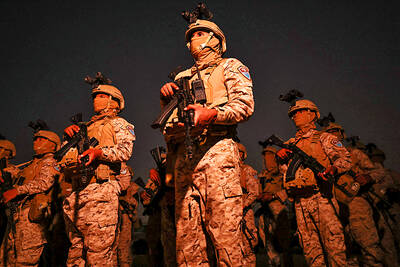
PRECARIOUS RELATIONS: Commentators in Saudi Arabia accuse the UAE of growing too bold, backing forces at odds with Saudi interests in various conflicts A Saudi Arabian media campaign targeting the United Arab Emirates (UAE) has deepened the Gulf’s worst row in years, stoking fears of a damaging fall-out in the financial heart of the Middle East. Fiery accusations of rights abuses and betrayal have circulated for weeks in state-run and social media after a brief conflict in Yemen, where Saudi airstrikes quelled an offensive by UAE-backed separatists. The United Arab Emirates is “investing in chaos and supporting secessionists” from Libya to Yemen and the Horn of Africa, Saudi Arabia’s al-Ekhbariya TV charged in a report this week. Such invective has been unheard of
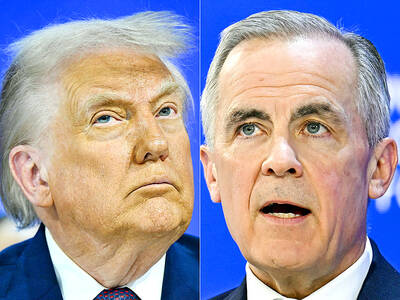
US President Donald Trump on Saturday warned Canada that if it concludes a trade deal with China, he would impose a 100 percent tariff on all goods coming over the border. Relations between the US and its northern neighbor have been rocky since Trump returned to the White House a year ago, with spats over trade and Canadian Prime Minister Mark Carney decrying a “rupture” in the US-led global order. During a visit to Beijing earlier this month, Carney hailed a “new strategic partnership” with China that resulted in a “preliminary, but landmark trade agreement” to reduce tariffs — but

Chinese President Xi Jinping’s (習近平) purge of his most senior general is driven by his effort to both secure “total control” of his military and root out corruption, US Ambassador to China David Perdue said told Bloomberg Television yesterday. The probe into Zhang Youxia (張又俠), Xi’s second-in-command, announced over the weekend, is a “major development,” Perdue said, citing the family connections the vice chair of China’s apex military commission has with Xi. Chinese authorities said Zhang was being investigated for suspected serious discipline and law violations, without disclosing further details. “I take him at his word that there’s a corruption effort under
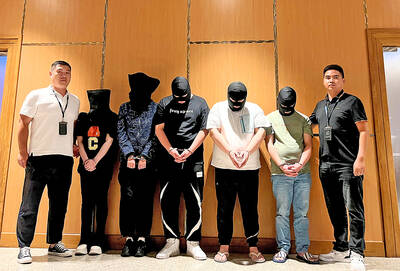
China executed 11 people linked to Myanmar criminal gangs, including “key members” of telecom scam operations, state media reported yesterday, as Beijing toughens its response to the sprawling, transnational industry. Fraud compounds where scammers lure Internet users into fake romantic relationships and cryptocurrency investments have flourished across Southeast Asia, including in Myanmar. Initially largely targeting Chinese speakers, the criminal groups behind the compounds have expanded operations into multiple languages to steal from victims around the world. Those conducting the scams are sometimes willing con artists, and other times trafficked foreign nationals forced to work. In the past few years, Beijing has stepped up cooperation


 RSS
RSS