


US President Barack Obama has awoken hope for redress of grievances in the hearts of some of the more than a billion Muslims scattered in diverse communities across the globe.
To win their minds, sceptical after a “war on terror” waged by his predecessor George W. Bush that many saw as an assault on Islam, Obama must follow his speech to the Muslim world this week with evidence of real change in US policy and outlook.
That, at least, is a common thread stressed by politicians and analysts from Muslim-majority countries — as is the urgency of US action to resolve the Israeli-Palestinian conflict.
From Kuala Lumpur to Kabul, from Ramallah to Riyadh, the messages for Obama throb with that central concern, along with a yearning for a break from the divisive, militaristic, pro-Israel stance many Muslims associate with the eight-year Bush era.
“It’s not too late to repair relations between the US and the Muslim world,” said Tifatul Sembiring, president of an Islamist party in Indonesia, home to the world’s largest Muslim population. “But Obama has to give us some proof that there will not be another opportunistic war, such as happened in Iraq.”
Sembiring, who leads the PKS (Partai Keadilan Sejahtera or Prosperous Justice Party), homed in on the Palestinian issue: “Are they [the Americans] serious about creating a real solution for Palestine? We are waiting for justice on this.”
Obama’s best chance to win over Muslims and Arabs was to use Washington’s leverage on its Israeli ally, Saudi political analyst Turad al-Amri said.
“By pressuring Israel, Obama will win in more than one area — in terrorism, the Iran file, Lebanon,” he said.
Obama has said Israel must halt all settlement expansion in the occupied West Bank, a demand that sets him on a collision course with Israeli Prime Minister Benjamin Netanyahu.
For Palestine Liberation Organization negotiator Saeb Erekat, Obama’s task was to ensure creation of a Palestinian state: “People of this region don’t want to hear words any more. They want to see deeds.”
In Kabul, Afghan lawmaker Sabrina Saqib said Obama’s roots, as a black American with a Muslim father, meant he understood deprivation and would work to settle the Palestinian issue.
“One speech will not work, but it’s good for a start,” she said of Obama’s planned address on Thursday. “When you pay homage to others and respect them, you enliven their spirit.”
“The change of US language under Obama must be translated on the ground,” said Ali Baraka, deputy representative of the Palestinian Islamist Hamas movement in Damascus. “The first step would be to pressure [Israel] to stop its aggression against Gaza and lift the siege on the Strip.”
In Iran, Mohammad Marandi, a professor who heads North American Studies at Tehran University, said Obama was “slowly running out of time” to repair the US image in the region.
He called for “substantial change” in US foreign policy toward the non-Western world, without detailing how Iran, under scrutiny over its nuclear program, might reciprocate.
Asked what he would like Obama to say, Marandi said: “That the US no longer sees itself as a country which is exceptional and has exceptional rights. It’s a country like all others ... I think Muslims and non-Muslims would all like to hear that.”
However, Obama’s decision to make Cairo the venue for his appeal to the Muslim world drew criticism as well as understanding.
“He could have thought out of the box and chosen Indonesia or even Malaysia to give a new shift in the paradigm for addressing the Muslim world’s issues,” said Dzulkifli Ahmad, strategist for the opposition Pan-Malaysian Islamic Party.
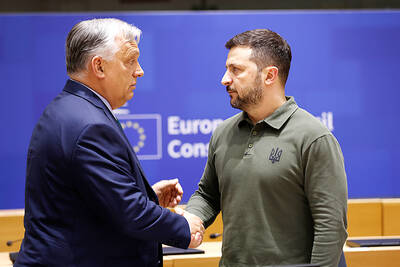
Hungarian authorities temporarily detained seven Ukrainian citizens and seized two armored cars carrying tens of millions of euros in cash across Hungary on suspicion of money laundering, officials said on Friday. The Ukrainians were released on Friday, following their detention on Thursday, but Hungarian officials held onto the cash, prompting Ukraine to accuse Hungary’s Russia-friendly government of illegally seizing the money. “We will not tolerate this state banditism,” Ukrainian Minister of Foreign Affairs Andrii Sybiha said. The seven detained Ukrainians were employees of the Ukrainian state-owned Oschadbank, who were traveling in the two armored cars that were carrying the money between Austria and
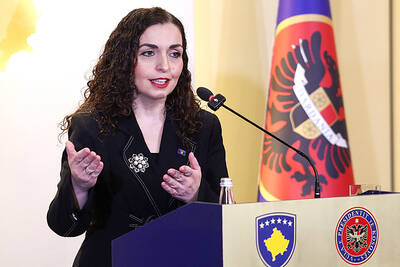
Kosovar President Vjosa Osmani on Friday after dissolving the Kosovar parliament said a snap election should be held as soon as possible to avoid another prolonged political crisis in the Balkan country at a time of global turmoil. Osmani said it is important for Kosovo to wrap up the upcoming election process and form functional institutions for political stability as the war rages in the Middle East. “Precisely because the geopolitical situation is that complex, it is important to finish this electoral process which is coming up,” she said. “It is very hard now to imagine what will happen next.” Kosovo, which declared

MORE BANS: Australia last year required sites to remove accounts held by under-16s, with a few countries pushing for similar action at an EU level and India considering its own ban Indonesia on Friday said it would ban social media access for children under 16, citing threats from online pornography, cyberbullying, online fraud and Internet addiction. “Accounts belonging to children under 16 on high-risk platforms will start to be deactivated, beginning with YouTube, TikTok, Facebook, Instagram, Threads, X, Bigo Live and Roblox,” Indonesian Minister of Communications and Digital Meutya Hafid said. “The government is stepping in so that parents no longer have to fight alone against the giants of the algorithm. Implementation will begin on March 28, 2026,” she said. The social media ban would be introduced in stages “until all platforms fulfill their
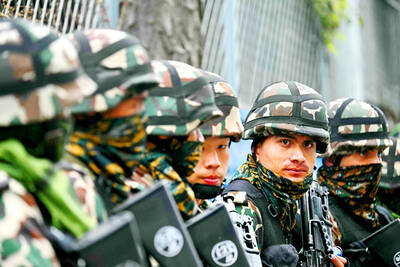
Counting was under way in Nepal yesterday, after a high-stakes parliamentary election to reshape the country’s leadership following protests last year that toppled the government. Key figures vying for power include former Nepalese prime minister K. P. Sharma Oli, rapper-turned-mayor Balendra Shah, who is bidding for the youth vote, and newly elected Nepali Congress party leader Gagan Thapa. In Kathmandu’s tea shops and city squares, people were glued to their phones, checking results as early trends flashed up — suggesting Shah’s centrist Rastriya Swatantra Party (RSP) was ahead. Nepalese Election Commission spokesman Prakash Nyupane said the counting was ongoing “in a peaceful manner”


 RSS
RSS