


Same-sex couples in Iowa began holding hastily planned weddings on Monday as the state became the third in the US to allow gay marriage, a leap that even some supporters find hard to grasp in the country’s heartland.
Within hours of a state Supreme Court ruling legalizing gay marriage taking effect, several same-sex couples had exchanged vows on the steps of the Polk County Administrative Building.
“It’s not very romantic, is it?” Melisa Keeton joked, referring to the location of the ceremony and the media attention, before marrying Shelley Wolfe.
The couple were allowed to wed after getting a judge to waive the state’s three-day waiting period. The waiver was granted after the couple claimed the wait was stressful on Keeton, who is pregnant and due in August.
The couple, who will go by the last name Keeton, were married by the Reverend Peg Esperanza of the Church of the Holy Spirit. She later married at least two other couples, all at no charge.
“God sent me here today and I’ve said OK,” said Esperanza, a lesbian who plans to marry her partner in October.
On April 3, the Iowa justices upheld a lower court ruling that rejected a state law restricting marriage to a union between a man and woman. The decision added Iowa to the list of states where gay marriage is legal, joining Massachusetts and Connecticut. A Vermont law allowing gay marriage will take effect in September.
Officials said the Polk County recorder’s office had received 82 marriage applications from same-sex couples by 4pm.
One of them was Alicia Zacher, 24, and Jessica Roach, 22, who waited in a misting rain to enter the office and file their application. They later got a waiver and planned to get married as soon as possible after seeing how California voters last year reinstated a ban on same-sex marriage.
“You just never know when they’ll try to take it away,” Roach said.
A poll by the University of Iowa taken just before the high court’s ruling showed 26 percent of Iowans support gay marriage.
That number rises to more than 50 percent when people were asked if they supported either gay marriage or civil unions.
“If they want to marry, I don’t see a reason not to let them,” said Joe Biase, a 31-year-old university student from Des Moines.
“For a state in the heartland, it’s come a long way,” he said.
Still, the issue is far from settled.
Bryan English of the Iowa Family Policy Center, which opposes same-sex marriage, said the legislature and Governor Chet Culver had put some “poor county recorders in an awfully tough position today” by not working to block the court’s ruling from taking effect.
The group wants the state to begin the multiyear process of amending Iowa’s Constitution to overturn the court decision.
Culver and majority Democrats have refused, which Republicans predicted would hurt Democrats in next year’s elections.
One gubernatorial candidate, Sioux City businessman Bob Vander Plaats, has already made gay marriage a focal point of his run for the Republican nomination.
“This will be a major issue in the campaign of 2010,” Vander Plaats said.
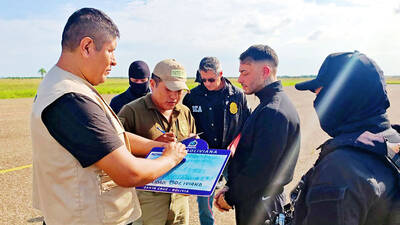
KINGPIN: Marset allegedly laundered the proceeds of his drug enterprise by purchasing and sponsoring professional soccer teams and even put himself in the starting lineups Notorious Latin American narco trafficker Sebastian Marset, who eluded police for years, was handed over to US authorities after his arrest on Friday in Bolivia. Marset, a Uruguayan national who was on the US most-wanted list, was passed to agents of the US Drug Enforcement Administration at Santa Cruz airport in Bolivia, then put on a US airplane, Bolivian state television showed. “The arrest and deportation were carried out pursuant to a court order issued by the US justice system,” Bolivian Minister of Government Marco Antonio Oviedo told reporters. The alleged kingpin was arrested in an upscale neighborhood of Santa

ACTIONABLE ADVICE: The majority of chatbots tested provided guidance on weapons, tactics and target selections, with Perplexity and Meta AI deemed to be the least safe From school shootings to synagogue bombings, leading artificial intelligence (AI) chatbots helped researchers plot violent attacks, according to a study published on Wednesday that highlighted the technology’s potential for real-world harm. Researchers from the nonprofit watchdog Center for Countering Digital Hate and CNN posed as 13-year-old boys in the US and Ireland to test 10 chatbots, including ChatGPT, Google Gemini, Perplexity, Deepseek and Meta AI. Eight of the chatbots assisted the make-believe attackers in more than half the responses, providing advice on “locations to target” and “weapons to use” in an attack, the study said. The chatbots had become a “powerful accelerant for
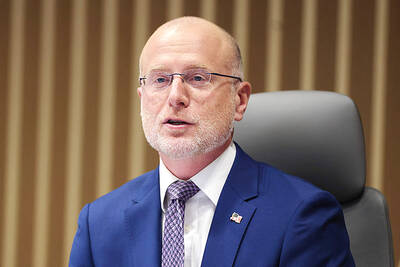
FAKE NEWS? ‘When the government demands the press become a state mouthpiece under the threat of punishment, something has gone very wrong,’ a civic group said The top US broadcast regulator on Saturday threatened media outlets over negative coverage of the Middle East war, after US President Donald Trump slammed critical headlines from the “Fake News Media.” The US president since his first term has derided mainstream media as “fake news” and has sued major outlets over what he sees as unfair coverage. Brendan Carr, head of the US Federal Communications Commission — which oversees the nation’s radio, television and Internet media — said broadcasters risked losing their licenses over news coverage. “The law is clear. Broadcasters must operate in the public interest, and they will
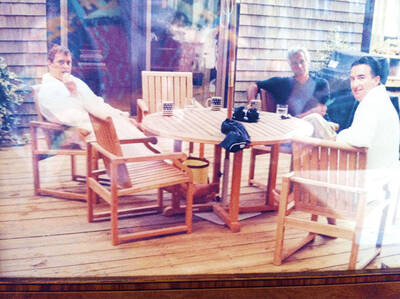
SCANDAL: Other images discovered earlier show Andrew bent over a female and lying across the laps of a number of women, while Mandelson is pictured in his underpants A photograph of former British prince Andrew and veteran politician Peter Mandelson sitting in bathrobes alongside late sex offender Jeffrey Epstein was unearthed on Friday in previously published documents. The image is believed to be the first known photograph of the two men with Epstein. They are currently engulfed in scandal in the UK over their ties to their mutual friend. The undated photograph, first reported by ITV News, shows King Charles III’s disgraced brother and former British ambassador to the US sitting barefoot outside on a wooden deck. They appear to have mugs with a US flag on them


 RSS
RSS