


National Grid Plc is investigating piping greenhouse gases released by power plants and refineries near London to undersea storage sites so they won’t add to global warming.
The manager of Britain’s natural gas-delivery network found the Thames Estuary could be used for pipelines to move carbon-dioxide gas toward depleted offshore wells, Network Operations director Chris Train said. In the north, the Teesside industrial hub is also being considered.
The US and Europe together have earmarked as much as US$14 billion in aid to develop technology to trap and bury the waste gas for eons, which in the London area may benefit utilities E.ON AG and RWE AG and refinery operator Petroplus Holding AG.
Pilot projects have developed slowly because of potential gas-transport costs. London-based National Grid is expanding its range of possible routes beyond Scotland and Humberside, banking on government support and its own unique position of already operating 7,400km of gas pipelines in Britain.
A carbon-capture system might help the government as well as industrial polluters to meet international greenhouse-gas agreements without having to buy emissions permits from traders.
The Thames river area near the country’s financial capital is home to large producers of greenhouse gases.
Train declined to name companies National Grid had spoken with about the plans beyond saying “we are talking with parties in both those areas” of England. “It’s pretty embryonic at this stage.”
Carbon capture and storage, commonly called CCS, will contribute a maximum of 10 percent of emission reductions needed globally in 2020 under expected greenhouse-gas trading programs, or 240 million tonnes of gas, New Carbon Finance, a London-based research company, estimated last month.
“The role of CCS will only be minor given the relative high cost of doing CCS projects prior to 2020,” said Milo Sjardin, an analyst in New York for the firm.
The rest of the reductions would come from increased fuel efficiency at factories, fuel switching and other abatement efforts, he said.
National Grid, which earns a regulated rate of return on its energy networks, is an “ideal” candidate to move the gas around Britain, provided the government sets rules that enable companies to make money by helping bury carbon dioxide, Train said.
“One of the barriers for the development of carbon capture to date is having the right incentive framework in place,” he said.
While National Grid’s focus is land-based pipes, “if it meant developing a project, we wouldn’t shy away from doing the offshore” leg of the transportation too, Train said.
The company is vying to control the transportation side of the unproven technology, which the International Energy Agency has said will be vital to meet the UN’s goal of cutting greenhouse-gas output by 50 percent by mid-century.


Showcasing phallus-shaped portable shrines and pink penis candies, Japan’s annual fertility festival yesterday teemed with tourists, couples and families elated by its open display of sex. The spring Kanamara Matsuri near Tokyo features colorfully dressed worshipers carrying a trio of giant phallic-shaped objects as they parade through the street with glee. The festival, as legend has it, honors a local blacksmith in the Edo Period (1603-1868) who forged an iron dildo to break the teeth of a sharp-toothed demon inhabiting a woman’s vagina that had been castrating young men on their wedding nights. A 1m black steel phallus sits in the courtyard of

JAN. 1 CLAUSE: As military service is voluntary, applications for permission to stay abroad for over three months for men up to age 45 must, in principle, be granted A little-noticed clause in sweeping changes to Germany’s military service policy has triggered an uproar after it emerged that the law requires men aged up to 45 to get permission from the armed forces before any significant stay abroad, even in peacetime. The legislation, which went into effect on Jan. 1 aims to bolster the military and demands all 18-year-old men fill out a questionnaire to gauge their suitability to serve in the armed forces, but stops short of conscription. If the “modernized” model fails to pull in enough recruits, parliament will be compelled to discuss the reintroduction of compulsory service, German
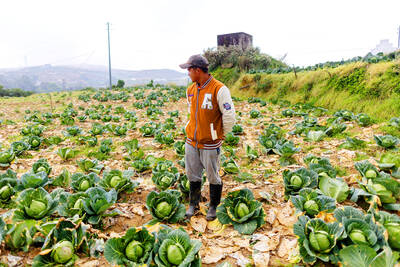
Filipino farmers like Romeo Wagayan have been left with little choice but to let their vegetables rot in the field rather than sell them at a loss, as rising oil prices linked to the Iran war drive up the cost of harvesting, labor and transport. “There’s nothing we can do,” said Wagayan, a 57-year old vegetable farmer in the northern Philippine province of Benguet. “If we harvest it, our losses only increase because of labor, transportation and packing costs. We don’t earn anything from it. That’s why we decided not to harvest at all,” he said. Soaring costs caused by the Middle East

For two decades, researchers observed members of the Ngogo chimpanzee group of Kibale National Park in Uganda spend their days eating fruits and leaves, resting, traveling and grooming in their tropical rainforest abode, but this stable community then fractured and descended into years of deadly violence. The researchers are now describing the first clearly documented example of a group of wild chimpanzees splitting into two separate factions, with one launching a series of coordinated attacks against the other. Adult males and infants were targeted, with 28 deaths. “Biting, pounding the victim with their hands, dragging them, kicking them — mostly adult males,


 RSS
RSS