


Bolivian President Evo Morales said on Saturday that Bolivia does not need US help to control its coca crop, stepping up his anti-Washington rhetoric days after rejecting a US request to fly an anti-drug plane over the South American nation’s territory.
Morales also compared US counter-drug efforts in the country, including Drug Enforcement Administration (DEA) flights, to espionage.
“It’s important that the international community knows that here, we don’t need control of the United States on coca cultivation,” the president told a gathering of coca farmers. “We can control ourselves internally. We don’t need any spying from anybody.”
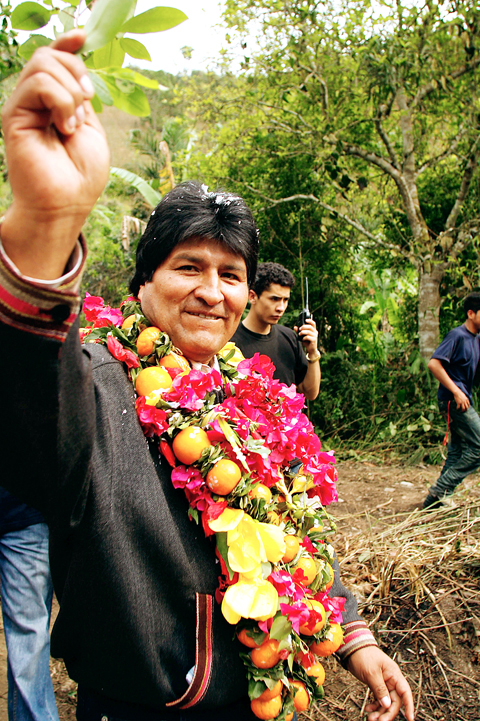
PHOTO: AP
US embassy spokesman Eric Watnik said the DEA makes periodic requests to fly a plane transporting US and Bolivian anti-narcotics personnel around the country. The aircraft is not used for surveillance, he said.
Relations between Washington and La Paz have continued to deteriorate in recent weeks. Morales expelled the US ambassador last month, accusing him of supporting deadly protests organized by his conservative opposition. The former ambassador denies the allegations.
The US responded by ousting Bolivia’s ambassador and later placed the Andean country on an anti-narcotics blacklist, saying Morales has not sufficiently cooperated with international anti-drug efforts.
“We’ve certified Bolivia twice before under the Morales government, even though they have taken a very different approach to counter drugs, especially to eradication, than previous governments,” Thomas Shannon, the top US diplomat for Latin America, said on Thursday.
“But what we’ve noticed over the past couple of months,” he said, “was a declining political willingness to cooperate, and then a very precise attempt by the part of some of the government ministries to begin to lower the level of cooperation and try to break the linkages” between US and Bolivian anti-drug efforts.
Washington did not cut off anti-narcotics aid, but the decertification prompted US President George W. Bush to recommend suspending Bolivia’s special exemption from US tariffs under an Andean-wide act that Congress has just renewed for another year.
Bolivian business leaders say that losing the tariff exemptions would cost South America’s poorest country up to 20,000 jobs.
Bolivia is the world’s third largest producer of coca — the base ingredient in cocaine — after Colombia and Peru. The Andean trade preferences have also benefited the latter two countries and Ecuador.


When a hiker fell from a 55m waterfall in wild New Zealand bush, rescuers were forced to evacuate the badly hurt woman without her dog, which could not be found. After strangers raised thousands of dollars for a search, border collie Molly was flown to safety by a helicopter pilot who was determined to reunite the pet and the owner. A week earlier, an emergency rescue helicopter found the woman with bruises and lacerations after a fall at a rocky spot at the waterfall on the South Island’s West Coast. She was airlifted on March 24, but they were forced to

HIGH HOPES: The power source is expected to have a future, as it is not dependent on the weather or light, and could be useful for places with large desalination facilities A Japanese water plant is harnessing the natural process of osmosis to generate renewable energy that could one day become a common power source. The possibility of generating power from osmosis — when water molecules pass from a less salty solution to a more salty one — has long been known. However, actually generating energy from that has proved more complicated, in part due the difficulty of designing the membrane through which the molecules pass. Engineers in Fukuoka, Japan, and their private partners think they might have cracked it, and have opened what is only the world’s second osmotic power plant. It generates

Showcasing phallus-shaped portable shrines and pink penis candies, Japan’s annual fertility festival yesterday teemed with tourists, couples and families elated by its open display of sex. The spring Kanamara Matsuri near Tokyo features colorfully dressed worshipers carrying a trio of giant phallic-shaped objects as they parade through the street with glee. The festival, as legend has it, honors a local blacksmith in the Edo Period (1603-1868) who forged an iron dildo to break the teeth of a sharp-toothed demon inhabiting a woman’s vagina that had been castrating young men on their wedding nights. A 1m black steel phallus sits in the courtyard of

Hundreds of Filipinos and tourists flocked to a sun-bleached field north of Manila yesterday, on Good Friday, to witness one of the country’s most blood-soaked displays of religious fervor, undeterred by rising fuel prices. Scores of bare-chested flagellants with covered faces walked barefoot through the dusty streets of Pampanga Province’s San Fernando as they flogged their backs with bamboo whips in the scorching heat. Agence France-Presse (AFP) journalists said they saw devotees deliberately puncturing their skin with glass shards attached to a small wooden paddle to ensure their bleeding during the ritual, a way to atone for sins and seek miracles from


 RSS
RSS