


The Philippine government has scrapped its controversial peace deal with the country’s Muslim minority after two weeks of deadly clashes in the south, the presidential palace said yesterday.
The pact signed last month between leaders of the mostly Christian country and the Moro Islamic Liberation Front (MILF) had called for a Muslim homeland to be established on the revolt-hit southern Mindanao.
“Cancelation of the Memorandum of Agreement on Ancestral Domain [MOA-AD] is a painful step,” presidential spokeswoman Lorelei Fajardo said, referring to the official name of the peace agreement.
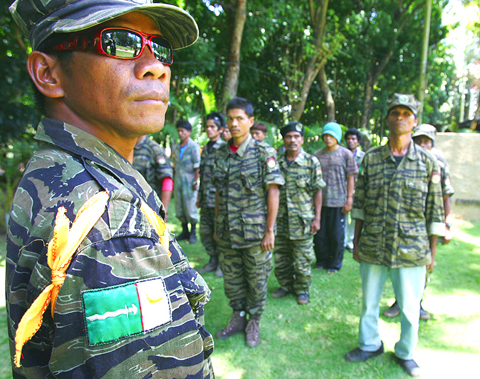
PHOTO: AP
Fajardo said President Gloria Arroyo was “sensitive” to the objections of local Christian leaders, who are opposed to the agreement and have taken to the streets, branding it a “sellout.”
“The president is committed to peace,” Fajardo told journalists. “The administration is sensitive to public sentiments and the president is also committed to upholding the constitution.”
“In doing so she will seek a new agreement within the boundaries of the law set within the constitution,” she said. “The president will not allow adventurism by MILF forces to pressure government to sign any agreement, even if it is for peace.”
On Aug. 4, the Philippine Supreme Court issued a temporary restraining order against the agreement following protests by several politicians who saw it as “unconstitutional.”
Two rebel MILF commanders have since taken up arms, in defiance of the group’s leadership, and killed Christian civilians and looted and burned homes and farms. More than 100,000 people have been made homeless as a result of the fighting.
The rebel MILF commanders have linked their attacks to the Supreme Court’s suspension, saying that the government had designed the agreement to fail.
Described as a “landmark deal,” the proposed MOA-AD would have paved the way for a “comprehensive compact” to end 40 years of bloodshed that has left more than 120,000 people dead and tens of thousands displaced.
The pact had called for the establishment of what amounted to a state within a state with its own “basic law,” police and internal security force.
The region would have been allowed to run its own banking and finance system, civil service, education and legislative and electoral institutions.
It would also have been given full authority to develop and dispose of minerals and other natural resources within its territory.
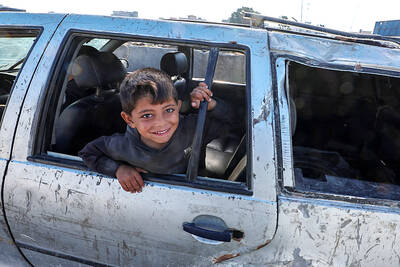
Gaza is rapidly running out of its limited fuel supply and stocks of food staples might become tight, officials said, after Israel blocked the entry of fuel and goods into the war-shattered territory, citing fighting with Iran. The Israeli military closed all Gaza border crossings on Saturday after announcing airstrikes on Iran carried out jointly with the US. Israeli authorities late on Monday night said that they would reopen the Kerem Shalom crossing from Israel to Gaza yesterday, for “gradual entry of humanitarian aid” into the strip, without saying how much. Israeli authorities previously said the crossings could not be operated safely during
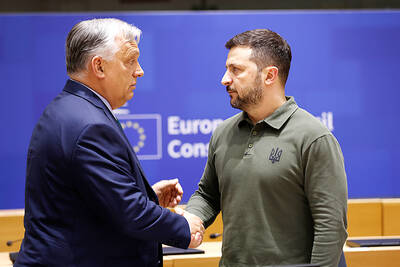
Hungarian authorities temporarily detained seven Ukrainian citizens and seized two armored cars carrying tens of millions of euros in cash across Hungary on suspicion of money laundering, officials said on Friday. The Ukrainians were released on Friday, following their detention on Thursday, but Hungarian officials held onto the cash, prompting Ukraine to accuse Hungary’s Russia-friendly government of illegally seizing the money. “We will not tolerate this state banditism,” Ukrainian Minister of Foreign Affairs Andrii Sybiha said. The seven detained Ukrainians were employees of the Ukrainian state-owned Oschadbank, who were traveling in the two armored cars that were carrying the money between Austria and
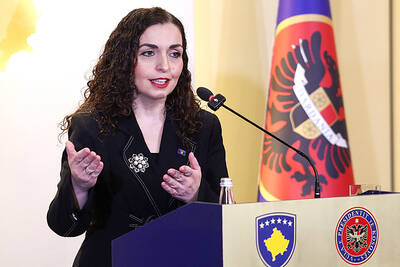
Kosovar President Vjosa Osmani on Friday after dissolving the Kosovar parliament said a snap election should be held as soon as possible to avoid another prolonged political crisis in the Balkan country at a time of global turmoil. Osmani said it is important for Kosovo to wrap up the upcoming election process and form functional institutions for political stability as the war rages in the Middle East. “Precisely because the geopolitical situation is that complex, it is important to finish this electoral process which is coming up,” she said. “It is very hard now to imagine what will happen next.” Kosovo, which declared

MORE BANS: Australia last year required sites to remove accounts held by under-16s, with a few countries pushing for similar action at an EU level and India considering its own ban Indonesia on Friday said it would ban social media access for children under 16, citing threats from online pornography, cyberbullying, online fraud and Internet addiction. “Accounts belonging to children under 16 on high-risk platforms will start to be deactivated, beginning with YouTube, TikTok, Facebook, Instagram, Threads, X, Bigo Live and Roblox,” Indonesian Minister of Communications and Digital Meutya Hafid said. “The government is stepping in so that parents no longer have to fight alone against the giants of the algorithm. Implementation will begin on March 28, 2026,” she said. The social media ban would be introduced in stages “until all platforms fulfill their


 RSS
RSS