


Mexico arrested two alleged drug cartel enforcers over the weekend, including a purported hit man accused of threatening officials and bribing police, and a suspect in the 1993 slaying of a Mexican cardinal.
Former local police chief Hector Izar Castro was detained on Sunday in the north-central state of San Luis Potosi on weapons, armed robbery and drug charges, federal police spokesman Edgar Millan said.
"This man is suspected of making a series of threats against local and state officials and has also been identified as the person in charge of paying off local police," said federal police spokesman Edgar Millan.
Police said Izar Castro had a rifle, pistols and cocaine in his possession at the time of his arrest, as well as three wooden clubs marked with the letter "Z" -- apparently signifying the Zetas, the gang of Gulf cartel hit men for whom he allegedly worked.
Late on Saturday, the commander of an army base in Tijuana announced that another alleged drug gunman had been collared: Alfredo Araujo Avila, also known as "Popeye," who allegedly worked for the Arellano Felix drug cartel as a hit man for more than two decades.
Araujo Avila is suspected of participating in the slaying of Roman Catholic Cardinal Juan Jesus Posadas Ocampo, who was riddled with bullets on May 24, 1993, while he sat in his car at the airport in the city of Guadalajara, General German Redondo told reporters.
Investigators have concluded that gunmen working for the Arellano Felix cartel mistook the cardinal's luxury vehicle for that of a rival drug trafficker whom they were targeting for assassination -- and whose own security forces were at the scene and returned fire.
But Church authorities have long disputed that official version of events, arguing that Posadas Ocampo was killed because he knew about alleged relationships between drug dealers and government officials.
Six people besides the cardinal were also killed. Twelve people have since been convicted and imprisoned for the attack, most recently ex-police commander Humberto Rodriguez Banuelos in 2005.
Redondo said on Saturday that Araujo Avila is also suspected in the 1997 shooting of Tijuana journalist Jesus -, who survived and died of natural causes at age 70 in 2006.
Araujo Avila was detained at a house in Tijuana, across the border from San Diego, California, on outstanding warrants. Redondo said he is also wanted on charges in the US, but did not elaborate.
The general said the suspect holds US citizenship, but US consular authorities were not immediately available to confirm that. A pistol and a police identification card were found in the house.
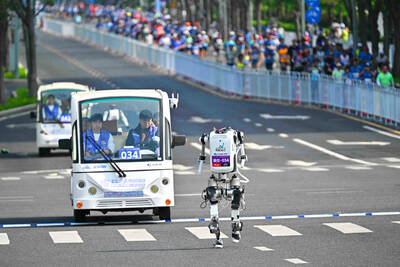
A humanoid robot that won a half-marathon race for robots in Beijing on Sunday ran faster than the human world record in a show of China’s technological leaps. The winner from Honor, a Chinese smartphone maker, completed the 21km race in 50 minutes and 26 seconds, said a WeChat post by the Beijing Economic-Technological Development Area, also known as Beijing E-Town, where the race began. That was faster than the human world record holder, Ugandan Jacob Kiplimo, who finished the same distance in about 57 minutes in March at the Lisbon road race. The performance by the robot marked a significant step forward
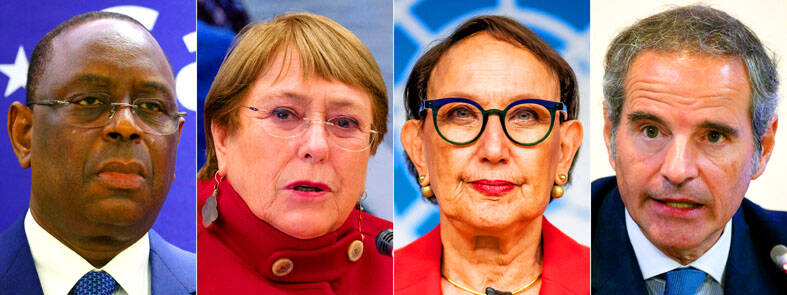
Four contenders are squaring up to succeed Antonio Guterres as secretary-general of the UN, which faces unprecedented global instability, wars and its own crushing budget crisis. Chile’s Michelle Bachelet, Argentina’s Rafael Grossi, Costa Rica’s Rebeca Grynspan and Senegal’s Macky Sall are each to face grillings by 193 member states and non-governmental organizations for three hours today and tomorrow. It is only the second time the UN has held a public question-and-answer, a format created in 2016 to boost transparency. Ultimately the five permanent members of the UN’s top body, the Security Council, hold the power, wielding vetoes over who leads the
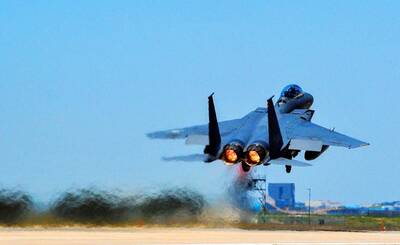
South Korea’s air force yesterday apologized for a 2021 midair collision involving two fighter jets, a day after auditors said the pilots were taking selfies and filming during the flight and held them responsible for the accident. “We sincerely apologize to the public for the concern caused by the accident that occurred in 2021,” an air force spokesman told a news conference, adding that one of the pilots involved had been suspended from flying duties, received severe disciplinary action and has since left the military. The apology followed a report released on Wednesday by the South Korean Board of Audit and Inspection,
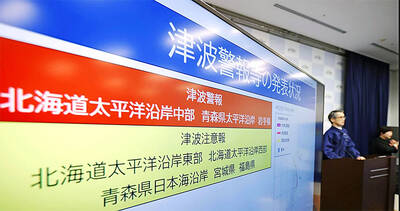
An earthquake registering a preliminary magnitude of 7.7 off northern Japan on Monday prompted a short-lived tsunami alert and the advisory of a higher risk of a possible mega-quake for coastal areas there. The Cabinet Office and the Japan Meteorological Agency said there was a 1% chance for a mega-quake, compared to a 0.1% chance during normal times, in the next week or so following the powerful quake near the Chishima and Japan trenches. Officials said the advisory was not a quake prediction but urged residents in 182 towns along the northeastern coasts to raise their preparedness while continuing their daily lives. Prime


 RSS
RSS