


In the heart of Mumbai's red light district several prostitutes sit on brown plastic chairs in a narrow room waiting to do something many have never been able to do before -- deposit their savings in a bank.
The small bank, set up in the notorious Kamathipura area, is the initiative of the sex workers and aims to help them break the vicious cycle of poverty and exploitation that keeps them indebted to brothel owners.
The simple act of squirreling away some money was previously out of reach for many customers of the Sangini Women's Cooperative Bank. Prostitutes are often shunned by regular banks or lack residence documents or birth certificates officially required to open an account in India.
Now, for the last three months, they have been able to enter the bank daily to deposit an average of US$0.25 to US$0.50 and dream of things they will do as their savings grow.
"We may not have house papers, but we also dream," said Indra Jai, 40, lured from a southern village 20 years ago with promises of a job in Mumbai and then forced into prostitution. "We should get respect, our money is also good."
Jai said she dreams of buying a small house and a tailor shop in her village and paying for her 19-year-old son's college education.
The government estimates there are 3 million prostitutes in India, many of whom start as children lured by traffickers. Others are teenagers sold by impoverished family members to brothel owners.
They spend up to five years working for free in dingy, airless rooms to repay the brothel owner's investment. To survive they often turn to moneylenders charging exorbitant interest rates.
Thoughts of breaking the cycle drives the bank's more than 900 customers.
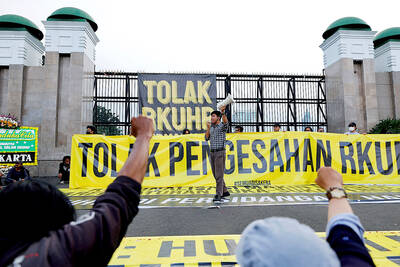
Indonesia yesterday began enforcing its newly ratified penal code, replacing a Dutch-era criminal law that had governed the country for more than 80 years and marking a major shift in its legal landscape. Since proclaiming independence in 1945, the Southeast Asian country had continued to operate under a colonial framework widely criticized as outdated and misaligned with Indonesia’s social values. Efforts to revise the code stalled for decades as lawmakers debated how to balance human rights, religious norms and local traditions in the world’s most populous Muslim-majority nation. The 345-page Indonesian Penal Code, known as the KUHP, was passed in 2022. It

‘DISRESPECTFUL’: Katie Miller, the wife of Trump’s most influential adviser, drew ire by posting an image of Greenland in the colors of the US flag, captioning it ‘SOON’ US President Donald Trump on Sunday doubled down on his claim that Greenland should become part of the US, despite calls by the Danish prime minister to stop “threatening” the territory. Washington’s military intervention in Venezuela has reignited fears for Greenland, which Trump has repeatedly said he wants to annex, given its strategic location in the arctic. While aboard Air Force One en route to Washington, Trump reiterated the goal. “We need Greenland from the standpoint of national security, and Denmark is not going to be able to do it,” he said in response to a reporter’s question. “We’ll worry about Greenland in
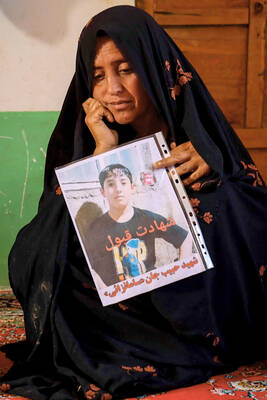
PERILOUS JOURNEY: Over just a matter of days last month, about 1,600 Afghans who were at risk of perishing due to the cold weather were rescued in the mountains Habibullah set off from his home in western Afghanistan determined to find work in Iran, only for the 15-year-old to freeze to death while walking across the mountainous frontier. “He was forced to go, to bring food for the family,” his mother, Mah Jan, said at her mud home in Ghunjan village. “We have no food to eat, we have no clothes to wear. The house in which I live has no electricity, no water. I have no proper window, nothing to burn for heating,” she added, clutching a photograph of her son. Habibullah was one of at least 18 migrants who died
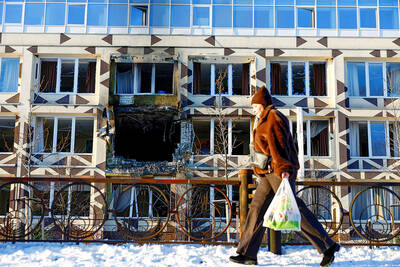
Russia early yesterday bombarded Ukraine, killing two people in the Kyiv region, authorities said on the eve of a diplomatic summit in France. A nationwide siren was issued just after midnight, while Ukraine’s military said air defenses were operating in several places. In the capital, a private medical facility caught fire as a result of the Russian strikes, killing one person and wounding three others, the State Emergency Service of Kyiv said. It released images of rescuers removing people on stretchers from a gutted building. Another pre-dawn attack on the neighboring city of Fastiv killed one man in his 70s, Kyiv Governor Mykola


 RSS
RSS