


The mayor of crime-ridden, earthquake-prone and smog-choked Mexico City is trying to do what some might consider impossible: transform his megalopolis into a place that's more healthy, livable and even -- he's daring to say it -- "fun."
With nearly 20 million souls crowding into the metropolitan area, and more than 4 million drivers speeding daily down potholed streets, Mexico City defines "chaotic."
It's notorious for "express kidnappings," whose victims are forced to drain their bank accounts from automated tellers at gunpoint. Millions live in cement hovels with little running water. At times, the city itself seems hostile to human life -- one sinkhole recently swallowed a young man, along with a car and a building's facade.
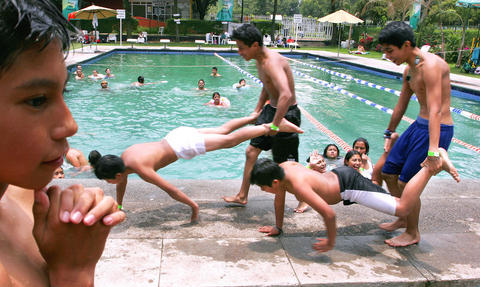
PHOTO: AP
Since assuming office last December, Mayor Marcelo Ebrard has imposed tougher traffic rules to increase respect for pedestrians, installed security cameras in high-crime neighborhoods and required city staffers to ride their bicycles to work once a month.
He even invited climate change activist Al Gore to lecture to city residents this week.
The city also trucked in sand to build "urban beaches" at seven public pools, put on outdoor movies and inaugurated "bicycle Sundays," when thousands of cyclists, skaters and pedestrians take over the main avenues.
Ebrard's goal is nothing short of transforming the city into Latin America's latest model of urban renewal. The big idea behind these relatively inexpensive measures is that by encouraging happiness, rather than solely economic growth, he just might change residents' image of their city -- and themselves.
"For us, it's important to continue promoting healthy living, and that means taking back public spaces to create a safe, better city," Ebrard explains.
Small things can make a big difference, said Jorge Melindez, 41, who brought his three children to pedal down normally congested Reforma Avenue.
"It's so stressful living here and this gives us a break after screaming at cars all week," Melindez said. "This doesn't take time away from confronting the problems. In fact, it helps so we can confront them."
Ebrard, 47, a former police chief, is following the example of Bogota, Colombia, where Enrique Penalosa built bike paths, closed thoroughfares to cars on Sundays and kept vehicles from parking on sidewalks. Penalosa's efforts softened life's edges in Bogota, another kidnapping-plagued Latin American capital.
"Fun City" may even restore the popularity of Ebrard's battered Democratic Revolutionary Party, whose losing presidential candidate, Andres Manuel Lopez Obrador, alienated supporters with protests that clogged the city for months.
Ebrard is considered more mainstream and a potential 2012 presidential contender, and he's getting recognition internationally as well: The World Bank lauded his efforts to reduce emissions and handed over a check for US$168,150 toward 300km of bike lanes.
But only time will tell if his plans can transform Mexico City; riding a bike remains an act of courage during the week, since few vehicles respect bike lanes.
Then there are the sinkholes -- the city is using cement in hopes of plugging at least 200 fissures that made some streets impassable. Civil Defense Secretary Elias Moreno blames the triple threat of earthquakes, groundwater extraction and torrential rains that weaken the shaky ground under the city, much of which was built on a lake bed.
Jesus Robles, president of the capital's leftist Alternative Party, said Ebrard should focus more on solving bigger problems "like water leaks, that now go three months without being addressed."
On Sunday the government held a "green referendum" to ask residents to weigh in on questions such as whether buses and taxis should be replaced with newer, cleaner vehicles.
But turnout was low at many of the informal polling places, and some voters expressed skepticism.
"I voted `no' on everything," said Belinda Suarez, 44, who cast a ballot at a supermarket in a relatively affluent neighborhood. "This is a joke. The authorities are there to make decisions, and if they want us to do their work for them, we should get their salaries."
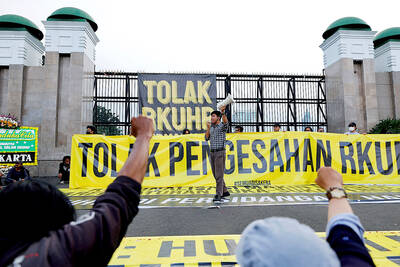
Indonesia yesterday began enforcing its newly ratified penal code, replacing a Dutch-era criminal law that had governed the country for more than 80 years and marking a major shift in its legal landscape. Since proclaiming independence in 1945, the Southeast Asian country had continued to operate under a colonial framework widely criticized as outdated and misaligned with Indonesia’s social values. Efforts to revise the code stalled for decades as lawmakers debated how to balance human rights, religious norms and local traditions in the world’s most populous Muslim-majority nation. The 345-page Indonesian Penal Code, known as the KUHP, was passed in 2022. It
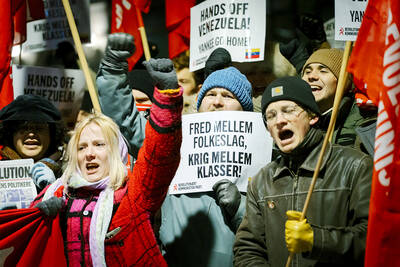
‘DISRESPECTFUL’: Katie Miller, the wife of Trump’s most influential adviser, drew ire by posting an image of Greenland in the colors of the US flag, captioning it ‘SOON’ US President Donald Trump on Sunday doubled down on his claim that Greenland should become part of the US, despite calls by the Danish prime minister to stop “threatening” the territory. Washington’s military intervention in Venezuela has reignited fears for Greenland, which Trump has repeatedly said he wants to annex, given its strategic location in the arctic. While aboard Air Force One en route to Washington, Trump reiterated the goal. “We need Greenland from the standpoint of national security, and Denmark is not going to be able to do it,” he said in response to a reporter’s question. “We’ll worry about Greenland in
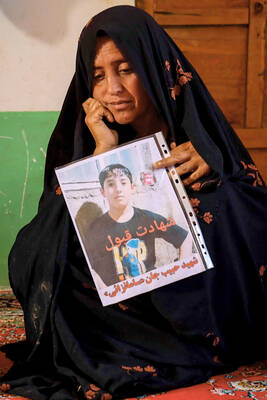
PERILOUS JOURNEY: Over just a matter of days last month, about 1,600 Afghans who were at risk of perishing due to the cold weather were rescued in the mountains Habibullah set off from his home in western Afghanistan determined to find work in Iran, only for the 15-year-old to freeze to death while walking across the mountainous frontier. “He was forced to go, to bring food for the family,” his mother, Mah Jan, said at her mud home in Ghunjan village. “We have no food to eat, we have no clothes to wear. The house in which I live has no electricity, no water. I have no proper window, nothing to burn for heating,” she added, clutching a photograph of her son. Habibullah was one of at least 18 migrants who died
Russia early yesterday bombarded Ukraine, killing two people in the Kyiv region, authorities said on the eve of a diplomatic summit in France. A nationwide siren was issued just after midnight, while Ukraine’s military said air defenses were operating in several places. In the capital, a private medical facility caught fire as a result of the Russian strikes, killing one person and wounding three others, the State Emergency Service of Kyiv said. It released images of rescuers removing people on stretchers from a gutted building. Another pre-dawn attack on the neighboring city of Fastiv killed one man in his 70s, Kyiv Governor Mykola


 RSS
RSS