


A specialist team of former detectives has begun re-examining evidence from Northern Ireland's most controversial killings -- those that allegedly involved the security forces.
The new unit within the police's Historical Enquiries Team (HET) will re-assess murders where there is suspicion of past collusion between soldiers, police officers and paramilitary gunmen.
The HET's "white team," under the authority of the Police Service of Northern Ireland, consists of highly experienced retired detectives. It is based in London and started work reviewing "cold cases" last week.
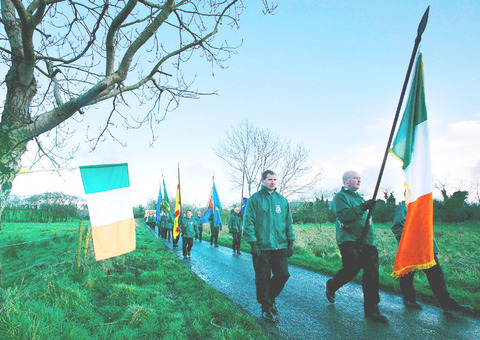
PHOTO: EPA
The decision to establish a separate investigative force follows mounting political pressure to review killings where there are substantive claims of collusion, particularly between loyalists and the security forces.
Northern Ireland Police Ombudsman Nuala O'Loan was yesterday to publish a report that was expected to be severely critical of special branch's use of Ulster Volunteer Force (UVF) informers, suggesting they were protected and allowed to continue murdering. Northern Ireland Secretary Peter Hain said yesterday it would make uncomfortable reading.
At least three former detectives have been arrested during the three-year investigation -- the largest ever carried out by the ombudsman's office.
The inquiry may even prove embarrassing for Sir Ronnie Flanagan, who was Royal Ulster Constabulary (RUC) chief at the time of the 1997 killing of Raymond McCord. A UVF gang was accused of killing McCord, a former Royal Air Force radar operator, whose murder triggered the ombudsman's inquiry. Flanagan, a former head of special branch, is now Her Majesty's Chief Inspector of Constabulary. He and O'Loan clashed over the publication of her previous investigation into the Omagh bombing.
Her latest report will raise fresh concerns about how widespread collusion was within the security forces and how many of the province's notorious killers may have been police or army agents.
David Cox, the director of the HET, is no stranger to the subterfuge involved in handling informers. A former Metropolitan police commander, he is a veteran of successive inquiries by Sir John Stevens into the army's manipulation of loyalist paramilitary killers.
Last autumn Cox gave evidence to an Irish parliamentary committee probing bombings and shootings in the republic during the 1970s, including those associated with the so-called "Glenanne gang" -- a UVF unit operating out of a farm near Armagh that was alleged to have had help from police officers and soldiers. Irish officials at the time claimed four RUC officers were also in the UVF.
Killings by the Glenanne gang are among the first being investigated by the "white team."
The historical enquiries team has close links to the Police Ombudsman investigators. Both are also examining the 1993 killing of Sharon McKenna, 27, a Catholic taxi driver from Newtownabbey, who was shot by the UVF at the north Belfast home of an elderly friend where she had gone to make his dinner.
The gunman was allegedly the same police informer who killed Raymond McCord.
Cox said: "Where our inquiries or the allegations from the victim's family -- which we can support -- tend to show there's aspects ... we should look at from a collusion approach [we will]."
"Rather than bottom up, it will be from top down ... who knew about this, was [somebody] giving guns to this group? You helicopter above it and look at the investigation again. The Glenanne cases will go to that team," he said.
Cox said he expected criminal charges as a result of the HET's work -- examining all 3,268 killings related to the Troubles between 1968 and 1998 -- over the next four years.
"I'm pretty sure there will be charges ... not a huge number," Cox said.
"There's a feeling from the [victims'] families that even if people don't go to prison they want [perpetrators] to be held accountable," Cox said.

Kouri Richins, a Utah mother who published a children’s book about grief after the death of her husband is to serve a life sentence for his murder without the possibility of parole, a judge ruled on Wednesday. Richins was convicted in March of aggravated murder for lacing a cocktail given to her husband, Eric Richins, with five times the lethal dose of fentanyl at their home near Park City in 2022. A jury also found her guilty of four other felonies, including insurance fraud, forgery and attempted murder for trying to poison her husband weeks earlier on Feb. 14, 2022, with a

DELA ROSA CASE: The whereabouts of the senator, who is wanted by the ICC, was unclear, while President Marcos faces a political test over the senate situation Philippine authorities yesterday were seeking confirmation of reports that a top politician wanted by the International Criminal Court (ICC) had fled, a day after gunfire rang out at the Philippine Senate where he had taken refuge fearing his arrest. Senator Ronald “Bato” dela Rosa, the former national police chief and top enforcer of former Philippine president Rodrigo Duterte’s “war on drugs,” has been under Senate protection and is wanted for crimes against humanity, the same charges Duterte is accused of. “Several sources confirmed that the senator, Senator Bato, is no longer in the Senate premises, but we are still getting confirmation,” Presidential

HELP DENIED? The US Department of State said that the Cuban leadership refuses to allow the US to provide aid to Cubans, ‘who are in desperate need of assistance’ US Secretary of State Marco Rubio on Wednesday said that Cuba’s leadership must change, as Washington renewed an offer of US$100 million in aid if the communist nation agrees to cooperate. Cuba has been suffering severe economic tumult led by an energy shortage that plunged 65 percent of the country into darkness on Tuesday. Cuba’s leaders have blamed US sanctions, but Rubio, a Cuban American and critic of the government established by Fidel Castro, said the system was to blame, including corruption by the military. “It’s a broken, nonfunctional economy, and it’s impossible to change it. I wish it were different,” he told

Myanmar yesterday published a parliamentary bill proposing the death sentence for those who detain or violently coerce people into working in online scam centers. Internet fraud factories have flourished in Myanmar, part of Southeast Asia’s scam economy, targeting Internet users worldwide with romance and cryptocurrency investment cons. The multibillion-dollar black market attracts many willing employees, but repatriated foreigners have also reported being trafficked to sites in Myanmar and tortured by scam center operators. The draft legislation would allow capital punishment for “violence, torture, unlawful arrest and detention, or cruel treatment against another person for the purpose of forcing them to commit online scams.” The


 RSS
RSS