


Cuban President Fidel Castro on Wednesday led tens of thousands of Communist Party faithful in celebrating the country's Revolution Day, saying his revolution's social achievements exceed anything a US-backed replacement could accomplish.
Returning to his roots in eastern Cuba, Castro also praised Granma Province, named for the yacht that carried him back to Cuba in 1956 to launch the battles that led him to triumph three years later.
"Granma [Province] doesn't need any Yankee transition plan to vaccinate and teach our people to read and write," Castro said, drawing loud applause from the crowd in this provincial capital. "They should tell Mr. Bush ... to come to Granma to see a development plan."
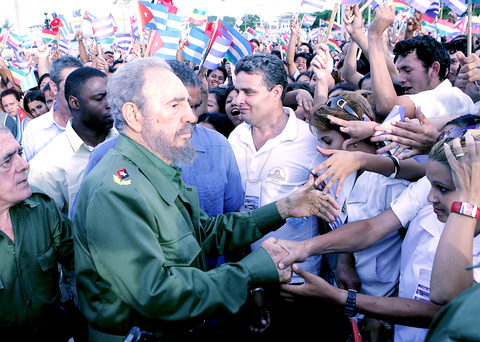
PHOTO: AP
The plan recently presented by a US presidential commission envisions a post-Castro Cuba with multiparty elections and free markets, led by a democratic transition government that would be encouraged to request aid and other support from the US.
Cuban leaders say there will be no transition after the death of Castro, who turns 80 on Aug. 13, but rather a succession within the existing system.
The leader's 75-year-old brother, Defense Minister Raul Castro, is to assume the presidency.
The country's top communist leadership began arriving earlier this week for the annual celebration of Castro's nearly suicidal barracks assault in the eastern city of Santiago that launched the Cuban Revolution.
Castro was just 26 when he led a ragtag band on July 26, 1953, in the assault on the Moncada barracks.
Organizers estimated that more than 100,000 people showed up for the early morning event in this city about 750km east of Havana. Virtually all wore bright red commemorative T-shirts and waved small red, white and blue Cuban flags distributed by local party officials.
Castro's attendance was not confirmed until he appeared onstage in his trademark olive green uniform, sending up a huge cheer from the crowd.
Addressing the assembly for more than two hours, Castro focused largely on regional matters, saying Granma Province's social and economic achievements "fill us with admiration and astonishment."
Now 47 years in power, making him the world's longest ruling head of government, Castro was born and raised in eastern Cuba. It was in this region, once known as Oriente Province, that he launched and fought the revolution that triumphed on Jan. 1, 1959, when dictator Fulgencio Batista fled the country.
A huge plaza was built in Bayamo for Wednesday's event, featuring a bronze and marble monument at the front carved with the faces of Cuban independence heroes including Jose Marti.

‘CROSSING THE LINE’: China’s embassy in Seoul criticized US Forces Korea Commander General Xavier Brunson, asking if his ‘hostile’ remarks were authorized by Washington South Korea and the US are in talks over recent public remarks by the commander of US Forces Korea, Seoul’s presidential office said yesterday, after the comments drew sharp criticism from China. In a recent podcast interview, US Forces Korea Commander General Xavier Brunson described South Korea as “the dagger in the heart of Asia” from China’s east coast, prompting the Chinese embassy in Seoul to say that he had “truly crossed the line.” The interview came amid growing speculation that Washington might seek to expand the role of US Forces Korea in countering the growing regional influence of China, a key

SEEKING ORDER: Rodrigo Paz said that ‘anyone who wants to destroy the nation will have to deal with this president and the full force of the constitution’ Bolivian President Rodrigo Paz on Wednesday said that the nation was at a “breaking point” after nearly a month of protests that have caused shortages of food, fuel and medicine. Paz, who took office six months ago amid the worst economic crisis there in four decades, is battling a groundswell of fury over his policies. The political capital, La Paz, has been besieged by low-income workers and members of the indigenous majority calling for his resignation. “The country needs order and is reaching breaking point,” the 58-year-old said at a public event in La Paz, renewing his appeal for dialogue. On Tuesday, the Bolivian

Australian researchers have trained lab-grown brain cells on a silicon computer chip to play the 1990s shooter game Doom and said they are just scratching the surface of what the neurons could be capable of doing. It is the science-fiction work of biotech boffins at Cortical Labs, who researched and developed the technology that harnesses the workings of the brain’s networking system. Each so-called “biological computer” contains about 200,000 living human brain cells, grown from stem cells that were harvested from blood donations. Having mastered the simple computer game Pong, where a paddle is moved up and down to send a ball

Through the noise of rushing papers and whirring belts at a print factory in Kyoto, two creators watch their photo essay come to life in broadsheet form — part of an effort to win new audiences in the age of artificial intelligence (AI). Despite the decline of the publishing industry, self-publication and handmade “zine” magazines are growing in popularity in Japan, reflecting the nation’s enduring love of paper in the digital era. While speaking to Agence France-Presse at the plant, his hands black with ink, one of the creators, Kazuma Obara, said: “I think [paper] is a medium that engages all five


 RSS
RSS