


The new Solomon Islands government said yesterday it believed riots which wracked the capital for two days were pre-planned.
The city was largely quiet yesterday following two days of rioting which broke out in Honiara when Snyder Rini was elected prime minister by fellow members of parliament (MPs), left parts of the capital in flames.
New Zealand Prime Minister Helen Clark said Rini had been formally installed by Governor-General Sir Nathaniel Waena yesterday morning, although the news was not made public in Honiara.
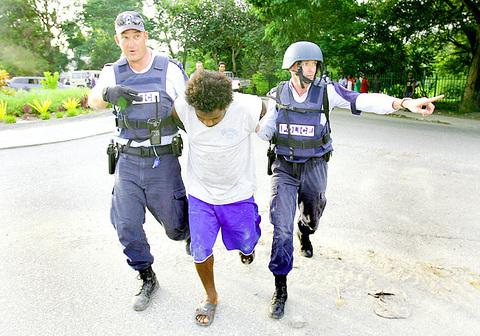
PHOTO: AFP
Interim government spokesman Edward Huniehu confirmed in a statement early yesterday evening that Rini had been sworn in.
Huniehu, an MP in Rini's coalition, said the rioting, which saw dozens of Chinese businesses burned and looted, was the result of misinformation put out by opposition politicians.
"We believe the reason for the opposition to give out the misinformation is purely to create hatred and enmity," he said. "We also believe the incidents had been pre-planned."
He denied opposition claims that Rini's supporters had bought votes to ensure the victory of Rini and that Taiwan had provided money to buy votes.
Honiara was generally peaceful yesterday.
Protesters were demanding that Rini stand down due to his alleged association with widespread corruption during years of civil unrest before an Australian-led armed intervention in 2003.
At the request of the Solomons' government, Australian Prime Minister John Howard deployed 110 troops and 70 Australian federal police to help restore order in the South Pacific nation. The deployment arrived on Wednesday.
New Zealand was also sending 30 soldiers and 20 police to the Solomons yesterday, while a further 20 police will come from Fiji.
Troops and both foreign and local police were patrolling the streets of the capital in large numbers yesterday to prevent crowds from forming.
Schools and banks remained closed, althought public transport, gasoline stations and health clinics had reopened.
Power was being restored to areas damaged by rioting.
Solomons Police Commissioner Shane Castles said the situation was calmer but added that an overnight curfew would be extended to last night.
Frightened residents were panic-buying food, government spokesman Johnson Honimae said.
"There is now fear that there will be a shortage of foodstuff after most of the stock in the Chinese shops has either been destroyed in the fires or looted by rioters."
Evacuated foreigners said they feared death during the violence.
New Zealander Ray Vuksich said he saw six local guards and two Australians arm themselves with machetes and baseball bats to beat back the rioters as they surged upstairs inside the Chinese-owned Pacific Casino hotel.
"We just got out by about 10 seconds," he told the Australian Associated Press. "It was deadly. We were concerned for our lives."
Robert Wales Feratelia, a leader of a group which demanded Rini step down, told the Solomon Star newspaper that Rini's refusal to quit would mean "further destruction of properties in the city."
Meanwhile, China has arranged shelter for about 500 nationals, Chinese Foreign Ministry spokesman Qin Gang (秦剛) said yesterday, in a sign of Beijing's growing diplomatic clout.
Chinese envoys were sent to Honiara from Papua New Guinea and arranged shelter for about 500 Chinese nationals, including five from Hong Kong, at the police headquarters compound, Qin said. He said China has asked Australia, New Zealand and Papua New Guinea to provide assistance to its nationals in case of emergency.

‘CROSSING THE LINE’: China’s embassy in Seoul criticized US Forces Korea Commander General Xavier Brunson, asking if his ‘hostile’ remarks were authorized by Washington South Korea and the US are in talks over recent public remarks by the commander of US Forces Korea, Seoul’s presidential office said yesterday, after the comments drew sharp criticism from China. In a recent podcast interview, US Forces Korea Commander General Xavier Brunson described South Korea as “the dagger in the heart of Asia” from China’s east coast, prompting the Chinese embassy in Seoul to say that he had “truly crossed the line.” The interview came amid growing speculation that Washington might seek to expand the role of US Forces Korea in countering the growing regional influence of China, a key

Through the noise of rushing papers and whirring belts at a print factory in Kyoto, two creators watch their photo essay come to life in broadsheet form — part of an effort to win new audiences in the age of artificial intelligence (AI). Despite the decline of the publishing industry, self-publication and handmade “zine” magazines are growing in popularity in Japan, reflecting the nation’s enduring love of paper in the digital era. While speaking to Agence France-Presse at the plant, his hands black with ink, one of the creators, Kazuma Obara, said: “I think [paper] is a medium that engages all five

Australian researchers have trained lab-grown brain cells on a silicon computer chip to play the 1990s shooter game Doom and said they are just scratching the surface of what the neurons could be capable of doing. It is the science-fiction work of biotech boffins at Cortical Labs, who researched and developed the technology that harnesses the workings of the brain’s networking system. Each so-called “biological computer” contains about 200,000 living human brain cells, grown from stem cells that were harvested from blood donations. Having mastered the simple computer game Pong, where a paddle is moved up and down to send a ball
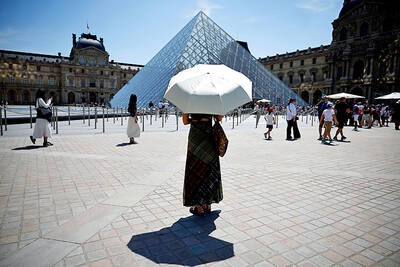
France experienced its hottest spring on record, the French weather service said on Tuesday, after an exceptional early heat wave that also broke highs for the season in England and Wales. Meteo-France said the average nationwide temperature over March to May was 13.8°C — about 1.7°C above the norm, and surpassing records set in 2011 and 2020. “The warmest spring since records began in 1900,” it said in a bulletin. All three months were warmer than average, but the onset of an “unprecedented heatwave” late last month pushed the mercury to highs typically seen at the height of the summer. “Our country had never


 RSS
RSS