


Iran backed calls from other Muslim and world leaders for an end to violent protests over the Prophet Mohammed cartoons, urging calm, amid demonstrations that have left at least 45 people dead in the Muslim world over the past month.
Iranian Foreign Minister Manouchehr Mottaki, on a visit to EU headquarters on Monday, said that he and EU foreign policy chief Javier Solana urged better dialogue between the Muslim world and the West over respect and tolerance.
"We accepted to cooperate with each other to calm down the situation, not to offend the values, religious values in particular from one side, and freedom of expression from the other side -- some kind of balance," Mottaki told reporters. "We should try to cool down the situation. We do not support any violence."
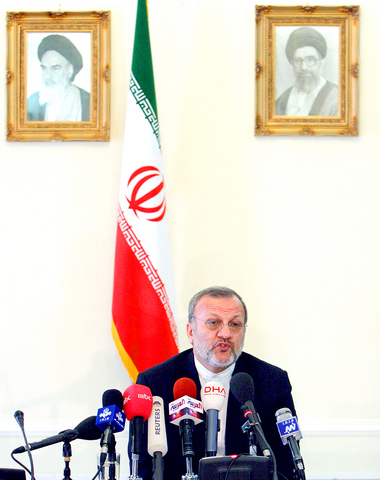
PHOTO: EPA
Solana said his visit last week to Saudi Arabia, Egypt, Iran and other Muslim nations to mend fences "was making headway."
Pope Benedict XVI also tried to soothe the tensions on Monday, saying religious symbols must be respected but violence can never be justified.
Mottaki added that freedom of expression must be exercised with sensitivity and with respect for others' values and beliefs.
Mottaki called on EU governments and media outlets "to take initiatives" preventing such cartoons from being published again to avoid further protest.
"We are all working, and we hope the press also will try to play their role and their responsibility," Mottaki said.
"We are facing ... angry Muslims all around the world. We have to try our best to avoid any violence," he said. "This is what we are trying to do in Iran ... So many of our policemen were attacked by angry people on the streets."
In Copenhagen, Danish Foreign Minister Per Stig Moeller warned that al-Qaeda terrorists were exploiting the outrage over the drawings and condemned a Pakistani cleric who last Friday offered a US$1 million bounty for killing one of the cartoonists.
He called the reward "insane" and tantamount to terrorism.
"When money is put on the cartoonists' heads, then terror is also being used," Moeller said. "It's incitement to murder. Murder is also banned by the Koran."
Moeller noted that protests against the cartoons have been tapering off in many Arab countries, while escalating in Pakistan and Turkey.
"It's the extremist forces that wish to keep it going," he told reporters in Copenhagen. "There is no doubt that all extremists will exploit the situation. Al-Qaeda, too, will use it and fan the fire."
Mottaki said European governments were being hypocritical in their respect for freedom of expression, pointing to the example of Holocaust deniers, who he said were being put in jail for expressing their opinions.
"When we are talking about the freedom of expression ... it is very strange to see some European authors, some European members of parties are kicked out from their post or their position because they are making or creating some doubt about some part of some historical happening," Mottaki said.
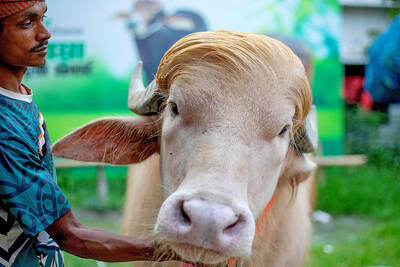
Crowds in Bangladesh are flocking to snap photographs with an unlikely social media star — an albino buffalo with flowing blond hair nicknamed “Donald Trump” that is due to be sacrificed within days. Owner Zia Uddin Mridha, 38, said his brother named the 700kg bull over its flowing helmet of hair resembling the signature look of the US president. “My younger brother picked this name because of the buffalo’s extraordinary hair,” he said at his farm in Narayanganj, just outside the capital, Dhaka. Mridha said that a constant stream of curious visitors — social media fans, onlookers and children — have come throughout

It began as a satirical online project. Now millions of young people in India are flocking to it as an outlet for their frustration. A parody political party called the Cockroach Janta Party, with the insect as its symbol, has exploded across India’s social media by turning absurdist humor into protest. Memes and short videos mocking corruption, joblessness and political dysfunction have flooded social media sites, where millions of users are embracing the cockroach — known for its ability to survive harsh conditions — as a tongue-in-cheek symbol of endurance. The online movement’s rise has been unusually rapid. The Cockroach Janta Party (CJP)
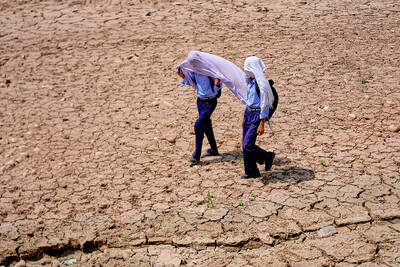
HOTTER: While Indians are accustomed to summer heat, climate change has caused northwestern India to warm faster than other parts of the country, an academic said Roads and markets have emptied during afternoons and some farmers have switched to nighttime work to avoid scorching temperatures as a heat wave grips large parts of India. The India Meteorological Department forecast maximum temperatures for yesterday of about 45°C in the capital, New Delhi, where authorities have opened temporary “cooling zones” to help people cope. The weather department warned that conditions would likely persist across several northern regions in the coming days, with temperatures staying well above seasonal averages. Authorities urged people to stay indoors during the hottest hours and take precautions against heat-related illnesses. India declares a heat wave whenever maximum temperatures
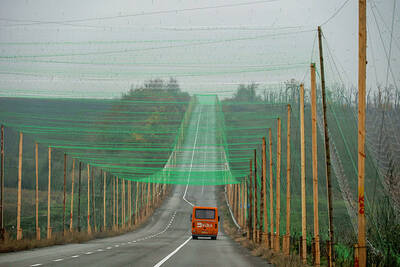
BIGGER ROLE: Beijing has said it maintains an impartial stance on the war in Ukraine, but by training Russian troops, China is far more involved than previously known China’s armed forces secretly trained about 200 Russian military personnel in China late last year, and some have since returned to fight in Ukraine, according to three European intelligence agencies and documents seen by Reuters. While China and Russia have held a number of joint military exercises since Moscow’s full-scale invasion of Ukraine in 2022, Beijing has repeatedly said that it is neutral in the conflict and presents itself as a peace mediator. The covert training sessions, which predominantly focused on the use of drones, were outlined in a dual-language Russian-Chinese agreement signed by senior Russian and Chinese officers in Beijing on


 RSS
RSS