


The massive bomb blast in Beirut that on Valentine's Day last year killed former Lebanese prime minister Rafik Hariri has clearly left its mark on the Lebanese.
Many feel their country has been torn apart by the Hariri killing, or as some call it "the earthquake that shook Lebanon."
In the streets of Beirut, a city which Hariri was largely credited with rebuilding following the 1975-1990 civil war, the repercussions of the assassination are evident.

PHOTO: AP
Large posters of Syrian President Bashar Assad, whose country was Lebanon's powerbroker and is now accused by many Lebanese of being behind the Hariri murder, were replaced with even larger ones of Hariri and his son, Saad.
The young Hariri and his bloc won the majority of votes in the last parliamentary elections in May and June as he seeks to continue his father's legacy.
Slogans daubed on walls and professing loyalty to the Syrian Baath regime have been covered with newer ones reading "freedom" and "independence" -- words hundreds of thousands of Lebanese chanted in the streets of the central district of Beirut to protest Hariri's death.
But a year after the killing, a year which has seen a wave of 15 bombings targeting anti-Syria activists and journalists, the most obvious change in the streets of Beirut is the public and loud criticism of the regime in Damascus.
"They [Syrians] are behind the assassination of Hariri, as well as the other blasts," Mona Yameen, a Christian woman in the neighborhood of Ashrafiyeh said. "They will do everything to try to destabilize the country, to find a reason to return to Lebanon and rule us like they did for 30 years."
Syria bowed to international pressure in April last year, withdrawing its troops from Lebanon and ending its military and intelligence presence for the first time since 1976.
Although a UN commission is investigating Hariri's murder, many Lebanese believe the Syrians are responsible and have ruled out other possible perpetrators.
"We do not have to wait for the investigation to end. I am sure the Syrians are behind the crime of the century," said Saeed Chuyab, a follower of anti-Syrian Druze leader Walid Jumblatt. "There is no doubt about that and they will kill others."
A large number of Lebanese Christians, Druze and Sunni Muslims want the neighboring Syrian regime to be changed, fearing that if it stays in power it will continue to work on destabilizing Lebanon's security and stability.
But in the mainly Shiite southern suburbs of the capital, where the Iran-backed Hezbollah group enjoys strong support, anti-Syrian sentiments are replaced by anger against the West.
"Some people want to put the blame on the Syrians and not wait until the investigation is over," Hezbollah follower Fatima Zeineddine said.
The "American-French alliance", according to Zeineddine, is eager to blame Syria for the murder of Hariri.
In an internet cafe inside the southern suburbs, a group of young Hezbollah followers described the current situation as "unstable," but ruled out the possibility of a new armed conflict.
"A new civil war is out of the question, although there are two camps in the country today," Mohammad Fakih, a Hezbollah follower explained.
One camp is supporting the "nationalistic Arab and Islamic countries," Fakih said , "and the other [anti-Syrian camp] want to invite American hegemony into the country."
But the new Lebanese generation, "whether they are Christian or Muslim, have learned from the old mistakes."
The clear-cut division prevailing in the country however has not prevented a small portion of Lebanese society to remain neutral without siding with the pro or anti-Syrian camps.
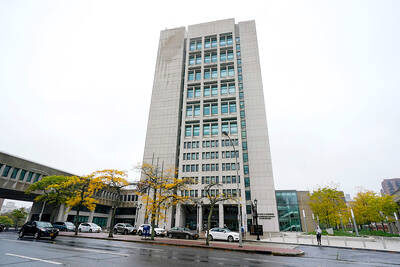
A coalition of civil rights groups on Tuesday asked a New York State judge to order one of its largest suburban counties to stop its deployment of nearly 600 license plate readers, calling it a warrantless and “indiscriminate surveillance system” that violates the state constitution. The class action lawsuit also alleged that Westchester County never got proper authorization to launch the program, which has amassed a database of 1.6 billion plate scans that has been shared with more than 50 outside law enforcement agencies. The complaint said the network “records the long-term travel patterns, daily habits, and intimate information of millions of

Pope Leo XIV on Wednesday blessed a giant new tower at Barcelona’s famed Sagrada Familia Basilica after celebrating mass inside what is now the world’s tallest church. A fireworks and light show illuminated the exterior of the temple at the end of the ceremony, bathing the unfinished basilica in shifting colours that highlighted its towering spires. A choir of 600 singers performed at the service which lasted around 90 minutes and was attended by Spanish Prime Minister Pedro Sanchez as well as King Felipe VI and Queen Letizia. The stained-glass windows in various colours shone brightly in between the tree-like

Voters in Switzerland yesterday cast their ballots on an initiative championed by the top right-wing party to cap the Alpine country’s population at 10 million. As of press time last night, early results showed that Swiss voters were leaning against it. The populist Swiss People’s Party, which has the most seats in parliament, has stirred up and fostered anti-migration sentiment over the years, notably about an influx of workers from the neighboring EU. Critics called the bid a self-inflicted wound, saying the boom in migration over the past generation has brought foreign labor and skills to sectors such as healthcare, finance, pharmaceuticals
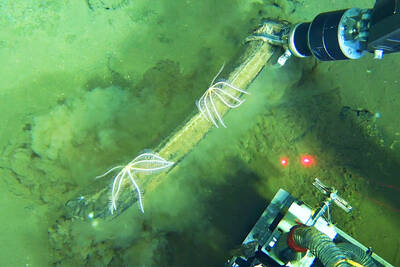
Scientists have discovered communities of marine life — including jellyfish, tubeworms and brittle stars — thriving on a whale graveyard. The graveyards form when whale carcasses fall to the sea floor, becoming a sustaining snack for nearby critters. This one, which is up to 7km below the surface of the southeastern Indian Ocean, spans the largest area, and is so far the deepest found. A whale’s sheer size and the unique chemistry of its bones are the keys to forming these unique underwater neighborhoods, said Song Xikun (宋希坤), a biologist with the Chinese Academy of Sciences’ Institute of Deep-sea Science and Engineering


 RSS
RSS