


Thai Prime Minister Thaksin Shinawatra, responding to public discontent with his government, said yesterday there would be a national referendum in April on whether to amend the Constitution.
Thaksin made the announcement on his weekly radio address, speaking ahead of a pro-democracy rally scheduled for later in the day in the capital that was expected to draw tens of thousands of people. Thaksin's critics accuse him of corruption and abuse of power.
Thailand enacted a reformist Constitution in 1997 meant to promote democracy, but in practice some of its statutes have consolidated power in the hand of the ruling party.
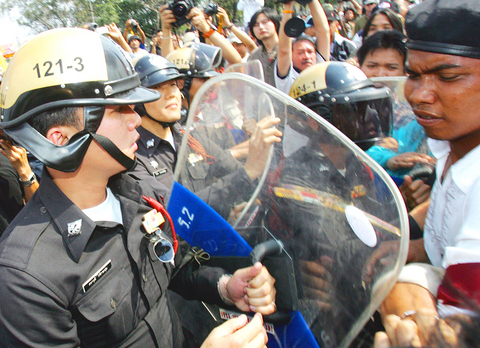
PHOTO: AP
Thaksin said the referendum would be held simultaneously with the next election for the country's senate, on April 19.
"If the people said they want the constitution to be amended, we will do so as the people hold sovereignty over the country," Thaksin said in his radio address.
Critics of the Constitution point to several flaws which they say run contrary to democratic principles.
A section which states that an election candidate must be a member of a political party for at least 90 days has had the effect of binding members of parliament to their party under threat of being unable to run again if a new election is called.
The provisions regarding independent state bodies, such as an anti-corruption commission, have failed to ensure the integrity of such institutions, which have proven susceptible to pressure from the government.
Thaksin has come under fire since last year after a one-time crony, publisher Sondhi Limthongkul, started staging rallies accusing him of abusing his office and calling for his resignation.
The anti-Thaksin campaign had appeared to be flagging until last month, when the prime minister's family sold its controlling interest in Shin Corporation -- a telecommunications conglomerate -- to Temasek Holdings, Sin-gapore's state-owned investment company, for 73.3 billion baht (US$1.9 billion).
The deal was heavily criticized, mainly because it was structured to allow the sellers -- Thaksin's children -- to avoid paying any taxes and placed what some described as important national assets in the hands of a foreign company.
Sondhi last weekend led a protest of up to 60,000 people demanding that Thaksin step down in what appeared to be Thailand's biggest political protest since 1992, when demonstrations toppled a military-backed government.
Thaksin has said repeatedly and firmly that he will not resign, because of the popular mandate he won in last year's general election that gave his Thai Rak Thai Party an overwhelming majority in the House of Representatives.
Several pro-democracy groups, including student organizations, had said they would join hands with Sondhi at yesterday's rally, which was expected to take place at the same venue as last week's event, the Royal Plaza near Parliament.
Government spokesman Surapong Suebwonglee said earlier that organizers would be allowed to use the Royal Plaza for their protest if they received permission from police and city authorities, but police have not been clear on whether they will allow the demonstration, citing traffic problems it may cause.
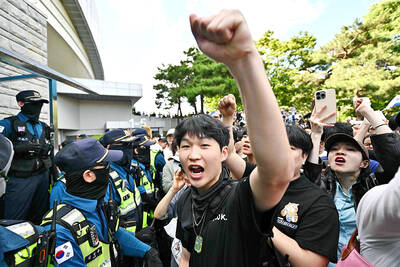
‘ABSURD MISTAKE’: The election commission said that there had been a failure to anticipate turnout after 14 polling stations ran short of ballot papers South Korean riot police yesterday cleared protesters from a Seoul polling station after a 35-hour blockade sparked by a shortage of ballot papers during local elections earlier this week. Wednesday’s election was the first nationwide vote since South Korean President Lee Jae-myung took office following the ouster of Yoon Suk-yeol over his short-lived martial law declaration. Lee’s ruling Democratic Party swept most races, but failed to flip the crucial Seoul mayoral seat. The South Korean National Election Commission apologized, blaming a failure to anticipate turnout after 14 polling stations in Seoul ran short of ballot papers. Some polling stations stayed open until 10pm to

France experienced its hottest spring on record, the French weather service said on Tuesday, after an exceptional early heat wave that also broke highs for the season in England and Wales. Meteo-France said the average nationwide temperature over March to May was 13.8°C — about 1.7°C above the norm, and surpassing records set in 2011 and 2020. “The warmest spring since records began in 1900,” it said in a bulletin. All three months were warmer than average, but the onset of an “unprecedented heatwave” late last month pushed the mercury to highs typically seen at the height of the summer. “Our country had never

A Sherpa guide was found crawling to base camp on Mount Everest a week after he went missing and was reunited with his family, who had given up hope he would return. Dawa Sherpa was last seen on Friday last week descending the mountain, but he did not reach base camp even though his client did. The pair were among the last climbers on the mountain as the climbing season came to an end and the route was dismantled. Dawa was located by a cleaning crew on Thursday morning as he was crawling down the snowy slopes around the Khumbu Icefall, just above
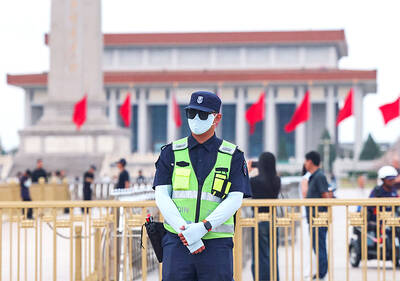
Chinese authorities are snuffing out any remembrance of the deadly 1989 military crackdown on student-led pro-democracy protests in Tiananmen Square, which happened 37 years ago yesterday, in a further tightening of a years-long campaign to erase what happened from public memory. Police told relatives of the victims they would not be allowed to visit a cemetery in Beijing on the anniversary of the crackdown, a person with knowledge of the matter said. Relatives of the victims visited the cemetery on the anniversary for more than 30 years to read memorial statements with police keeping watch, Amnesty International said. Hundreds of people,


 RSS
RSS